Healthcare providers have long depended on phone calls and plain text messages because they’re familiar…

Patient Adherence vs. Compliance: Why the Difference Matters for Modern Healthcare
Patient adherence and compliance sound the same but they’re not. One treats patients like partners. The other treats them like they should just do what they’re told.
That difference changes everything from how doctors talk to patients to whether patients actually stick with their treatment plans.
It’s not just semantics. When healthcare leaders focus on the differences, they create space for better outcomes, stronger engagement, lower costs, and care models built on mutual respect rather than authority.
Adherence vs. Compliance: What’s the Difference?
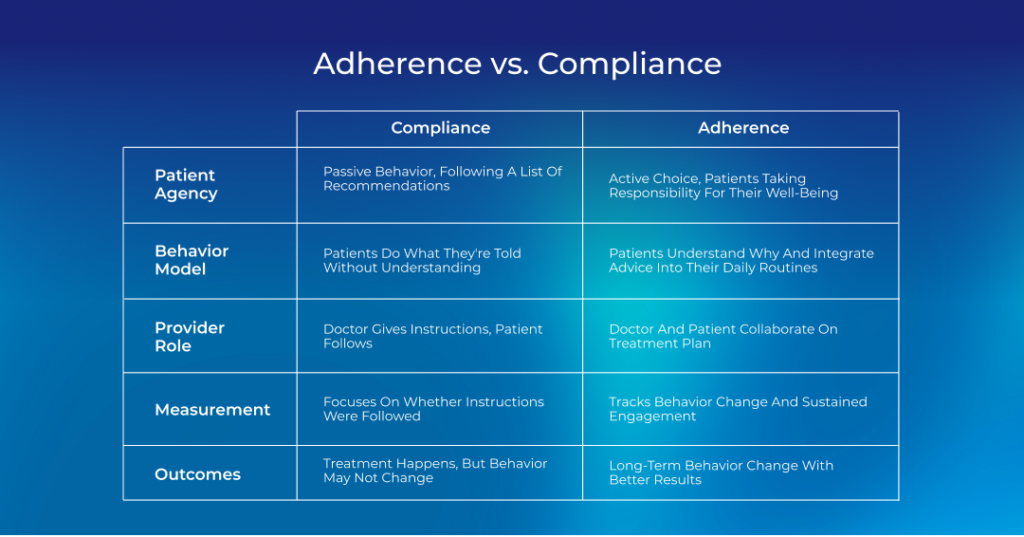
How well a treatment works for a patient stands as the main difference between adherence and compliance.
When someone complies, they just do as they’re told without understanding why. When someone adheres, they take full ownership and change their lifestyles because they understand the healthcare benefits.
Why Healthcare Providers Should Shift from Compliance to Adherence?
Compliance has long been a core pillar of our healthcare sector. However, major organizations are now rethinking their approach. They’re moving towards adherence because of how it delivers better outcomes and lower costs.
How Patient Behavior Models Shape Engagement
Patient compliance treats patients like they should follow orders. Patient adherence acknowledges that real barriers prevent people from adhering to treatment.
The COM-B model breaks down these barriers into three categories:
- Capability – can the patient physically and mentally do this?
- Opportunity – does their life allow for it?
- Motivation – do they want to do it?
For example, an arthritis patient will probably find it hard to open child-proof bottles. Someone working two jobs won’t even consider showing up for a mid-day appointment.
When providers understand these specific barriers, they can design care plans that fit specific needs. This approach works because it addresses the actual problem instead of assuming patients just aren’t trying hard enough.
Redefining the Provider’s Role in Modern Patient Care
Adherence is about providers and patients working together to find solutions that will work. This collaboration increases patient satisfaction and trust, and when patients start to trust their doctors, they start following their treatment plans.
You can also see it another way. Patients will follow the treatment because they helped create the care plan.
Moving Beyond Binary Metrics: Measuring True Engagement
Traditional patient compliance tends to focus on just one side of the coin. For example, a provider can track whether a patient filled the prescription. However, refill-based adherence measures like Medication Possession Ratio only show when patients have medication available, but not whether they’re actually taking it.
Modern adherence measurement digs deeper. Digital health tools track refill data to confirm patients have enough medication for the month. There are also smart packaging solutions that track how many doses get removed compared to what was prescribed.
So, when someone stops taking medication, providers know immediately, before the patient ends up back in the hospital.
Outcomes and Implications for Health Systems
The difference between adherence and compliance isn’t just a matter of words. It shows up in real-world outcomes-and in the hospital’s bottom line. Medicare now links payments to quality of care, placing providers under pressure to improve communication and coordination.
For example, patients who receive a follow-up within seven days of discharge have a 12.7% readmission rate, while waiting a little longer brings that number up to 17.5%.
Healthcare leaders should understand that value-based care rewards prevention, better coordination, and patient education. These are the same actions that lead to healthier outcomes and better care systems.
How Technology Empowers Better Adherence and Patient Follow-Through
Digital tools make patient adherence more practical by removing friction from the treatment process.
SMS/RCS Reminders
Text messages are highly reliable because patients don’t have to download apps or log into a portal. A reminder for an upcoming appointment or refill date is guaranteed to be received and read. It’s much simpler and faster than logging in to read an email or hear a voicemail.
RCS adds another layer of speed and trust. Patients benefit from improved visual aid, clear instructions, and one-tap actions where they can reschedule or confirm without calling the office.
Two-Way Messaging
Constant communication is key to improved adherence rates. Two-way messaging covers both inbound and outbound reach to allow providers to proactively check in and their patients to reach out 24/7.
Self-service portals make this even easier. Patients can view test results, message their doctor, and get timely responses within the same thread. There’s no need to call the office.
This instant communication helps providers spot problems early, whether a patient is struggling to afford medication or needs clarification on instructions.
Automated Outreach and Personalization
Automated systems help improve adherence at a scale your manual efforts can’t. The system can tailor messages using data from your EHR and other connected platforms, and send them to patients through their preferred channel and in their preferred language.
It beats your front desk trying to track down hundreds of patients. The system automatically identifies patients who are likely to fall off track, prompting your staff to step in early.
Messages also need to arrive when patients can act on them. A pre-surgery text the day before can include prep steps for that specific procedure. An appointment reminder might mention what to bring. Hence, messages land when they’re useful, not just when they’re scheduled.
Generic reminders get ignored. When messages address what patients actually need at that moment, they pay attention and follow through.
Partner With Televox to Build a More Connected, Adherence-Driven Patient Journey
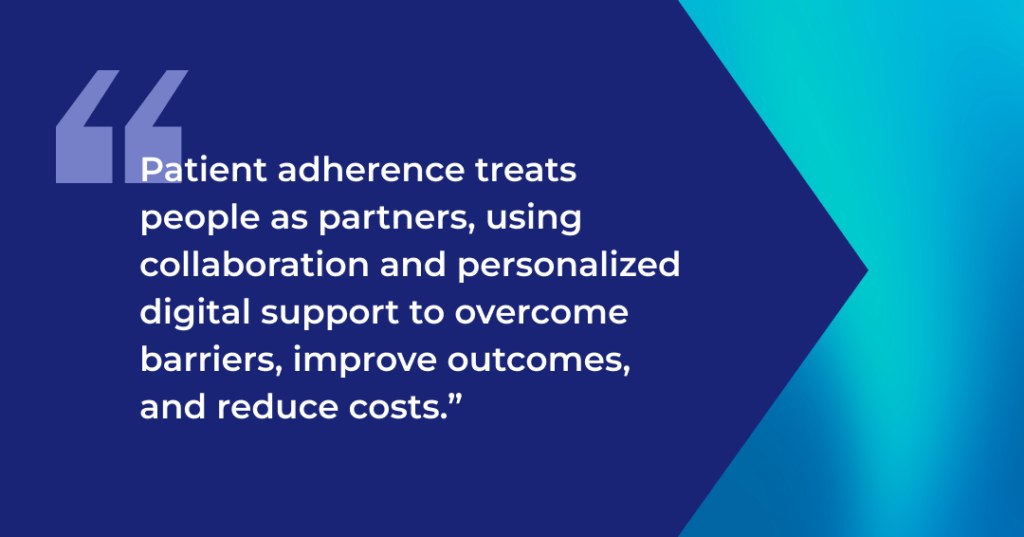
The best healthcare system is the one that supports patients, not one that tells them what to do. Televox delivers that through a unified, EHR-integrated patient engagement platform that turns every interaction into an opportunity for enhanced engagement, clarity, and follow-through.
We’ve long helped providers like you meet patients where they are instead of forcing them to jump through unnecessary hoops.
Engage is our conversational AI solution that automatically handles routine inquiries through voice, chat, and SMS/RCS. Its secure, bi-directional communication keeps patients connected throughout their entire patient journey, even between visits.
Insights360 adds another layer by tracking every patient voice interaction to show friction points, revealing opportunities to improve wait times and workflows.
You’re not just adding another messaging tool by partnering with Televox; you’re embedding a communication engine that supports adherence, reduces no-shows, strengthens trust, and lightens staff burden.
Let’s schedule a demo to show you just how.
Related Posts