Dental patient communication has moved well beyond appointment reminders. Large practices and hospital-based dental teams…
RCS in Healthcare: Improves Patient Engagement and Streamlines Care
Rich Communication Service (RCS) is an advanced messaging format that goes beyond standard SMS in healthcare. It lets providers share interactive messages, appointment confirmations, reminders, and updates with visuals, branding, and clickable actions.
Patients can respond quickly with only a few taps, making communication much easier and direct. Because of that convenience and clarity, more health systems are adopting RCS into healthcare to help messages get through faster, stay consistent, and keep patients more engaged while reducing the administrative load.
Key Benefits of Using RCS Across the Patient Care Lifecycle
RCS messages allow patients to take action without jumping through hoops. This, basically, sums up all the benefits of rich messaging.
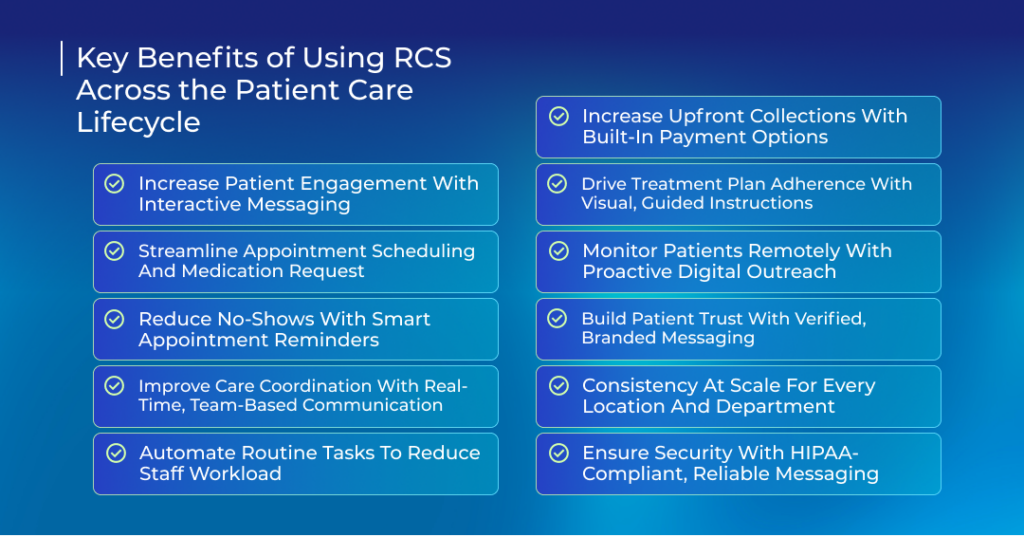
Increase Patient Engagement With Interactive Messaging
Your patients are likely to respond when they get an actionable message with clear steps built in. It’s the difference between a text that tells you to call a given number and an RCS that just says “tap here” to call or confirm an appointment.
Streamline Appointment Scheduling and Medication Request
Patients book their appointments and request a refill within the same RCS thread. They will even see a reminder with details and a button they can tap to take the next step.
In the case of appointments, the message shows available time slots, from which patients can tap one, and the provider’s system will automatically update its appointment calendar. RCS eliminates the need to place a call to the office.
Reduce No-Shows With Smart Appointment Reminders
Patients no longer have a reason to miss their appointments. RCS addresses their forgetfulness as well as stress related to rescheduling.
The reminder arrives a few days before with complete details and two buttons: confirm or reschedule. The patient can easily tap once to reschedule the visit for a more convenient day.
Hence, the provider’s schedule stays full because changing plans takes 10 seconds instead of 10 minutes. It’s one of many major ways to reduce no-show rates for improved revenue.
Improve Care Coordination With Real-Time, Team-Based Communication
Providers send updates the moment something changes or happens. Integrating RCS with all your systems means that patients can get an alert about their test results or prescriptions as soon as they’re ready. They can then ask questions within the same thread, without calling or waiting.
When a patient reports a new symptom through the thread, the team sees it and can schedule a follow-up or adjust treatment. No information gets lost between phone calls and voicemails.
Automate Routine Tasks to Reduce Staff Workload
RCS gives even more benefits when paired with automated chatbots. These virtual agents handle routine questions and reminders without any staff involvement.
Patients can ask multi-step questions like what to bring to an appointment, and the bot will reply within the same thread. This automation reduces administrative burden, allowing your front desk to focus on in-office patients instead of the phone.
Increase Upfront Collections With Built-In Payment Options
Like appointment messages, RCS sends patients a rich text that contains their bill as well as a secure payment link they can tap to pay. There’s no need to log into another app or portal. This also increases the likelihood of patients paying the moment they read the message, solving a major collection pain point for healthcare organizations.
Drive Treatment Plan Adherence With Visual, Guided Instructions
RCS communication makes it easier for patients to understand care instructions. It’s because they contain images and videos that guide patients through every step.
Take physical therapy, for example. An RCS thread can include photos for different exercises. It makes care even more accessible for patients, boosting adherence. This isn’t possible with regular SMS.
Monitor Patients Remotely With Proactive Digital Outreach
Providers check in without asking patients to come to the office. A can message ask about symptoms or request a blood pressure reading.
Patients with chronic conditions report their numbers through the thread or send a photo of their surgical site. The care team then reviews and catches problems early.
If something looks wrong, they can reach out immediately instead of waiting until the next scheduled visit.
Build Patient Trust With Verified, Branded Messaging
RCS messages include the provider’s logo and name. Every communication comes with a verified badge to ensure patients that it’s real, not some scam pretending to be their doctor’s office.
Trust is why patients engage. When they see their provider’s branding, they’re more likely to read it and take action.
Consistency at Scale for Every Location and Department
Every patient gets the same quality of communication whether they visit the main hospital or a clinic across town. You use custom templates to keep appointment reminders, follow-up instructions, and health tips consistent.
This means that nobody gets a better or worse experience based on which location they use. The messaging looks the same, works the same, and maintains the same standard everywhere.
Ensure Security With HIPAA-Compliant, Reliable Messaging
Technically, RCS does offer secure messaging to protect sensitive health information. However, it comes down to the patient’s phone or device. If the patient doesn’t have RCS enabled, your messages automatically fall back to SMS, which isn’t secure and definitely not where you want to send anything sensitive.
Google’s RCS terms specifically outline that RCS shouldn’t be used to send healthcare data or any sensitive information, regardless of industry. So while RCS is a great channel for general updates, reminders, and non-sensitive communication, it’s not meant for PHI.
Implementing RCS at Scale Across Healthcare Systems
Rolling out RCS in healthcare across an enterprise requires planning around systems, staff, and governance. Here’s what health systems need to deploy successfully:
Connect to existing systems
Start with EHR integration to ensure your patient data flows automatically between platforms as needed. RCS isn’t as beneficial if your staff has to manually switch to a different system to copy information.
This is also where testing compatibility becomes critical. You can’t afford to go live with disconnected systems. That’s potential service disruptions in the making.
Set clear governance policies
Define which message types are approved for RCS and which require other channels. Document compliance requirements for staff, especially around protected health information.
Custom templates help here to maintain consistency. This keeps everyone on the same page and reduces the risk of sending the wrong information through the wrong channel.
Train staff on workflows
Show clinical and administrative teams how RCS fits into their daily tasks. You have to address their resistance with explanations of how automation reduces their load and isn’t there to replace them. It’s also helpful to listen to them while optimizing workflows. They’re the ones on the front lines, so their opinion matters.
Make compliance and security a priority
Encrypt every message and keep audit trails to track activity. Make sure the platform follows local data privacy rules. For patients whose devices don’t support RCS, set up an SMS fallback so everyone stays connected.
The Future of Patient Communication: Beyond RCS
Healthcare organizations are shifting their patient communications toward simpler, but more connected experiences. RCS fits into this shift by giving care teams a strong base for direct messaging. It’s also helping providers keep up with patient expectations, who now expect personalized communications. Here’s where the next wave is heading:
AI support for routine questions and basic guidance
AI-driven virtual assistants are smarter than traditional chatbots. They automatically handle your front desk’s workload and give patients quick, accurate answers.
Someone has an upcoming appointment? Your RCS remembers. It’ll send an automated message with the timing, what to bring, and the option to shift the appointment to another date—all without calling the office or waiting on staff.
Several healthcare organizations are using machine learning to train their AI chatbots from each interaction. They become more accurate over time, enough to even handle complex, multi-step queries.
Personalization based on visit history or patient preferences
Patients know when they are being handled as just another number in the system. They want personalized care that relates to their specific condition, lifestyle, or other personal factors.
RCS is helping providers address this challenge by sending instructions and visual aids tailored to each patient. The system automatically pulls the necessary information about every patient from your connected platforms and triggers the AI to understand what each person needs or expects.
So, someone who has just had a surgical procedure will receive a rich message about the recovery phase once they reach home.
Multichannel messaging that connects
The benefits of RCS are easy to see when you think about how every patient has a phone, and they’re accustomed to using it for their everyday needs. That’s a walking communication channel you can reach at any time. You just need to use the right content.
RCS works here because it gives patients another option that works naturally within the messaging apps they already use.
See How RCS Can Power Your Patient Engagement Strategy
If your healthcare teams are ready to move past email overload and missed calls, it’s time to take a closer look at Televox.
We help providers deliver clear, actionable updates through RCS so patients can confirm visits, reschedule, or review instructions from their native messaging app, without logging into portals or waiting on staff.
Your team gets response rates higher than SMS, actionable tracking of read receipts and confirmations, quick communication with one-tap actions, and secure delivery across Android and iOS with SMS fallback.
It’s a straightforward way to reduce back-and-forth, keep workflows consistent, and maintain compliance for patient privacy.
Consider scheduling a demo to see how this works for your system.
Related Posts