Dental patient communication has moved well beyond appointment reminders. Large practices and hospital-based dental teams…

How to Measure and Improve Patient Satisfaction Score in Healthcare
Your patient satisfaction scores are a major KPI that gives you a clearer picture of how patients actually feel about the care they receive. It’s not just about how good the treatment results were, but the entire experience wrapped around every interaction.
Someone who appreciates the convenience of scheduling an appointment digitally may still be dissatisfied with your on-site staff. There’s an aspect at every corner that shapes a patient’s experience, and these scores help you understand which parts of that journey feel reassuring and which ones need attention.
How to Collect Data for Patient Satisfaction Calculation
The collection method you pick shapes the type of data you get and how useful it becomes. That said, the best approach typically combines several methods to obtain the complete picture.
Patient Satisfaction Surveys
The most common examples are CAHPS surveys, which are relatively straightforward to create and track. Patients rate their experience from poor to excellent, making it easy for you to compare your services against other providers.
The questions primarily concern various aspects of a visit. So, you can ask patients to rate how easy or fast it was to book their appointment or whether their doctor answered all their questions. Standardized surveys are intended to be concise and straightforward. This gives you a more reliable look at their overall satisfaction.
The number of participants determines how reliable your data is. The best way to improve your response rates is to use the most appropriate channel.
Most healthcare providers have on-site kiosks and comment cards that patients can quickly fill out. Text messaging and emails are also effective, as patients can fill them out at home. Mail surveys, however, see the least amount of participants.
Real-Time Feedback Data
Real-time feedback catches patient reactions while everything is still fresh in their mind. This means asking for input during the visit or right after they leave.
Patients remember details better when you ask within hours instead of days later. You also spot problems faster when feedback comes in immediately.
Some facilities put tablets in exam rooms or checkout areas. Staff can ask patients to complete a quick rating before they go. These short surveys take a minute or two but provide instant visibility into how things are going.
This continuous stream of responses helps you calculate your patient satisfaction score in real time. You can watch trends develop and catch issues early instead of discovering them weeks later when you review monthly data.
Use of Sentiment Analysis
Sentiment analysis uses AI to automatically go through thousands of feedback forms and tell you how many patients are having positive or negative experiences.
When many patients mention waiting too long with frustrated language, the system highlights this as something you need to address. It beats having someone manually read every single response.
The system also flags emotions hidden between the lines. It knows the difference between an “amazing doctor” and a “doctor who was fine”. This works well when you get massive amounts of written feedback.
Large hospitals with thousands of patients use sentiment analysis to improve patient satisfaction scores by finding specific problems in how they deliver care.
Online Reviews and Ratings
Online reviews on Google, Healthgrades, Yelp, and the like can’t be ignored when measuring patient satisfaction. Patients read these reviews before selecting a provider. The ratings affect both your reputation and how many new patients come through your door.
Hence, track your average star rating across different platforms. Most use five-star systems that work like standard satisfaction metrics. When your Google rating drops, it often signals service problems before your internal surveys catch them.
Also, responding to reviews shows patients you care about their experience. This attention can actually improve your ratings over time.
Note that surveys measure specific things you ask about, but reviews show what patients care about enough to tell the world. Using both sources gives you a complete view when you measure your patient satisfaction score.
Qualitative Feedback
Qualitative feedback means giving patients open-ended survey questions. This way, patients have the option to tell you why they rated something the way they did. Their words show exactly what they value and what frustrates them.
Someone might give cleanliness a 4/5, but a space below is where they specifically mention that the left-wing bathrooms are not usable.
Communication comes up constantly in written feedback. Patients describe whether their doctor listened, explained things clearly, or seemed to care. These interpersonal skills affect your good patient satisfaction score as much as your clinical expertise.
This feedback will be useful only if someone in your team categorizes it. Common themes involve waiting time, behavior of your staff, billing issues, and follow-up communication.
Organizing it that way allows you to spot real patterns, which then helps you fix the operational issues patients actually talk about, thus driving better patient satisfaction overall.
How to Calculate Patient Satisfaction Score
If you know about customer satisfaction scores, you’ll find calculating patient satisfaction very familiar. The process follows the same logic: patients rate their experience on a scale of 1-5 or 1-10. Most providers go with the former.
You also determine what range falls into positive, neutral, and negative. For instance, a score of 8-10 can be considered positive or excellent, indicating that patients are highly satisfied.
Patient Satisfaction Score = (Number of Positive Responses / Total Responses) x 100
Consider that your team conducted 500 surveys. 300 of them gave a positive rating. Using the same formula shows that 60% of your survey patients are highly satisfied with the care they received.
How to Improve Patient Satisfaction Scores as a Provider
Patients remember how you made them feel long after the visit ends. The methods below help you create more supportive experiences in that regard.
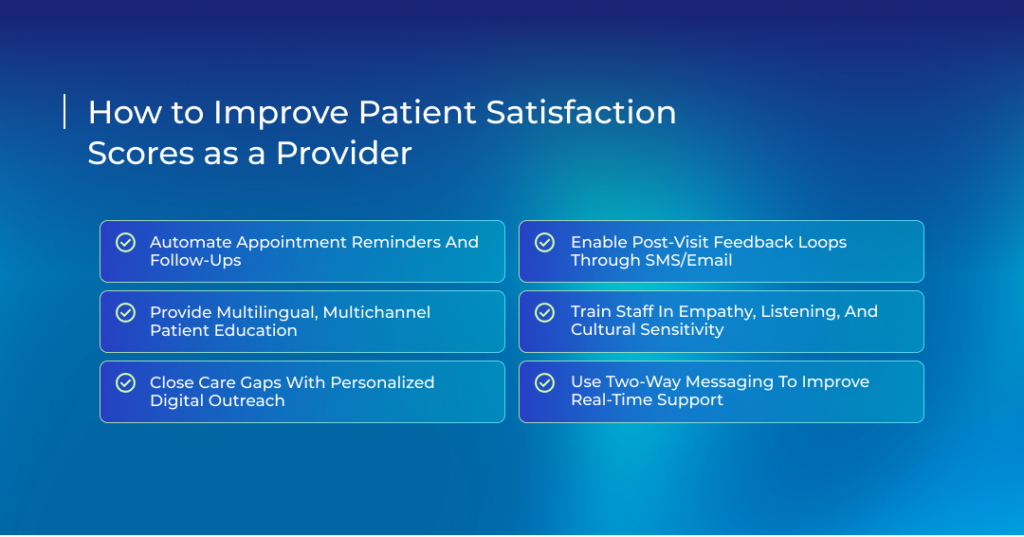
Automate Appointment Reminders and Follow-Ups
Missed appointments create problems for everyone. Your schedule has empty slots, other patients wait longer to book, and the person who forgot goes without needed care.
Having an automated reminder system in place reduces your no-show rates. It automatically sends a text to remind patients about their upcoming appointment. This also gives them a chance to reschedule.
The same system automates your follow-up messages as well to show you’re still thinking about their health. Someone receiving a text after discharge about how they’re feeling or reminding them about medication tells them you care beyond the office visit. Patients remember this attention, and it shows up in their ratings.
Since you’re automating your reminders and outreach, your staff is free to focus on on-site patients. The reduced administrative burden shows up in how much time they give to patient care, leading to improved patient satisfaction.
Provide Multilingual, Multichannel Patient Education
Healthcare organizations serve diverse communities. Your patients will always appreciate it if you communicate with them in their native language.
It’s also a way to make care more accessible because someone who speaks Spanish, for example, is far more likely to understand their discharge instructions when they’re written in the language they’re most comfortable with.
The channel you use to communicate also matters because everyone absorbs information differently. Some prefer quick text messages, while others prefer emails. Voice calls work better for older patients who find reading difficult.
Sending healthcare resources through multiple channels like texts, emails, patient portals, and printed sheets reaches everyone on their terms. This understanding shapes how patients view the quality of care they received.
Close Care Gaps With Personalized Digital Outreach
A generic email about flu season won’t garner the same attention as a personal text that reminds each patient by name about their upcoming flu shot. That specificity shows you’re paying attention to their individual health.
Reminders for mammograms, colonoscopies, or diabetes checks help people stay on track. Most simply forget or don’t realize they’re overdue. A targeted text removes that obstacle and makes scheduling easy.
Patients notice these personalized moments. When you help them keep up with preventive care, they’re less likely to face serious problems down the road. They also see that you’re invested in their ongoing health. This recognition heavily influences measuring patient satisfaction results.
Enable Post-Visit Feedback Loops Through SMS/Email
Immediate feedback gets you information faster than surveys that show up days later. You catch problems early and fix them before they affect more people. Most providers have automated systems that reach out after a visit to ask about their visit.
Patients feel valued when you ask what they think. A post-visit message shows you care about their opinion and want to do better. Even people who don’t respond appreciate being asked.
Train Staff in Empathy, Listening, and Cultural Sensitivity
Patients are often stressed out. Empathizing with their situation helps calm their nerves. This also reduces the chance of a patient becoming overly angry or frustrated. Training your staff to pick up on these moments shows patients you value their health.
Active listening matters just as much. Teach your staff the magic of patience. Let patients finish what they’re saying. This makes them feel genuinely heard and understood. It also helps your staff to respond better.
Cultural sensitivity ties everything together. A chatty, informal approach may put one patient at ease while making another feel uncomfortable. Spotting these differences allows your staff to tailor their approach to each individual. The interactions become much more respectful in nature, and patient satisfaction scores naturally go up.
Use Two-Way Messaging to Improve Real-Time Support
Two-way messaging lets patients ask questions and get answers without the stress of calling the office.
The fact is that phone calls frustrate everyone. Text conversations work around schedules. They can message whenever they want and receive timely answers within the same thread. The same applies to live chats.
This also handles routine inquiries like refill requests, appointment changes, and questions about forms. Managing these through text or live chat frees up phone lines for urgent calls and gives patients an option that fits their day.
This convenience directly contributes to good patient satisfaction score outcomes by eliminating common frustrations from the patient experience.
What Are the Benefits of Improving Patient Satisfaction?
Improving patient satisfaction score does more than make patients happier. Better satisfaction affects your bottom line, your reputation, and how well you can actually take care of people. Here’s what you gain when you focus on patient experience:
- Your reimbursement rates go up. Medicare and most insurance companies connect payment amounts to how satisfied your patients are. Practices with better scores get bonus payments. Lower scores mean you get paid less.
- You get more referrals. Patients who leave happy will naturally refer you to their friends and family. This starts an organic chain that doesn’t cost you anything to attract more patients.
- Patients become more loyal. A satisfied patient has no reason to find another provider. They’ll always come back for their next appointment. This matters because patient retention costs less than bringing in new ones. You also earn more from long-term patients because they use more of your services over time.
- Patients actually get healthier. Improved adherence is directly backed by patient satisfaction. They show up for follow-ups, take their medications correctly, and report any symptoms they experience. This compliance leads to better health results.
- Your team gets a morale boost. They don’t burn out from dealing with frustrated and angry patients all day long. Better morale means less turnover, which saves you from constantly hiring and training new team members.
Using Televox to Measure and Improve Patient Satisfaction
Televox helps healthcare providers like you turn everyday patient interactions into measurable opportunities to improve satisfaction.
We understand that you’re not just looking to collect feedback but also a way to actively shape positive experiences from the very first interaction.
TeleVox’s Engage is our speech-to-speech AI-powered virtual agent that handles routine inquiries with human-like conversations while also identifying key moments that need human expertise. It pairs with LinguaAI to drive multilingual communication. When patients can communicate clearly, they’re more likely to follow through with their care and feel positive about the entire experience.
We also offer self-service tools that allow patients to confirm appointments, update their information, or request refills at their convenience. It makes them happy, and your staff can breathe a little easier.
Reaching patients however they prefer to be reached makes all the difference. Our system utilizes multichannel outreach, ensuring that important messages don’t get lost simply because they arrive through the wrong channel.
For providers managing high appointment volumes, our Practice Edition automates the scheduling process that typically requires multiple back-and-forth exchanges. The system handles confirmations and rescheduling requests without staff intervention, freeing your teams to focus on patients who need personal attention during their visits.
Schedule a demo today, and discover how Televox’s suite of solutions can boost your patient satisfaction scores.
Related Posts