Dental patient communication has moved well beyond appointment reminders. Large practices and hospital-based dental teams…
RCS Use Cases in Healthcare: How Rich Messaging Improves Patient Engagement
Healthcare providers have long depended on phone calls and plain text messages because they’re familiar modes of communication. However, familiarity doesn’t always translate to effectiveness.
RCS messaging emerges as a more effective alternative. You enhance your standard texting with images, buttons, branding, and two-way interaction without requiring any apps or logins. Your messages arrive in the same inbox patients already use, but with far more clarity and context.
The sections below break down practical RCS use cases that support better patient experiences across the full care journey.
How RCS Transforms Key Touchpoints Across the Patient Journey
RCS messaging examples extend beyond basic appointment confirmations. Your patients receive messages that look and feel like real conversations, complete with branding that confirms the message comes from their provider, not a spam number.
Scheduling becomes simpler. Patients tap buttons to book, reschedule, or confirm appointments instead of calling the office. Each message contains details about upcoming visits, the provider’s name, and map locations.
Patient education also gets richer when delivered through RCS. Providers send pre-visit instructions with instructional videos or graphics that patients understand easily, helping reduce pre-procedure questions and improving preparation.
Post-visit follow-ups check on recovery progress. Simple button taps allow patients to send updates like new symptoms, creating a direct communication line that keeps care teams informed. This back-and-forth builds confidence and catches potential complications early.
RCS use cases in chronic care allow patients to submit daily health reports like blood pressure readings or glucose levels. Care teams monitor these metrics in real time and adjust treatment plans when needed.
Hence, patients stay more engaged between visits. They feel heard, informed, and connected to their provider throughout their entire health journey.
Top RCS Use Cases in Healthcare for Patient Engagement and Experience
Healthcare providers already using RCS report higher engagement and fewer missed appointments. This is because patients respond faster when messages feel modern and easy to use, and with Apple’s iOS 18 update now supporting RCS, your reach extends beyond Android users.
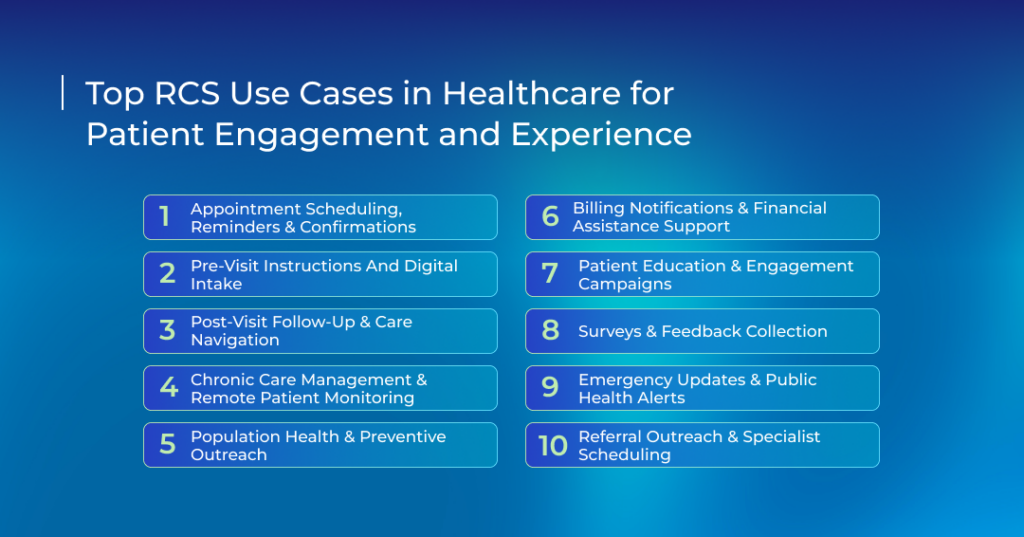
1. Appointment Scheduling, Reminders & Confirmations
SMS works great in telling a patient about their appointment. RCS improves that messaging by including a button they can tap to easily confirm or reschedule. It also shows patients additional information, like an embedded map showing how to reach the office.
This approach turns a passive text reminder into an interactive tool. Everything a patient needs is right there in a single RCS message. It improves response rates and, importantly, reduces no-shows to stop costing providers millions in lost revenue.
2. Pre-Visit Instructions and Digital Intake
Patients often arrive unprepared because they either forgot the prep instructions or never received them in the first place. RCS solves this by delivering everything needed before the visit. Your messages can include preparation steps like what to bring and whether to come on an empty stomach or not. Rich cards display each instruction clearly, with images showing required documents or items.
The best part about RCS is that it doesn’t send you a secure link to an intake form like with traditional SMS; it sends you the whole form itself. Patients can tap the embedded button to open the form inside the messaging app and fill out all the fields.
Once completed, the message syncs with the provider’s system automatically. This not only makes it highly convenient for patients but also for your staff, who now have less paperwork to deal with.
3. Post-Visit Follow-Up & Care Navigation
It’s easy to forget recovery instructions that patients receive during discharge. SMS already helps by texting important information like medication prescriptions, dosages, and timings. RCS climbs another rung by including a complete summary of the entire discharge report. It can also include visual cards to highlight physical therapy or embed a video to show that in action.
Even better, an RCS message can contain a button that links to the pharmacy. Patients can simply tap it to schedule a refill. This beats calling the pharmacy or visiting there in person.
RCS handles surveys the same way. You can send the entire feedback form within the same message instead of a link that routes them elsewhere.
4. Chronic Care Management & Remote Patient Monitoring
RCS makes it easier for chronic patients to connect with providers between appointments. They receive regular check-in messages with buttons that patients can click to reflect their health condition. A person who needs medical attention may click on “Need help,” and the system will alert the provider to send a care team.
For patients tracking blood pressure or glucose, messages include links to take readings and log data in their patient account.
Some systems integrate wearable device data. If a patient’s blood pressure spikes, they receive a message asking them to take a manual reading and report results. This creates a feedback loop between patient and provider without requiring an office visit.
5. Population Health & Preventive Outreach
RCS enables targeted outreach at scale. Instead of generic postcards for upcoming flu shots, providers can send rich texts explaining why it matters and listing available appointment times. Patients can tap a button to book immediately. This reduces anxiety and increases participation.
RCS use cases extend to wellness programs as well. A health system promoting weight management can send recipes, workout videos, and progress tracking tools. Patients engage with content without leaving their messaging app, making healthy habits more accessible.
6. Billing Notifications & Financial Assistance Support
RCS removes the confusion from medical bills. When a bill becomes available, patients receive a message showing the amount owed, what insurance covered, and their payment options. A button opens a secure payment page where they can pay in full or set up a payment plan. The entire process happens in the messaging thread. There’s no need to log into a portal or download another app.
The ability to one-tap to pay bills means that providers get paid faster. The transparency also removes the chance of any billing disputes. Patients see exactly what they owe and why. They don’t feel ambushed by unexpected charges because the message explains everything clearly.
7. Patient Education & Engagement Campaigns
Healthcare works better when patients understand their health. RCS delivers education in formats people actually watch and read.
A provider can launch a whole campaign about how to keep a healthy heart. Each week, patients receive a message with a short video explaining topics like cholesterol, blood pressure, or exercise benefits. The videos play directly in the message. You don’t even need to download the YouTube app.
Procedure preparation content similarly helps reduce anxiety by sending rich cards and videos showing what happens during the procedure and what they can do to prepare.
8. Surveys & Feedback Collection
Patient feedback shapes better care. RCS makes collecting it simple.
After a visit, patients can receive a quick survey with star ratings and simple questions. Tapping the stars takes seconds. You can also leave space for them to type optional feedback.
Some providers ask specific questions about the care experience: “Was your wait time reasonable?” “Did your provider explain things clearly?” “Do you feel your concerns were addressed?” This targeted feedback helps identify specific improvement areas.
Real-time surveys also catch issues quickly. If a patient rates their experience poorly, the system alerts the patient experience team immediately. They can reach out the same day to address concerns before they become formal complaints.
Review requests work through RCS too. After positive visits, patients receive a message asking them to share their experience on Google or other review sites. A button opens the review page directly. This simple path increases the number of reviews and helps other patients choose providers.
9. Emergency Updates & Public Health Alerts
Emergency messages can’t afford to be unclear. They need to reach people fast and make sense at a glance. SMS does that but RCS does it better.
When a heat wave hits, you can send visual cards at a massive scale to show how much water to drink and ways to stay safe. If wildfires have taken place nearby, patients at higher risk or those with breathing issues can get timely guidance on how to protect themselves.
You can also share maps with nearby shelter locations as a hurricane approaches, helping patients act quickly without scrambling for information.
10. Referral Outreach & Specialist Scheduling
Getting patients from primary care to specialists involves too much friction. RCS removes those barriers.
After a primary care visit, patients receive a referral message explaining why the specialist visit is needed, who they’ll be seeing, and available appointment times. The message can include the specialist’s photo and credentials, with a button that opens the booking system for that provider.
Some systems integrate even further. The message includes the reason for referral so patients understand what to expect. If prior authorization is required, the message explains the process and expected timeline. Patients see when to expect approval and how they’ll be notified.
For complex referrals requiring multiple specialists, RCS keeps track of the journey. Patients receive messages as each step completes, like authorization approved or appointment scheduled. This coordination reduces confusion and prevents patients from falling through gaps in the system.
After the specialist visit, the primary care provider receives a summary, and patients are notified that their doctor is up to date and that the next steps are in place.
RCS and HIPAA: What Healthcare Providers Should Know
RCS delivers interactive content but these rich messages are fit for protecting health information. PHI includes sensitive data like patient names, their medical records, and other personal details. HIPAA mandates that all healthcare communication needs to have end-to-end encryption. Your default RCS services don’t provide this level of protection.
Most modern healthcare organizations still use RCS but only for touchpoints that don’t involve any PHI. This means adjusting your messaging to not include any details that can identify the patient. So appointment reminders can include date, time, and location, but not medical conditions. Similarly, prescription notifications don’t reference medication names or diagnoses.
Instead of forcing providers to manage compliance on their own, platforms like Televox build it directly into how RCS works. Their RCS solution is designed with HIPAA requirements, securing messages through encryption, logging every interaction for audit purposes, and connecting with EHR systems without exposing patient data.
This means providers can use RCS messaging to improve patient engagement without exposing themselves to compliance violations.
The Televox Advantage for RCS Communication in Healthcare
You’ve seen the RCS examples that work: branded messages with interactive buttons, appointment reminders that patients actually respond to, and follow-ups that feel like real conversations. Now, picture combining that with a platform built specifically for your healthcare workflows.
That’s where Televox changes the equation. We didn’t just add RCS to an existing system. We built Rich Communication Services into a comprehensive patient engagement solution that handles everything from discovery to post-visit care while maintaining the compliance healthcare demands.
However, RCS alone isn’t enough when your staff is drowning in routine questions and appointment requests. That’s where our conversational AI steps in. Engage handles patient interactions naturally across phone, SMS, and chat 24/7, using speech-to-speech AI that understands tone, intent, and emotion.
The capability completes tasks like appointment rescheduling, payments, eligibility checks, and follow-ups directly in the conversation, turning what used to be a five-minute phone call into a fifteen-second exchange.
Healthcare organizations using our RCS report 50-80% conversion rates on reminders and campaigns, with 3x higher response rates than SMS.
We combine the visual richness of RCS with the intelligence of conversational AI and the operational power of deep EHR integration.
Your patients get the experience they expect. Your staff gets relief from repetitive tasks that eat up hours every day, and you get 35% fewer no-shows, 25% appointment lifts, and 7-10 minutes saved per interaction.
Schedule a demo and we’ll show you exactly how Televox transforms patient communication across your entire organization.
Related Posts