
Rich Communication Service (RCS) is an advanced messaging format that goes beyond standard SMS in…

How Voice Technology Transforms Patient Engagement and Outcomes in Healthcare
Voice technology is quickly changing how healthcare providers connect with patients, making communication smoother while taking some of the everyday pressure off staff. AI-powered automation handles routine calls and adapts conversations in real time, making every interaction feel personal instead of scripted. You get to manage patient communications at scale while giving each one the attention they deserve.
Why Voice Is Essential to a Multichannel Communication Strategy
For healthcare organizations, voice technology fills the gaps that digital channels often leave behind. Text messages are effective for basic reminders but not for complex scenarios. Emails can sit in spam folders, and live chat requires patients to step outside their comfort zone to type their concerns.
However, when urgency matters, when access barriers exist, or when complex health information needs clear delivery, voice cuts through all the noise.
Patients who struggle with smartphones still answer phone calls. Elderly populations who can’t navigate patient portals respond better to verbal instructions.
Non-English speakers benefit from multilingual VAs in healthcare systems that break through language walls. The medium reaches patients where they are, using the most natural form of communication we have.
However, voice technology alone can’t create a robust communication ecosystem that modern healthcare providers want. You have to pair it with other channels like SMS, email, and chat. Every channel has its own importance, but voice communication is responsible for handling critical activities that require immediate attention and easy understanding.
Key Use Cases of Voice Technology in Patient Engagement
Modern voice systems enable healthcare organizations to deliver positive experiences without burning out their staff.
Appointment-Related Communication
Automated voice systems handle the repetitive cycle of appointment management without human intervention. They send reminders at scheduled intervals, place calls to confirm appointments, and process rescheduling requests through natural conversation.
The constant voice interactions at multiple touchpoints, especially the automated reminders, help you significantly reduce your no-show rates. Plus, your staff gets to focus on complex scheduling scenarios that require human expertise instead of being glued to the phone.
Pre- and Post-Visit Patient Instructions
Automated voice calls prepare patients days before their scheduled visits so that they arrive with all the necessary paperwork. If a procedure is coming up, the system explains fasting rules or medication. Hence, patients show up prepared and your front desk avoids last-minute cancellations.
The same proactive approach works for follow-ups as well. Patients often forget their discharge instructions. Automated voice calls reach out to check on recovery progress and remind patients about their meds and dosages.
Patients can also mention new symptoms during the same call and get an appointment scheduled right away. It keeps care on track and improves outcomes without adding extra work for clinical staff.
Patient Access and Contact Center Efficiency
Phone systems using voice recognition in healthcare route incoming calls based on patient needs. The IVR asks targeted questions to understand the call purpose, then directs patients to appropriate resources. Common questions about hours, locations, or prescription status receive immediate automated answers.
For complex issues, the system transfers calls with context, eliminating repeated explanations. Hence, hold times decrease because automated systems handle routine inquiries. Patients can even call outside business hours to receive self-service options.
Preventive and Promotional Campaigns
Healthcare teams use voice outreach to encourage more patients to get vaccinated or book wellness visits. The system automatically calls specific patient groups in the thousands or millions, explaining benefits and offering to schedule an appointment on the spot.
Manual teams can’t effectively reach patients at such a large scale. You need to rely on modern voice tech to drive your voice campaigns for flu shots, cancer screenings, or annual checkups. This also works for the elderly or patients with limited technology access.
Financial and Administrative Communications
Voice assistants are an excellent way to deal with billing questions. Patients are automatically called in advance to remind them about their outstanding balance. The VA even answers questions about insurance coverage or payment plan options.
More advanced voice systems can also verify insurance eligibility ahead of appointments. Patients are alerted to missing documents in advance, minimizing billing disputes at the end.
Emergency and Service Disruption Alerts
When weather closes facilities or emergencies require rescheduling, voice broadcasts reach large patient populations quickly. The system contacts affected patients within minutes, explains the situation, and offers rebooking options immediately.
Urgent care location changes, vaccination clinic updates, or public health alerts require rapid communication. Automated voice systems deliver consistent messages across thousands of patients simultaneously, something manual calling cannot accomplish at scale.
Patient Education
Voice calls deliver education tailored to specific conditions or treatments, including tips, medication reminders, and lifestyle guidance. The conversational format increases retention compared to written materials that patients may not read.
Patients ask questions during these calls, and the system provides answers from approved clinical content. This ongoing education support helps patients make informed decisions about their health.
Positive Impact of Voice Technology in Patient Engagement
Voice technology creates value for healthcare organizations in a number of ways. They improve their reach, adherence, messaging, and most importantly, operational scalability.
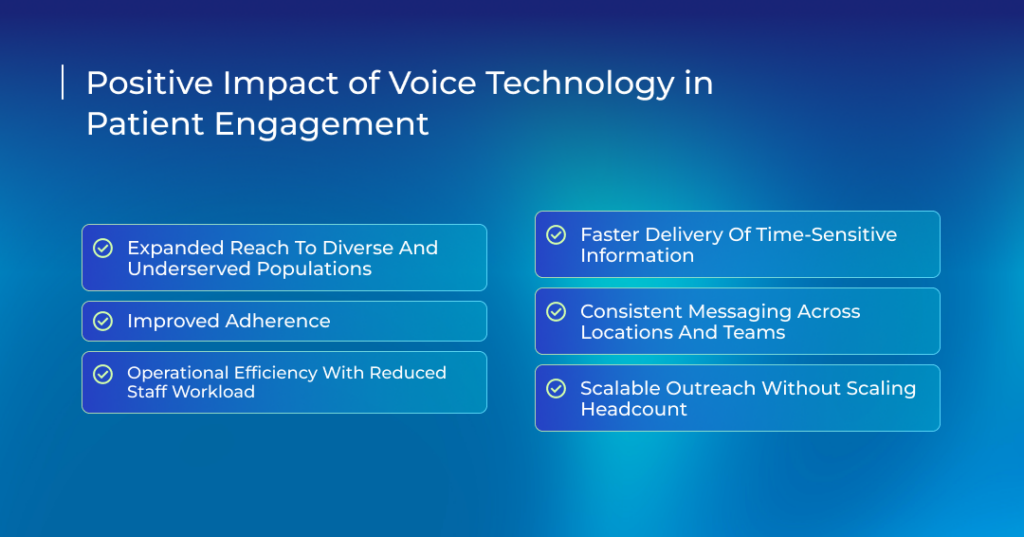
Expanded Reach to Diverse and Underserved Populations
The digital age might be here but most patients still prefer a traditional phone call from their providers. This is especially true in older adults who either have limited internet access or are not comfortable navigating their way around emails and patient portals.
Most rural areas also have non-English speakers, making manual outreach difficult unless you have native agents. Multilingual voice systems tackle that challenge without losing context. This ensures crystal-clear messaging for all patient groups.
Improved Adherence
Appointment reminders sent through voice calls are generally more effective at reducing no-shows for healthcare providers. Calling at different time intervals like a week before, 4 days before, and then 2 days before signficantly increase the likelihood that they’ll remember their appointments.
Follow-up calls further improve adherence rates. Checking on patients recovering at home allows your team to catch issues early and reinforce care instructions. This consistent support helps patients follow through on clinical recommendations.
Operational Efficiency With Reduced Staff Workload
Voice calls are effective but only when automated. A manual approach requires too many resources. You’d rather have your staff spend their time and expertise on patients who need it instead of spending hours each day making routine phone calls.
Voice assistants help healthcare teams process hundreds of calls simultaneously. There’s no need to increase your headcount. You can easily add more assistants during peak seasons without requiring any human oversight. These VAs handle everything from appointment confirmations to follow-ups.
Faster Delivery of Time-Sensitive Information
Automated voice systems deliver urgent messages immediately. A routine lab test that uncovers something critical can’t wait for staff availability. The system automatically calls up the patient in question, shares the report, and offers to schedule an appointment.
This speed prevents delays that could seriously impact health outcomes. Similarly, voice tech makes emergency updates reach entire patient populations within minutes rather than hours or days.
Consistent Messaging Across Locations and Teams
Manual communication varies based on who makes calls and how they explain information. A healthcare system’s voice assistant maintains consistent messaging to eliminate any chance of confusion. This consistency is especially important for multi-location health systems. It ensures patients receive the same quality experience regardless of which facility they use.
Scalable Outreach Without Scaling Headcount
Healthcare organizations expand patient engagement programs without hiring additional staff. Voice systems contact thousands of patients for preventive care campaigns, survey outreach, or appointment confirmations using existing resources.
Seasonal volume increases, like flu shot campaigns or open enrollment periods, no longer require temporary staffing. The technology handles demand spikes that would overwhelm manual calling approaches. This scalability allows organizations to reach entire patient populations cost-effectively.
Voice Technology Challenges and How Televox Addresses Them
Healthcare organizations face several obstacles when implementing voice systems. Automated systems might reduce manual overheads, but too many calls can create what we call message fatigue. If your messaging is too generic, you’re essentially spamming patients, which can lead to a drop in engagement.
Additionally, AI-driven voice systems raise concerns about HIPAA regulations and security, emphasizing the need to manage compliance from the outset.
Each challenge creates friction in the patient experience.
Televox tackles these problems through its Engage platform, which delivers streaming speech-to-speech AI interactions that feel genuinely human.
The system uses LinguaAI to understand multilingual needs and detect tone, acting autonomously to make every conversation natural. Instead of robotic scripts, patients hear empathetic responses that adapt to their specific situation.
The platform also addresses message fatigue through Insights360, which analyzes every patient intent, tracks interaction paths, and reveals exactly where automation succeeds or needs improvement.
Most importantly, Televox complies with HIPAA rules and regulations from day one. You get seamless integration with your EHR systems to pull and update patient data without manual entry. All interactions occur within a protected environment that meets regulatory standards while maintaining the conversational ease patients expect.
Ready to Transform Care Delivery With Cutting-Edge Voice Technology?
Poor patient engagement is often because it’s mistimed, misrouted, or easy to ignore. Televox helps healthcare organizations change that by turning every outreach into a moment that actually moves care forward.
This data-driven approach means providers send the right message at the right time through the right channel, helping teams spot gaps in care handoffs, reduce wait times, and make each interaction feel purposeful rather than intrusive.
You get smoother workflows for staff and clearer, more responsive communication for patients without adding complexity behind the scenes.
If you’re ready to see how intelligent voice technology can support scalable, patient-first care delivery, schedule a demo with Televox today.
Related Posts