
Dental patient communication has moved well beyond appointment reminders. Large practices and hospital-based dental teams…

How Patient Experience Data Improves Care Quality
Surveys are helpful, but they often hide underlying issues. Someone who was able to book an appointment online may highly score your online scheduler, but there might be ways they think it could be improved. Healthcare providers need to understand that every patient interaction across departments contains such patterns.
That collective feedback is what we call patient experience data. It shows you what they care about from their perspective, not yours. It surfaces problems you didn’t know existed and highlights what actually matters to the people you’re treating. This roadmap helps you improve outcomes and create experiences patients genuinely value.
Why Patient Experience Data Matters for Healthcare Providers
Healthcare organizations are always under pressure to prove their value through outcomes. What matters is how many patients feel better after getting care, not how many patients received care. This pressure makes patient experience data a critical basis for reimbursements.
The pressure comes from multiple directions. CMS started publicly reporting HCAHPS results in 2008, and by 2012, those scores began affecting hospital payments. Today, anyone can compare hospitals on Medicare’s website. Your scores are out there for patients, competitors, and insurance companies to see.
The Hospital Value‑Based Purchasing (VBP) Program alone withholds 2% of base Medicare payments and redistributes that pool based on hospital performance. For a mid-sized hospital, we’re talking millions of dollars riding on how patients rate their stays.
Your patient experience matters because it affects reputation, revenue, and standing with regulatory bodies. Get it right, and you protect your payments while building trust in your community. Get it wrong, and you’ll watch patients choose competitors while your value-based purchasing scores cost you money.
Key Types and Sources of Patient Experience Data
Your patient experience data flows from multiple sources, each answering different questions about the care received.
Standardized Patient Surveys
This covers HCAHPS and CG-CAHPS. The first survey measures hospital stays. It asks about nurse and doctor communication, room cleanliness, discharge instructions, and whether patients would recommend the hospital.
Ambulatory practices use CG-CAHPS instead. It covers appointment access, provider communication, and office staff interactions.
Both surveys let you compare your scores to others and track changes over time, but you’re only hearing from patients who bother to respond, and that’s usually a minority.
Operational Metrics
Your systems already track most of what patients experience. These include wait times, appointment scheduling gaps, portal login rates, etc. These numbers show where care breaks down before patients complain.
Some metrics are particularly helpful in predicting issues. High no-show rates might signal reminder failures, or long gaps between referral and appointment suggest coordination issues. This patient experience data runs constantly without requiring surveys.
Qualitative Insights
A survey might show a patient rating communication as satisfactory, but in reality, they thought the doctor rushed through discharge. Focus groups, advisory councils, and complaint analyses reveal patterns to show the full story.
Additionally, open-ended survey comments add detail to numeric ratings. The patient experience data from these insights explains the numbers and points to specific fixes.
Behavioral and Engagement Analytics
What patients do tells you more than what they say sometimes. Portal message open rates, survey completion patterns, and online booking behavior are actions that show how people interact with your tools when no one’s watching.
Low portal adoption after email invitations means something about how signup feels difficult. High drop-off rates on digital check-in suggest confusing steps.
This behavioral patient experience data updates constantly and requires no surveys. You just need to look at what people actually click, open, and complete.
How to Collect Patient Experience Data Effectively
You won’t get any useful feedback from sending surveys randomly. Providers need to combine multiple sources of information to see a complete picture of how patients actually felt at every touchpoint.
Real-Time and Standardized Survey Methods
Timing is a big key in the collection of patient experience data. A survey sent within one or two days after discharge will yield better data because the experience is still fresh. If you wait a week or two, the patient will struggle to recall details.
Standardized surveys like CAHPS give providers a quick and easy way to measure care. They use the same questions, so surveys can be pushed at every touchpoint. The same questions also mean you can compare your performance against other providers.
Digital Engagement Channels
Text message surveys get more responses than paper forms sent by mail. Most people read texts within minutes, and completing a short survey on a phone takes seconds. Email works too, especially for patients who prefer longer, more detailed questionnaires.
The key is making surveys easy to access: tablets in waiting rooms or prompts in patient portals. Feedback requests in places where patients already interact with your system make it more likely that they’ll respond.
Involving Patient and Family Advisory Councils
A survey might tell you patients are confused by discharge instructions. A council member can explain exactly why and suggest better alternatives.
Good councils don’t just review hospital decisions after the fact. They help shape initiatives from the start. When you design a new patient portal or rewrite billing statements, having actual patients involved means you catch problems before they reach thousands of people.
Integrating With EHR and CRM Systems
Connecting your feedback tools to EHR and CRM systems allows you to automate patient experience data collection. When a patient finishes an appointment, the system triggers a survey without anyone clicking buttons or remembering to send it.
Integration also means patient experience data doesn’t sit in isolation. Negative feedback gets flagged and routed to the right department immediately. Staff can see survey responses right next to clinical notes, making it easier to spot patterns.
If satisfaction drops after a process change, you’ll notice. If certain departments consistently score lower, you’ll know where to focus improvements.
Benefits of Collecting Patient Experience Data
Patient experience data shows which parts of care are working and which parts leave patients confused or ignored. Fix those gaps and patients stop skipping appointments or giving up on treatment halfway through.
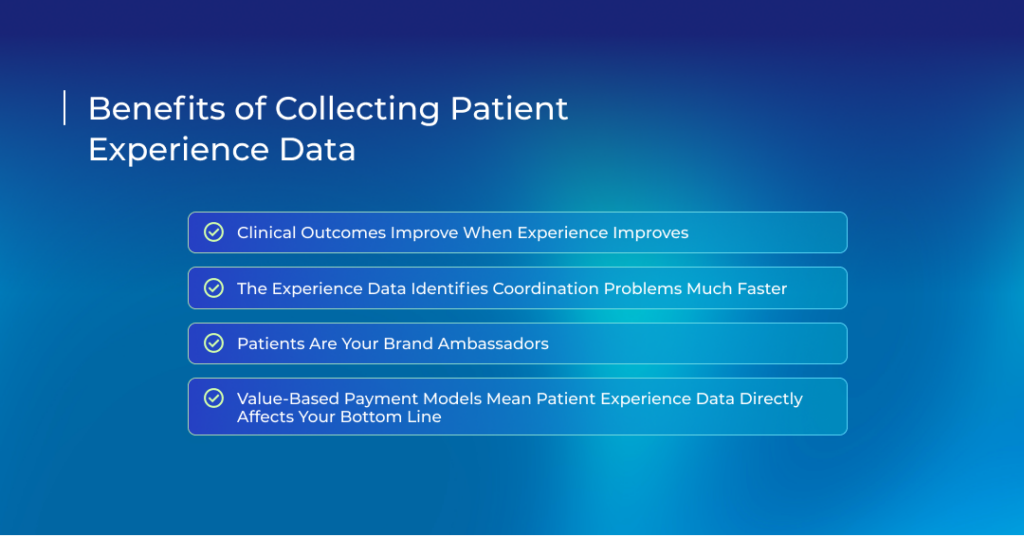
Clinical outcomes improve when experience improves. It’s not a coincidence that providers with positive feedback scores tend to have fewer readmissions. When discharge nurses take time to explain medications clearly, patients don’t end up back in the ER three days later because they took the wrong dose.
The experience data identifies coordination problems much faster. Patients bouncing from specialist to specialist may have taken the same blood test twice because their medical records were never forwarded. These are fixable problems, but only if you know it’s happening. That’s where your patient feedback comes in.
Patients are your brand ambassadors. When their friends ask about a good specialist, they’ll always refer you if their previous experience was excellent.
Today, public satisfaction scores matter more than they used to. Everyone reads online reviews before choosing a provider. Better-rated hospitals find it easier both to attract patients and staff. Nobody wants to visit or work in a place known to treat people badly.
Value-based payment models mean patient experience data directly affects your bottom line. Medicare looks at HCAHPS scores when deciding reimbursement rates. Score well and you get paid more. Score poorly and you take a financial hit.
How to Analyze Patient Experience Data for Better Outcomes
It starts with gathering patient feedback, but the real value comes after you’re able to make sense of this data. The right tools help dig into thousands of patient surveys and reviews to find hidden patterns.
Visualizing Patient Experiences
Dashboards save you from digging through multiple systems. You can see your wait times, satisfaction scores, complaints, or anything you need to know, all at once from a single screen.
KPIs pair with dashboards to tell you when something crosses a line. Set a threshold for nurse communication scores, and the dashboard alerts you when they dip. You see the problem while it’s still happening, not weeks later when patients have already left upset. That timing matters because you can actually do something about it.
Using BI Tools to Track and Benchmark Experience Data
Business intelligence platforms pull patient experience data from your connected systems into one place. They also show you how you stack up against other hospitals.
When your discharge instruction scores lag behind the regional average, you know you need to change how staff explain things to patients before they leave.
These tools track changes over time, too. Did that new check-in process actually help, or did patient satisfaction stay flat? You can see the answer instead of guessing. Some platforms even send alerts when numbers move outside normal ranges, so your team only checks the dashboard when something needs attention.
Extracting Actionable Insights From Patient Feedback Using AI and NLP
Reading through hundreds of comments manually takes forever. Natural language processing does it for you within seconds.
NLP scans text and figures out if feedback is positive or negative. It also spots patterns. If 20 patients this week complained about parking, the system flags parking as a recurring issue. You see which problems come up most often without reading every single comment. Sentiment analysis breaks down how patients feel about different parts of their stay. Maybe nurses get glowing reviews while billing gets hammered. That tells you exactly where to focus your improvement efforts.
Top Technology Solutions for Managing Patient Experience Data
The right platform makes collecting and acting on patient experience data manageable instead of overwhelming. Here’s what these solutions actually do.
- Automated survey platforms send questionnaires right after appointments or discharge without any human oversight. You can customize questions by department or procedure, so ER patients get different surveys than surgical patients.
- Analytics platforms combine survey responses, online reviews, and complaints into one dashboard. They show you where your scores fall compared to other hospitals and alert you when numbers drop.
- Patient engagement platforms send appointment reminders, collect feedback, and route complaints to staff who can fix problems immediately. They also nudge satisfied patients to leave public reviews while keeping negative feedback internal.
- Text analysis software reads open-ended comments and flags recurring issues like billing confusion, parking problems, and medication questions. Natural language processing spots patterns faster than anyone reading comments manually.
- EHR-integrated feedback systems connect survey responses directly to patient charts. When someone complains about discharge instructions, care teams see that feedback next to clinical notes without switching systems.
See How Televox Can Transform Your Patient Experience With Data
Most healthcare teams collect patient feedback, but very few turn it into something meaningful. Televox closes that gap by turning everyday interactions like phone calls, messages, surveys, and post-visit reviews into clear signals about what patients need and where their experience breaks down.
Insights360 tracks every voice call in real time to highlight bottlenecks, long waits, confusing handoffs, and patterns that providers typically only notice after problems grow. Our platform draws directly from patient behavior to reveal issues traditional surveys can’t fully capture.
Televox also lets you layer in automated surveys to gather immediate, context-rich feedback after appointments, follow-ups, or outreach campaigns. It pairs excellently with our patient engagement platform that makes it easy to automatically request reviews, monitor sentiment, and address concerns before they escalate.
The collective impact grows even stronger when paired with Engage, our speech-to-speech AI-powered virtual agent that keeps patients connected between visits, handles routine questions automatically, and Journey Insights reveals how your IVA performs—tracking interaction paths and containment points to uncover opportunities for improvement and deliver a clearer picture of patient engagement effectiveness.
If you want to see how this works end-to-end across your patient journey, let’s schedule a demo and walk you through it.
Related Posts