Dental patient communication has moved well beyond appointment reminders. Large practices and hospital-based dental teams…

Patient Lifecycle Management: What It Is and How to Get It Right
Patient lifecycle management is how healthcare organizations stay connected to patients beyond the exam room. It’s a structured way to support and engage patients at every stage of their journey. They move forward with confidence in knowing what comes next and why it matters. When done right, PLM reduces gaps between visits and helps providers deliver consistent support across the entire care journey.
Typical Stages of a Patient Lifecycle
The patient lifecycle spans across a series of connected stages that shape your patients’ experiences. Each stage is an opportunity to either build trust or falter to create friction.
1. Engagement (Awareness)
This is where patients first learn about you. They might find your website while searching for local providers or hear about your clinic from a friend. First impressions matter here because the potential patient is still comparing options. They haven’t completely decided to reach out.
They’ll try to gain more information from your website but don’t expect them to spend time digging for what they need. Patients will likely move on to the next provider option if they can’t easily find clear details about services or how to contact you. This makes the difference between someone who calls and someone who doesn’t.
2. Becoming a Patient
The real work begins when someone decides to contact you. They might directly call your office or try to book an appointment. They may even send an email to ask for further information. That’s followed by registration, insurance and other preparation for their first visit.
This stage is full of friction points. Phone lines that go to voicemail. Forms that ask for the same information twice. Unclear instructions about what to bring or where to go. Each barrier increases the chance that the patient will go elsewhere.
3. Diagnosis and Treatment
This is the core care stage. This is where all the clinical work happens that brought the patient to you in the first place. However, patient lifecycle management involves more than just the test results or consultation. What happens between appointments is equally important.
Are patients clear on what comes next? Do they understand their treatment options? The right communication during this stage ensures that patients adhere to their care plan.
4. Ongoing Monitoring
Care doesn’t stop when patients leave your office. Ongoing support becomes even more important for those managing chronic or complex conditions. A heart patient who skips routine check-ins only increases the chance of complications down the line. Patient lifecycle management keeps these patients connected between visits. It reinforces care plans and reduces the risk of avoidable readmissions.
5. Retention, Recall, and Advocacy
Patients either stick with you or they don’t. Retention is when they come back for routine visits and new concerns. Recall is how you remind them when they’re due for something important. Advocacy is when they leave positive reviews and refer friends.
None of this happens by accident. It takes intentional outreach, clear communication and systems that know when patients are due for care. Without that, patients fall behind or choose another provider.
Building a Patient Lifecycle Management Model as a Provider
Most organizations know patient lifecycle management matters. But few have a working model that actually improves outcomes. The difference is in how you approach it.
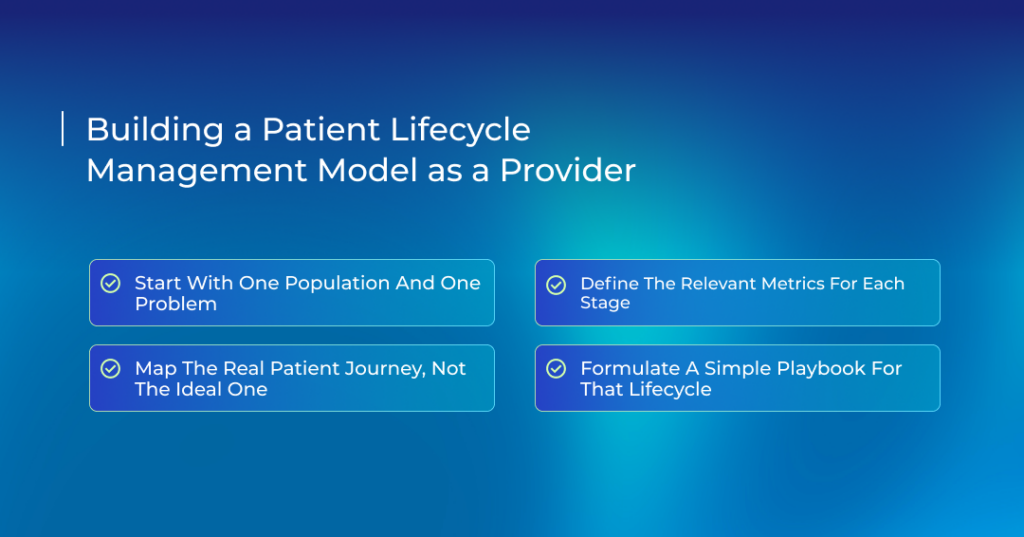
Start With One Population and One Problem
Trying to fix everything at once leads nowhere. Pick a specific group and then start with one clear problem. Maybe it’s readmissions for diabetic patients. Maybe it’s no-shows for another patient group.
Starting small makes your efforts manageable. You can test what works and see results quickly. That enables you to adjust before expanding to other populations.
Map the Real Patient Journey, Not the Ideal One
You probably have an idea of how patients should move through your system. That’s not the same as how they actually move through it. Gather input from your staff. Look at your data and then map every handoff, every wait, every place where patients drop off.
Some examples can be referrals suddenly taking too long or appointment reminders not reaching patients at the right time. Remember to be honest about friction points. Don’t overlook something just to give your new system more time.
Define the Relevant Metrics for Each Stage
Each lifecycle stage needs a set of metrics to measure success. That’s how you know what’s working and what’s not. For example, track missed appointments for newly registered patients or response rates for retention.
This helps your team focus their efforts where it matters. Knowing readmissions are spiking because of unclear discharge instructions is better than reviewing the entire department for why patients are suddenly piling up.
Formulate a Simple Playbook for That Lifecycle
Turn your mapped lifecycle into a basic playbook. Define triggers like what exactly should prompt an action? You need to also choose the right channels and times for messaging. Each team should know what they’re responsible for.
This playbook should be easy to understand and easy to update. A workflow that’s suddenly slowing down should be fixed fast. The goal is a repeatable process that your team can follow without confusion.
Patient Lifecycle Management Strategies for Modern Healthcare Providers
Having a model is one thing. Executing it is another. PLM works best when it involves specific and repeatable processes to improve patient experience. They’re practical steps that address the exact points where the patient lifecycle tends to break down.
Converting First Contacts Into Confident New Patients
Your clock starts when someone calls or submits an online inquiry. Every hour you wait to respond increases the chance they’ll contact another provider. It should ideally be within an hour for phone calls or a few hours for online requests.
Consistency matters as much as speed. Train your staff to give clear information. Answering one question shouldn’t make a patient ask for clarification. “We can book you for Tuesday at 2 or Thursday at 10” works better than “We have slots available on Tuesday”.
Patients also need to know what to expect after they book an appointment. Your front desk should tell them what to bring or where to go. Building confidence at this stage reduces the drop-off between inquiry and actual appointment.
Frictionless Onboarding From Scheduling to First Visit
The path from scheduled appointment to arrival is full of opportunities to lose people. Digital intake forms eliminate the clipboard and pen routine. Patients fill out their information at home, on their time. This also means you get accurate data.
Send reminders at strategic intervals like one week out, two days, and then the morning of the visit. Tell them if they need to fast or stop a medication. Make sure their visit isn’t wasted because your staff assumed the patient would know how to prepare.
Confusion kills show rates. A patient who doesn’t know which building to enter or whether they need their insurance card is more likely to cancel. Remove that guesswork.
Connect Every Care Instance With Clear, Ongoing Communication
Every visit or procedure should be wrapped in communication. The fact is that patients forget details and often mishear instructions. They leave the office unsure about their medication or when to schedule a follow-up. A simple message the day after their visit that says what the doctor discussed and what their next steps are closes that gap.
This isn’t about sending more messages. It’s about sending the right ones at the right time so patients always know where they stand. Even a simple detail about how long an appointment will take is helpful.
Build Structured Journeys for Chronic and High-Risk Patients
These patients need structured journeys with regular touchpoints. Someone out of surgery should receive daily check-ins for the first week and then weekly for a month. A cardiac patient should get educational content about diet, exercise, and medication adherence over their recovery period.
Without structure, patients assume everything is fine until it isn’t. With structure, you catch problems early.
Support Preventive Care With Smart Reminders
Take it as a rule of thumb that patients are more likely to show up when there are as few steps as possible between the reminder and the appointment.
Start with a gentle reminder. Then follow up two weeks later if they still haven’t scheduled. Send a final nudge the week before if the slot is still open.
One message isn’t enough. Sticking to a single channel isn’t effective either. Try emails and texts for the first couple of attempts before making a phone call.
Online schedulers further make it easy for patients to show up. Your messages can include a direct link to an online scheduler. So they can read your text and then simply reply “Yes” to automatically schedule.
Personalize Outreach
Personalization only works when patients feel seen instead of managed. They are more likely to respond to messages that fit their situations than to something that sounds generic.
Segmenting your outreach by age, condition, language, or other communication preferences helps make your messages relevant. Someone younger might respond better to a quick text, while someone older prefers a phone call.
Behavior data helps you refine this approach. It reveals what channels or message timings actually work for different patients.
This creates a patient lifecycle strategy over time that adapts to real behavior and strengthens engagement without adding burden to care teams.
Use Automation to Scale Touchpoints
You can’t expect your staff to manually send reminders to hundreds or thousands of patients. Providers who only see many of their patients fall under the radar. Automation makes sure that doesn’t happen. The system handles all repeatable routine tasks in large volumes. You can even scale your operations during peak seasons without the pressure of hiring or managing more staff.
Automation also frees your team to focus on complex cases. They can give more time and empathy to an anxious patient who wants to talk to a real person about their diagnosis. This attention improves satisfaction on both ends.
That said, many providers take automation as a way to replace their staff. These tools are there to support your teams to do their jobs better. The human touch is still a valuable element in healthcare communication.
Key Benefits of Patient Lifecycle Management
PLM delivers value where it matters most for a healthcare organization. Here’s what changes when you track and manage the full care journey.
- Patients get better care. They experience fewer delays because everyone involved in their care has access to the same information. Providers make faster treatment decisions without reordering tests or asking patients to repeat information.
- Real care coordination across providers. Visibility matters when multiple teams treat the same patient. Test results, medications, and treatment plans are easy to access by each specialist or team. This reduces miscommunication and prevents fragmented care.
- Less administrative work for staff. Teams spend less time chasing paperwork or fixing data errors. All patient information flows automatically into a central system. This frees your staff to focus on patient care or complex cases that deserve their time.
- Lower costs through smarter processes. Automated routine tasks reduce the chance of any errors due to multiple teams performing the same work. The system also spots issues early so that your team can avoid costly fixes and compliance risks.
- Actionable insights for leadership. Lifecycle tracking reveals patterns that aren’t visible in disconnected systems. Administrators can identify bottlenecks and monitor patient trends with ease. Your team also gets to allocate resources where they’ll have the greatest impact.
- Faster, smoother patient onboarding. Digital intake replaces clipboards and manual data entry. Scheduling happens with fewer delays so new patients start care without unnecessary friction.
- Compliance gets easier. The system flags incomplete forms before they cause audit problems. All documentation lives in one place instead of scattered across different systems. This makes regulatory reviews faster, cleaner, and far less disruptive.
How Televox Supports Patient Lifecycle Management Initiatives for Providers
Patient lifecycle management breaks down when patient communication lives in silos. Televox brings those moments together into a single platform that helps you guide patients forward at every stage of care. We make patient interactions easier to manage, track, and improve without adding complexity for your staff.
Engage, our conversational AI solution, uses intelligent virtual agents to manage the patient conversations that often overwhelm front desks and call centers. With our IVAs, patients get answers, manage billing or prescription refills, and access intake forms instantly through self-service chat. Hence, patients arrive prepared and teams aren’t buried in administrative work.
Insights360 then turns those interactions into clear, actionable visibility across the lifecycle. You can see where patients disengage and where workflows slow down. Our analytics paints a complete picture of what’s driving patient experience and revenue.
Schedule a demo and see how Televox helps you stay connected to patients long after the visit ends.
Related Posts