Average Handle Time (AHT) tracks how long a support interaction takes from start to finish…
Top Patient Experience Trends Defining Modern Healthcare
Your patients are not just passing the time in your waiting rooms. They’re already forming opinions about their care. Every step of their journey shapes how they see their provider. These patient experiences have become one of the strongest forces driving modern healthcare. They help you anticipate what your patients value the most in 2025 and beyond.
Critical Role of Patient Experience for Healthcare Providers
Take note that over 83% patients will only consider a healthcare provider if they have a minimum 4-star rating, while over 50% will completely avoid providers that lack any sort of reviews at all.
This makes it all the more important for providers to start treating their reputation as more than just branding. The reputation your organization builds over time has a significant say in attracting new as well as existing patients. This is further cemented in the fact that the majority of patients return to the same provider if they receive quality care.
In 2024, more than half of all healthcare payments in the United States were made through value-based reimbursement models. This means that reimbursement is becoming more and more dependent on patient satisfaction, and with that, patient experiences are now a core part of how modern healthcare organizations sustain themselves.
Top Patient Experience Healthcare Trends Transforming Healthcare
Recent years have seen patients become more demanding than ever. They are looking for more convenience, quality services, quicker access to care, and most importantly, a provider they can trust without doubt. Their patient experiences are driving successful organizations, and are what you should pay attention to as well.
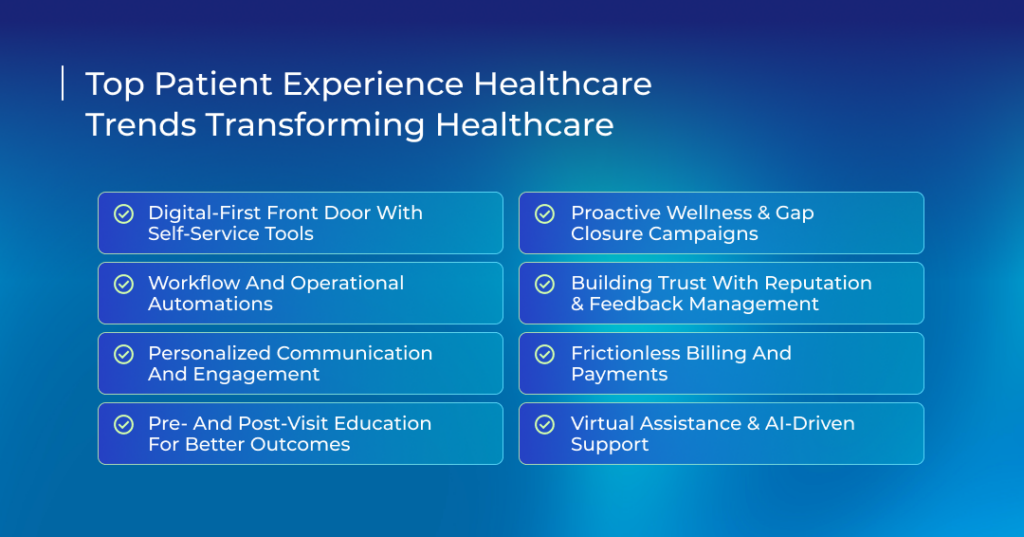
Digital-First Front Door With Self-Service Tools
Most patients prefer handling their healthcare tasks themselves. It’s why self-scheduling software is becoming so popular lately.
Patients can go looking for specialists and schedule a visit even at midnight. Some providers even automate the process of managing their appointment calendars (with thousands of appointments) without anyone ever answering the phone.
Mobile forms are also a popular feature, allowing patients to complete paperwork easily prior to visiting the clinic. It saves time and the frustration of a congested waiting room.
Younger patients especially prefer this approach. They grew up booking everything online and expect the same from their doctor’s office.
Workflow and Operational Automations
Healthcare institutions are resorting to automation to prevent their personnel from burning out while enhancing operational effectiveness. Reminders for appointments and follow-up messages go out in automatic mode without any human intervention. This timely messaging prevents patients from missing their visits or forgetting discharge instructions. Hence, reducing no-show and readmission rates.
The staff no longer needs to keep track of every message and patient. It’s up to the system to give patients the information they need without delay.
Personalized Communication and Engagement
Patients don’t appreciate being treated as another number in the system. They want to hear from their providers who take into account their preferences. This starts from using patients’ preferred channels. Some prefer texts. Others check emails. A few still want phone calls.
When providers offer multiple options, patients engage more. The language matters too. Sending personalized messages that mention their names and appointments makes all the difference in gaining their trust.
Pre- and Post-Visit Education for Better Outcomes
Yet another patient experience trend that’s transforming healthcare today is educating them about their condition and treatment. Someone who has a colonoscopy appointment must adhere to certain prep requirements. A text message can remind them to fast, what to consume, and the time to stop eating.
You see better health outcomes when patients get clear instructions ahead of time. This is likewise for post-visit, where patients need to know about their medications, doses, warning signs, etc.
Proactive Wellness & Gap Closure Campaigns
Successful healthcare organizations understand the value of preventive care. Wellness campaigns and recall programs are now easier than ever with automation tools integrated into your EHR. Thousands of patients with similar conditions and risk factors are scanned daily to flag patients who might need preventive screenings.
Someone with a family history of heart disease, for example, is a prime candidate for a heart screening. The same goes for mammogram reminders or diabetic checks.
This brings in more revenue while keeping patients healthier. It also shows patients that their doctor is concerned about their overall health over the long term, rather than addressing issues as they come up.
Building Trust With Reputation & Feedback Management
Most patients check online reviews before choosing a healthcare provider. It’s why collecting feedback is so important, but it doesn’t have to be a manual process.
With automation, feedback requests go out automatically after each visit or staff interaction. Positive responses get directed to public review sites. Negative feedback goes to the provider to be quickly addressed.
This builds online visibility, attracts new patients, and shows responsiveness to concerns. Managing reputation actively turns satisfied patients into advocates.
Frictionless Billing and Payments
Medical billing doesn’t have to be confusing anymore. Many healthcare organizations are using digital tools to create clear, easy-to-understand statements that break down every charge.
Patients are sent a safe payment link by SMS so that they can instantly pay from their phones. Numerous providers are also adding digital wallets such as Apple Pay and Google Pay to make it even more convenient.
Beyond improving the patient experience, digital statements reduce printing and mailing costs. And because they’re so convenient, patients are happier and far more likely to pay sooner rather than later.
Virtual Assistance & AI-Driven Support
More and more providers are using AI chatbots to answer hundreds of common patient questions every single day. These virtual assistants are online 24/7, taking calls and messages to provide support throughout the year without adding more work to the staff.
The reduced call volumes mean that the staff can finally focus their time and effort on complex cases instead of just playing phone tag. On the other hand, the fast and convenient AI-driven support increases patient satisfaction as well as their number of online bookings.
How to Improve Patient Experience as a Provider
Delivering a great patient experience requires clear action. Here’s what providers can do:
Set up feedback collection points across the care journey. Use your digital channels, phone surveys, and post-visit follow-ups to learn about your patients’ experiences. This is real-time data that can enable immediate action. Your other choice is to wait for yearly or bi-yearly reports, but then it is too late.
Segment your data to see gaps that hide behind scores or ratings. Race, age, admission type, symptoms, etc, are ways to further learn about a specific demographic or care pathway. Younger patients, for example, usually report lower satisfaction with how quickly they can access care.
Offer self-service digital tools to make it easy for both patients and your staff. Online scheduling and patient portals let people book appointments, access records, and manage billing without making phone calls. That’s convenience that is always appreciated.
Use automation for administrative tasks, not patient interaction. It’s normal to consider automating every aspect of your operation, but keep in mind that patient experiences rely on human connections. Losing that means eroding trust and satisfaction down the road.
Close the loop on individual complaints immediately. The whole point of patient feedback at every touchpoint is to quickly address issues. Otherwise, a patient who faces the same issues on their second visit will think their feedback doesn’t matter.
The TeleVox Advantage: Delivering Next-Generation Patient Experiences
Each patient encounter is an opportunity to reinforce trust and gain their loyalty. TeleVox helps providers like you make these moments count by connecting the entire care journey through smart automation and seamless communication.
With Insights360, you get a complete picture of how patients engage with your organization. It tracks outreach performance, response rates, and behavior trends in real time, so you can spot gaps, adjust your approach, and cut down on no-shows before they happen.
SMART Agent brings that same intelligence to patient conversations. Its AI-powered, two-way messaging lets patients reschedule, ask questions, or make payments instantly. Routine requests are handled automatically, giving staff more time to focus on care while patients get fast, convenient service that feels personal.
If you’re ready to turn every interaction into an opportunity for connection, schedule a demo and see what next-generation patient experience truly looks like.
Related Posts