Healthcare providers have long depended on phone calls and plain text messages because they’re familiar…

How to Reduce Average Handling Time (AHT) for Better Patient Support
Average Handle Time (AHT) tracks how long a support interaction takes from start to finish. In healthcare, this usually means phone calls, but the same concept applies to live chat and emails, where agents help with appointments, billing problems, etc.
An AHT between 3.5 and 6.6 minutes per interaction is considered optimal in healthcare, reflecting the complexity of medical inquiries compared to retail or other industries.
Knowing where your team falls within these benchmarks helps you understand if you’re on track or if something needs attention. This article breaks down how to measure AHT the right way and gives you practical steps to reduce AHT across phone, email, and chat support without rushing patients or cutting corners on the information they need.
How AHT Is Tied to Patient Support and Experience
Low average handling time matters in healthcare because it directly affects wait times. When patients spend less time per call, queues move faster. These faster queues mean patients get answers sooner, which matters when they’re in pain or anxious about test results.
Staff can handle more calls when each one takes less time. But here’s what makes healthcare different: cutting time can’t mean cutting corners. A rushed conversation about medication changes or symptoms could lead to missed information.
The goal is to find the point where calls stay short without sacrificing the details that keep patients safe and informed. When done right, lower AHT creates better experiences.
Common Reasons for High AHT in Healthcare
Healthcare calls take longer than they should for reasons that are specific to patient workflows. Most of these delays are fixable, once you understand where time is actually being spent during the call.
- Inefficient call routing sends patients to the wrong department, forcing transfers that restart the entire conversation from scratch.
- Agents lack immediate access to patient records, leading to hold times while they search through multiple systems or wait for information from other staff.
- Manual data entry after calls extends handle time as agents type notes, update records, and complete required documentation without automation.
- Long after-call work happens when agents must follow up with billing, schedule appointments in separate systems, or complete compliance forms that weren’t integrated into the call flow.
How to Reduce AHT for Better Patient Outcomes and Support
Lower AHTs mainly revolve around smarter workflows, which stem from better tools and a staff that knows how to use them effectively. The strategies below work specifically for healthcare environments where accuracy matters as much as speed.
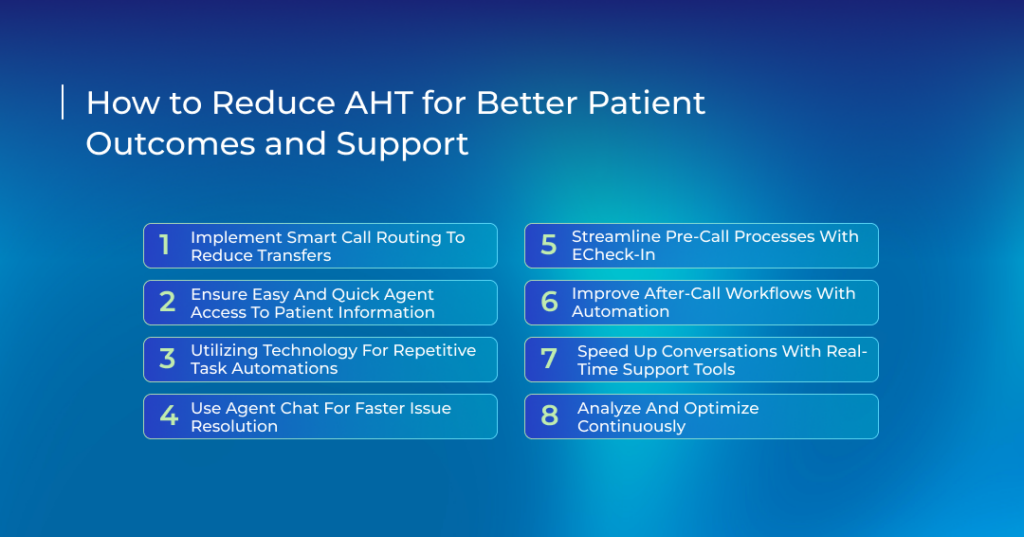
1. Implement Smart Call Routing to Reduce Transfers
Modern phone systems can route by department, visit type, insurance question, or prescription refill. A patient calling about billing goes straight to the billing staff. Someone scheduling a follow-up connects with scheduling.
Skills-based routing takes this further by matching calls to staff expertise. Your most experienced scheduler should always handle complex multi-appointment requests. New staff should get simpler appointment bookings while they learn.
The fewer times a patient explains their situation, the faster the call resolves. Set up your system to capture the call reason upfront through IVR prompts, then route accordingly.
2. Ensure Easy and Quick Agent Access to Patient Information
Integration matters. When your phone system connects to your EHR, patient records appear automatically when calls come in. Staff see appointment history, last visit notes, outstanding balances, and insurance details before saying hello. Your team doesn’t need to ask patients to repeat information already in the system.
CRM integration adds another layer. Notes from previous calls appear immediately. If a patient called yesterday about rescheduling, today’s agent sees that context and picks up where the last conversation ended.
Single sign-on eliminates the password shuffle. Staff log in once and access everything they need without typing credentials into four different systems. Those 15 seconds per login add up across hundreds of daily calls.
3. Utilizing Technology For Repetitive Task Automations
Why make your employees waste time on mundane tasks when you can get them done for you by automation? Have your system send automatic reminders to patients at varying time intervals and you can reduce no-shows. Let your patients confirm or reschedule through automated messages instead of calling the office.
In a similar manner, post-visit surveys can be sent automatically after each clinic visit. The self-service portal can alert patients to available lab results.
Chatbots are excellent at handling basic questions outside business hours. Patients checking office hours, confirming locations, or asking about accepted insurance can get instant answers.
The volume of incoming calls drops when patients get information through automated channels. This frees your staff to focus on more complex matters.
4. Use Agent Chat for Faster Issue Resolution
Live chat support handles multiple patients at once, something impossible with phone calls. One staff member can manage 3-4 chat conversations simultaneously while still providing personal attention to each patient.
Simple requests work perfectly through chat. Appointment confirmations, address updates, referral requests, and general questions can be resolved quickly through typing. Your staff can easily copy-paste frequently used responses, send links to patient portal resources, and share forms without verbal explanation.
Patients get to message whenever convenient instead of calling during limited phone hours. This also reduces your call volumes.
Track chat response times separately from phone AHT. Good chat teams respond within 2-3 minutes on average, with concurrent conversations keeping individual wait times low.
5. Streamline Pre-Call Processes with eCheck-In
Patients arriving for appointments generate a flood of verification calls. Is insurance still active? Has the address changed? Is the card on file still valid? Digital check-in completes these tasks before patients walk through the door.
Send check-in links a day or two before appointments. Patients can then update their insurance information, complete intake forms, and handle copay payments at their own convenience. This means they arrive fully prepared and your staff can complete their verification processes within seconds.
Automated systems run insurance checks when patients complete eCheck-ins. The system confirms coverage and flags issues before the appointment. Your front desk can then call patients with coverage problems days in advance, giving time to resolve issues without delaying care.
Hence, patients know what to expect. That reduces the chance of billing disputes and ensures you get paid on time.
6. Improve After-Call Workflows With Automation
After-call work extends AHT beyond the conversation itself. Staff document calls, update records, send follow-up emails, schedule callbacks, process requests, etc. Automation handles these repetitive parts.
Call documentation templates speed up note-taking. Staff select from dropdown menus and checkboxes for common call types instead of typing everything from scratch. The system auto-generates summaries using standardized language that satisfies compliance requirements.
Automated appointment confirmations are sent immediately when they enter the calendar. There’s no need to manually email or text patients.
Referral workflows trigger automatically. Staff can click a button during a call and the system generates the referral request, attaches necessary records, and routes it to the appropriate specialist office.
Also, if a patient needs a callback in three days, the system creates the task and adds it to the appropriate staff queue. This eliminates manual calendar entries or sticky notes that might get lost.
Make sure to track after-call work AHTs separately. If staff consistently spend more than 30 seconds wrapping up calls, see why. Often, it’s manual steps that could be automated or poorly designed documentation requirements.
7. Speed Up Conversations with Real-Time Support Tools
Real-time assist tools provide information exactly when needed without putting patients on hold.
Knowledge bases with instant search let staff find answers mid-conversation. Response templates standardize common explanations with the click of a button. Real-time alerts flag important information during calls to enable proactive support.
Furthermore, AI suggestions analyze call content and recommend relevant knowledge base articles or next steps. The system predicts what information staff might need during a live call and brings it up automatically to significantly reduce your average handling time.
8. Analyze and Optimize Continuously
Track your AHT by call type, staff member, time of day, and department. Breaking them down reveals patterns that let you push targeted improvements.
Call recordings reveal inefficiencies. Listen to long calls and identify where time gets wasted. Do staff put patients on hold repeatedly? Are they searching for information? Do certain questions consistently stump the team? Each discovery creates an improvement opportunity.
Identify bottlenecks through data analysis. If insurance verification calls run long, investigate why. Is the insurance portal slow? Do staff lack training on specific payers?
Compare high and low performers. What do your most efficient staff members do differently? Document their techniques and share them through training.
Set realistic targets by call type. Appointment scheduling should take less time than complex insurance questions. Benchmark each category separately and track progress.
Review metrics monthly with the team. Share progress, discuss challenges, and gather input on what would help them work faster. Staff on the phones every day often have the best ideas for process improvements.
How to Measure AHT?
The standard formula has three components. “Talk Time” is the actual conversation your agent has with the patient. “Hold Time” is the waiting period during the call, and “After-Call Work” or ACW is the time spent on documentation, follow-ups, etc, after the call.
Take the sum of these three elements across all interactions, then divide by total call volume.
If your team logs 500 minutes of talk time, 150 minutes of hold, and 100 minutes of ACW across 100 calls, your AHT is 7.5 minutes.
AHT alone doesn’t tell the full story though. Track it alongside your FCR to see if faster calls actually solve problems. Compare it with Patient Satisfaction Scores to confirm speed isn’t compromising care quality. Lower average handle time becomes meaningful only when these metrics move together in the right direction.
How to Reduce AHT for Email and Live Chat Support
The same principles that lower AHT for phone calls apply to email and chat, but with a few adjustments.
For email, your AHT is the time between the first question and final response, plus follow-up actions. Long drafts, repeated clarifications, and manual lookups extend handling time. The trick is to have pre-built templates for common questions. Customize them quickly for each patient on the spot so that your responses don’t appear generic.
For live chat, count active chat time and post-chat notes to know your average handling time. Multiple tabs, delayed replies, and repeated identity checks add friction. Make sure that your agents have quick access to patient records and standardized responses ready.
Both email and chat need clear escalation paths so agents know when to move complex cases to phone support instead of dragging out written exchanges.
The key difference: written channels let you review past interactions faster, so use that advantage to spot patterns in what slows agents down and fix those bottlenecks first.
Reduce AHT and Deliver a Better Patient Experience With Televox
Televox helps healthcare teams lower their handling times without sacrificing the quality of patient interactions. We know that lower AHTs start with delivering the right tools to your agents and automating their routine tasks, allowing them to focus on conversations that require human attention.
Engage is our conversational AI solution that deploys virtual agents to handle your appointment scheduling, prescription refills, and common questions across phone, SMS, and chat 24/7. Patients get instant answers without waiting on hold.
The system uses speech-to-speech AI that understands tone and intent, so conversations feel natural instead of robotic. When patients need human help, Engage routes them to the right person with full context already in hand. Your agents spend less time gathering information and more time solving problems.
Insights360 takes things further by tracking the entire patient journey from first contact through every transfer and handoff. It shows you exactly where time gets wasted so you can fix those specific bottlenecks.
Together, these tools do more than just reduce AHT. We provide everything your team needs to create a smoother experience for patients while giving staff space to focus on complex cases that require their expertise.
Schedule a demo to see how Televox can work for your healthcare organization.
Related Posts