Dental patient communication has moved well beyond appointment reminders. Large practices and hospital-based dental teams…

HIPAA & AI: Best Practices for Compliance and Security
Healthcare runs on trust and that trust depends on compliance. HIPAA defines how patient data can be used, protected, and shared, making the stakes high when those rules aren’t followed.
AI adds a new layer of complexity. It moves fast, relies on large datasets, and involves third-party vendors, all of which make AI and HIPAA compliance harder to manage than general healthcare software.
This blog breaks down the best ways for providers to protect patient data, meet regulatory requirements, and deploy AI without creating new security or compliance risks.
Understanding HIPAA Requirements for AI
HIPAA’s privacy rule states that AI systems should only access PHI for pre-approved purposes like treatment, payment, or operations. Even then, you can only feed data that’s required for each specific task. Nothing more. Nothing less. You cannot use patient data to train your AI models. That requires authorization from every patient at scale.
Next up is HIPAA’s security rule that requires you to protect PHI from unauthorized eyes. This applies to every AI tool that handles data. You need encryption protocols, storage protection, access controls, and regular risk assessments.
Finally, you have breach notifications when something goes wrong. Patients whose data has been leaked must be notified within 60 days. BAAs matter here because they legally require AI vendors to report incidents quickly so providers can meet HIPAA deadlines.
Key Risks and Compliance Challenges of Using AI in Healthcare
You can’t just add and forget AI systems. Each tool poses new challenges that need to be addressed from day one.
- Many vendors offer AI solutions that aren’t exactly built for healthcare. Failing to verify compliance puts you at risk of leaving patient information unprotected.
- Transparency is another challenge. Many AI tools make it difficult to understand how data was handled or how the system came to a particular solution.
- The transparency issue often branches into bias. Low-quality training data makes your AI treat specific patient groups differently.
- Then there’s shadow AI use. When employees turn to consumer tools like ChatGPT without approval, they sidestep internal controls and may expose PHI to platforms that don’t offer Business Associate Agreements at all.
- AI demands large datasets but HIPAA requires you to give your system limited data access. It’s a challenge for most providers to find a middle ground.
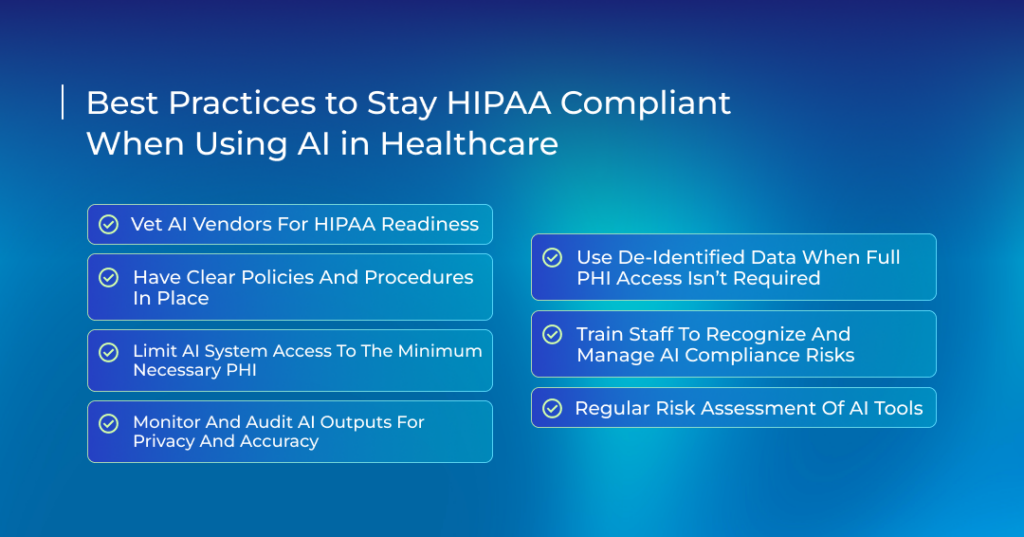
Best Practices to Stay HIPAA Compliant When Using AI in Healthcare
AI integration surfaces additional compliance requirements for the healthcare sector. The steps below form a working framework for AI and HIPAA compliance.
Vet AI Vendors for HIPAA Readiness
Any AI vendor that processes protected health information becomes a business associate under federal law. This requires a signed Business Associate Agreement before sharing any patient data.
The BAA establishes legal obligations. It defines how the vendor can use PHI, what security measures they must maintain, and breach notification procedures. Without this signed agreement, using the vendor’s AI tools with patient data violates regulations.
Some AI companies refuse to sign BAAs. OpenAI’s consumer ChatGPT product, for example, cannot be used with PHI because no BAA is available. Their API platform does offer BAAs for qualified healthcare organizations, but requires a case-by-case review process.
Confirm the vendor maintains similar agreements with their subcontractors. If your AI vendor uses cloud infrastructure from another provider, that chain of BAAs must be complete.
Have Clear Policies and Procedures in Place
Document how AI tools are going to be used in your healthcare environment. These policies need to clearly specify every aspect of use, for example, what types of patient data the AI can access and when. If you’re using RCS with an automated platform, your policy should clearly dictate that the AI cannot include any PHI in its rich messaging.
This also means that you need to include decision criteria for when AI can be used. Some situations may require human review before AI processes sensitive information. Other workflows might allow automated processing with periodic audits.
Make sure to assign ownership for system oversight, compliance monitoring, and incident response. Your staff should know who to contact if they spot compliance concerns. They need clear steps to report potential violations without delay.
Limit AI System Access to the Minimum Necessary PHI
HIPAA and AI implementations must follow the minimum necessary standard. Your AI tools should only access the patient data required for their specific function.
A scheduling assistant doesn’t need full medical histories. A diagnostic support tool might need imaging results but not billing information.
While many models work better with comprehensive datasets, compliance takes precedence. Work with vendors to identify the smallest data subset that maintains acceptable accuracy.
You also need role-based access controls. A physician might need the full context, while the administrative staff only needs scheduling data.
Importantly, document your justification when broader access is necessary. If an AI tool needs entire medical records to function properly, it should maintain records explaining why more limited data proved insufficient.
Technical controls help enforce these limits. Configure APIs to filter fields, mask sensitive values, or truncate records before the AI processes them.
Monitor and Audit AI Outputs for Privacy and Accuracy
Regular review catches problems before they become violations. This starts with data logs to see who accessed what data and what the AI did with it. This also helps prove compliance during audits.
Most modern healthcare organizations review AI-generated workflow samples weekly or monthly to check for accuracy issues or inappropriate PHI handling. It also helps check for bias. If your AI was trained on low-quality data, it can start treating some patients differently from others without anyone noticing.
That’s why monitoring matters. Set up automated alerts to flag issues, like a sudden spike in data access, repeated failed login attempts, or AI responses that hit sensitivity filters.
Use De-Identified Data When Full PHI Access Isn’t Required
De-identification removes HIPAA protections, allowing broader AI use without compliance restrictions. Two methods meet federal standards: Safe Harbor and Expert Determination.
Safe Harbor is the more straightforward option. It requires stripping out 18 specific identifiers (names, addresses, dates, and phone numbers, etc) so the data can’t be traced back to an individual. This method provides clear guidelines but may limit data usefulness for some AI applications.
Expert Determination uses statistical analysis to confirm re-identification risk falls below acceptable thresholds. This allows retaining more data points but requires qualified expertise to perform and document.
Consider de-identification for AI training data. If you’re developing or improving models, training on de-identified datasets avoids compliance complexity while building useful capabilities.
Make sure to guard against re-identification risks. When combining multiple de-identified datasets, the aggregate information might allow patient identification even if individual sources don’t.
Don’t assume de-identification equals no risk. If your organization could reasonably re-identify individuals using other available information, HIPAA protections may still apply.
Train Staff to Recognize and Manage AI Compliance Risks
Your staff needs to know the difference between HIPAA-compliant AI tools and consumer AI products. Many employees use ChatGPT or similar tools at home and might not realize that these can’t be used with patient information at work.
Include real scenarios in training. Show what appropriate AI use looks like and demonstrate common violations. Use examples specific to your organization’s workflows.
Reference guides are extremely helpful here. Paste them around the office so your staff can quickly double-check to confirm which tools are approved and who to contact if they’re unsure or spot a potential issue.
Regular Risk Assessment of AI Tools
It cannot be stressed enough that AI systems need to be part of a healthcare organization’s risk assessment the day they are implemented.
Assess how AI handles PHI across its lifecycle. This means starting from the input source and tracking the data through processing, output, and storage. Identify where vulnerabilities might exist at each stage.
Since AI is meant to evolve with time, your risk team also needs to consider new changes made to any models. Your vendor might update the algorithm or an internal workflow might add a new automation step. Each change needs to be thoroughly assessed to confirm there are no new compliance issues in the making.
Check integration points. When AI systems connect to electronic health records, billing systems, or other applications, those interfaces create potential exposure points.
Test security measures. Verify encryption works correctly, audit logs capture required information, and backup procedures protect AI-processed data.
Lastly, maintain records showing what risks you identified, how you addressed them, and what ongoing monitoring you perform.
Misconceptions About AI and HIPAA Compliance
It’s common for healthcare organizations to believe that AI tools are automatically compliant if the vendor claims they are. They put the burden of responsibility on the vendor. HIPAA doesn’t see it this way. Its rules clearly state that both the vendor and provider are equally responsible.
This also paves the way to another misconception: if an AI tool is HIPAA-compliant, it can be used however you want. True HIPAA compliance actually depends on both the vendor’s capabilities and how your organization implements the tool. A vendor may provide the right security controls, but a poor configuration on your end can still leave patient data exposed.
Some organizations believe internal AI development avoids vendor requirements. If you build AI systems that process PHI, your organization must implement the same security measures required of external vendors.
The “black box” nature of AI leads some to think compliance verification is impossible. While AI decision-making may lack transparency, organizations can still audit inputs, outputs, access logs, and data handling procedures.
Several assume that consumer AI tools become compliant through organizational policies alone. No policy makes ChatGPT or similar public tools acceptable for PHI. These platforms don’t offer the required safeguards regardless of internal rules.
Finally, there’s confusion about whether HIPAA changes for AI. The regulations remain the same, but AI introduces new technical challenges in meeting existing requirements. Organizations must adapt traditional safeguards to AI-specific risks.
Partnering With AI Vendors That Prioritize Compliance and Security
The difference between staying compliant and facing millions of dollars in fines is a thorough vetting of your AI vendors. Accepting their claims at face value is usually how healthcare organizations inherit security vulnerabilities and compliance gaps that they only come to know about after a quarterly or yearly audit. By then, the damage is already done.
The right AI partner is ready to sign BAAs. They’ll not hesitate to show how their systems encrypt information during transit and storage. Their demo will focus more on HIPAA-compliant features like audit logs and automated alerts instead of flashy features that look impressive but introduce unnecessary risk.
Support equally matters. AI vendors for healthcare have specialist teams who understand medical terminology and clinical workflows. They’ll help configure your systems to make them compliant from day one. If a vendor hesitates on any of these points, walk away.
Televox’s Approach to HIPAA-Compliant AI for Patient Engagement
Televox was built primarily for healthcare, which means we treat compliance as a foundation, not as an optional add-on. Every AI interaction is designed to meet HIPAA requirements while still making patient communication faster, clearer, and more reliable.
Televox’s Engage is a next-generation conversational AI solution that operates under signed Business Associate Agreements and supports secure, bi-directional communication across voice, chat, and SMS.
Your patients can initiate conversations with our virtual agents to ask questions, request refills, manage billing, or complete other routine tasks, while you maintain full control over how PHI is accessed and used.
All patient data is protected through encryption in transit and at rest, strict access controls, and detailed audit logs that record every interaction.
Every AI workflow is intentionally scoped to use only the data needed for a given task, reinforcing HIPAA’s minimum necessary standard while still delivering timely, personalized responses.
The result is more than automation. Engage becomes part of a broader communication engine that supports adherence, reduces no-shows, improves access, and eases staff workload without compromising patient trust or compliance.
Schedule a demo to see how Televox delivers HIPAA-compliant AI patient engagement in practice.
Related Posts