Dental patient communication has moved well beyond appointment reminders. Large practices and hospital-based dental teams…

How to Improve Patient Experience in Healthcare: Strategies That Work
Patient experience covers every interaction someone has with your healthcare system. It’s not just about patient satisfaction surveys. They only play a small role here. Patient experience is the sum of how patients feel heard, respected, and cared for during their entire journey.
The gap between knowing this and actually fixing it is where most providers get stuck. They understand patient experience drives outcomes and revenue, but struggle to translate that into daily practice.
This guide focuses on ways to improve patient experience that work in real settings. You’ll find practical strategies that you can implement with your current team and resources to create a better patient experience starting now.
Importance of Patient Experience Backed by Data
The numbers tell a straightforward story. Patient experiences directly affect clinical outcomes. They also influence revenue and patient loyalty.
- 49% of patients say a positive patient experience directly affects their health outcomes. It changes how seriously they take their treatment plans and whether they follow through on care.
- Happier staff affects patient satisfaction. Hospitals with highly engaged staff are 3 times more likely to achieve top patient experience scores.
- HCAHPS scores control 25% of Medicare payments under the Value-Based Purchasing Program. Patient satisfaction is now a direct line to revenue and financial survival.
- 60-70% of patients return to providers who deliver quality care, but 30-40% leave after negative experiences. One bad encounter can end a relationship that took years to build.
- Poor medication adherence costs the U.S. healthcare system $100-$300 billion annually in avoidable hospitalizations and emergency visits. Closing medication gaps helps avoid those acute episodes and saves an average of $167 per member annually.
Where Patient Experience Breaks Down in Healthcare
Scheduling frustrations start the problems. Many providers still rely on phone scheduling during business hours when most people are at work. They also offer limited appointment slots that often follow long hold times.
That frustration builds up when patients actually visit their provider. They arrive on time but have to sit in crowded rooms. The front desk doesn’t apologize but can point out incomplete paperwork, which means patients have to either wait longer or return another day.
Communication gaps create confusion at every stage. Patients hear complex medical terminology or receive test results without any context. They return home without any understanding of their next steps.
Insurance and billing processes further add to the confusion. Patients receive surprise bills months after visits. Benefits forms read like legal documents. The front desk can’t answer basic coverage questions because systems don’t communicate with each other.
These broken moments require patients to repeat information unnecessarily. The intake form asks for medication lists. The nurse asks again. The doctor asks a third time. Each repetition signals disorganization and wastes everyone’s time.
Staff burnout is evident throughout the entire patient journey. Providers rush through appointments and give short responses. Patients notice this and lose trust in the provider even when their outcomes are good.
Poor implementation of tools meant to improve patient experience in healthcare sometimes makes things worse. Patient portals confuse older adults, while automated reminders go to wrong numbers.
Effective Ways to Improve Patient Experience in Healthcare
You lose trust the moment patients have a poor healthcare experience. They start looking into other providers and often end up delaying their care. A positive experience does the opposite. It gives patients the confidence to follow their care plan and keep returning.
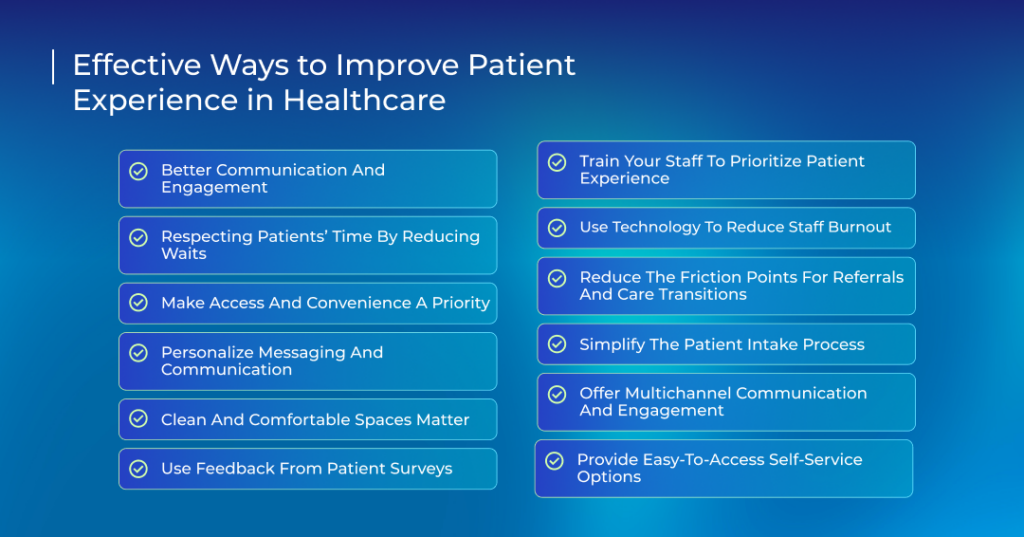
Better Communication and Engagement
The path to better patient experiences starts with plain language. Avoid using complex medical terms during appointments and ask patients to repeat instructions back to you in their own words. This “teach-back” method catches misunderstandings because they cause problems.
But communication challenges don’t end at the exam room door. They appear at every touchpoint of the patient journey. Hence, healthcare organizations need consistent, clear communication across every channel.
Send a text to confirm appointments. Call after procedures to check on recovery. Provide clear discharge instructions with numbers to call in case of questions.
Two-way communication channels are especially helpful here. They let patients reach their providers without having to call the office. Patients can message a new symptom or ask to clarify dosage instructions, and receive timely responses from their providers to keep them on track.
Respecting Patients’ Time by Reducing Waits
Every minute a patient spends on hold tells them that you don’t value their time. Packed waiting rooms and delayed test results create a similar level of frustration and anxiety.
Start by confirming where bottlenecks happen. Then address the root causes instead of just apologizing for delays.
Use online schedulers to let patients manage their bookings without calling anyone. Integrate digital check-ins to let patients fill out paperwork from home. Send automated texts when test results are ready. Include secure links for billings. These steps show respect for patient time and contribute significantly to a positive patient experience.
Make Access and Convenience a Priority
The ease of getting care shapes a patient’s opinion about your organization before the first visit even happens. Someone who managed to book an appointment after three phone calls will probably look into competitors who don’t have those same barriers.
Hence, give your patients control over how they want to access care. Let them schedule appointments on their own time through online schedulers. Extend your hours to accommodate working patients. Early morning and weekend slots often capture patients who would otherwise delay care.
Accommodate patients who have to travel a long way for each visit. Remote consultations save them travel time and costs while keeping them engaged at every step. You also free up your office space for visits.
Additionally, make it easy to reach the right person. Patients still have to call your office now and then. But don’t greet them with confusing phone trees. Use smart routing systems or offer text messaging for quick questions that don’t require a full appointment.
Personalize Messaging and Communication
The problem with generic communication is that it often gets ignored. Patients respond better to messages that speak to their specific situation.
Start by grouping patients by condition. Then consider their language preference and risk level. A diabetic patient needs different wellness tips than a patient managing hypertension. Patients who prefer Spanish should receive messages in their language. High-risk patients benefit from more frequent messaging than those who are stable.
Track your patients’ preferences as well. Patients who prefer phone calls for confirmations shouldn’t be sent a text. Those who prefer texts should receive messages that include key details. “Your A1C test is due next Monday” works better than “You have an appointment next week.” This attention to individual needs shows that you value your patients and don’t see them as numbers in the system.
Clean and Comfortable Spaces Matter
Your physical office speaks before your staff does. Cluttered waiting rooms and dirty restrooms create a highly negative impression. Patients notice overflowing trash cans and dusty sitting areas. These details suggest you don’t care about their comfort or safety.
Small changes lift that experience. Provide comfortable seating and clean environments. Clear signage reduces anxiety about finding the right location. Patients also appreciate charging stations for their mobiles and complimentary water dispensers.
Use Feedback From Patient Surveys
Most healthcare organizations collect feedback, but few use it effectively. Have automated loops that send and track surveys after every interaction. This saves time and allows patients to share their experience at every touchpoint.
Feedback helps you identify friction points. Multiple complaints about long wait times or a specific department let you get to the root of the problem. Quick fixes show patients that their opinions are valued.
It’s also equally important to share feedback with your teams. Positive comments improve morale while negative ones show them areas for improvement.
Train Your Staff to Prioritize Patient Experience
Great patient experiences aren’t built on clinical expertise alone. They’re shaped by how your staff show up when patients feel anxious or confused. That starts with listening patiently and letting patients know their concerns are being taken seriously.
Most providers simulate real scenarios during workshops to help staff build confidence for tough conversations. It also prepares them for de-escalation. A front desk that knows how to respond calmly and compassionately can turn negative situations around to retain patients.
Use Technology to Reduce Staff Burnout
Staff who are burned out can’t deliver great patient experiences. Overwhelmed teams simply don’t have the patience or energy to give to patients.
Automation helps free them by handling their repetitive tasks. This includes appointment reminders and routine patient communications. Your staff can instead focus on complex cases that require their human specialities.
Better workflows reduce frustration as well because your staff doesn’t have to chase after information or populate the same forms twice in separate systems. Remember that technology isn’t about replacing employees. It’s used to empower your teams to perform better.
Reduce the Friction Points For Referrals and Care Transitions
Patients feel lost when they don’t know what happens next after a referral. They chase information themselves because providers don’t communicate with each other. Hence, create clear referral workflows to make their next steps easier. Tell patients exactly what to expect after referring them to a specialist.
Additionally, ensure smooth transitions. Patients shouldn’t have to repeat their entire medical history at each stop. Their information should flow with them when they move from hospital to home care or from primary care to specialty care.
Simplify the Patient Intake Process
Filling out forms is the quickest way to frustrate patients before they even see a provider. Repeatedly asking for the same information and making them wait in long queues suggests disorganization.
Digital intake allows patients to complete their paperwork at home. They can enter information at their own pace without any pressure. They can also verify their insurance coverage to make sure they arrive fully prepared. This speeds up check-in and reduces errors from illegible handwriting.
That said, digital intakes only work best when they’re integrated with your systems. This way, any information that patients provide is automatically updated in your connected systems. Your staff doesn’t have to manually re-enter the same data in your EHR, for example. This simplification is key to improving patient experience in healthcare.
Offer Multichannel Communication and Engagement
Every patient prefers to be contacted differently. Some want phone calls while others want text messages. Many expect digital outreach that includes a patient portal. Respect those preferences and let patients choose how they receive appointment reminders or updates.
Multichannel communication also ensures consistency. Context is carried forward to prevent agents from asking the same questions that the last one did. Your staff gets complete visibility into the full communication history regardless of channel. This ensures faster resolutions and reduced wait times.
Provide Easy-to-Access Self-Service Options
Not every interaction needs staff involvement. Patients can handle routine tasks themselves if you give them the right tools. They actually prefer to solve their own problems.
Self-service portals allow patients to perform a lot of tasks that would normally require them to call the office. They can manage their appointments and pay bills. The portal shows them their complete medical history and lets them download test results. Patients can also message their providers to ask about new symptoms or dosages. These capabilities give patients control over simple tasks on their own schedule.
However, always have a clear path to reach a real person. Highlight CTA buttons that patients can tap to talk to a human agent. Convenience through self-service is fundamental to better patient experience, but it can’t come at the cost of inaccessible support when patients truly need human help.
How Technology and AI Help Enhance Patient Experiences
Technology isn’t meant to replace your staff. It removes obstacles in the path, so that providers can spend time on actual patient care.
- Automated appointment reminders reduce no-show rates. The system automatically sends texts that patients are likely to read. The reminder itself takes seconds, but the impact shows up in continuity of care.
- AI triage tools like chatbots help route patients to the right team for faster care. Patients don’t have to call back after bouncing around different departments. Hence, your staff shift from answering basic questions to handling complex cases.
- Clinical documentation tools that summarize patient visits free up minutes during each appointment. Those minutes add up. A physician who spends less time typing can listen fully and explain treatment options without rushing. The way to improve patient experience often starts with giving providers time to be present.
- EHRs connect everyone involved in a patient’s care. They don’t have to chase information or ask the same questions. This coordination makes care feel organized rather than fragmented.
- Patient portals put information in patients’ hands. They can check test results at midnight instead of waiting for a callback. They can message their provider with a quick question and get a response within hours. Access feels immediate because it is.
These tools work best when they fade into the background. Patients notice shorter wait times and clearer communication. But they don’t necessarily know an AI system routed their insurance query or that automation scheduled their appointment. They just leave satisfied with a better patient experience in healthcare.
How to Measure and Sustain Improvements in Patient Experience
Improving patient experience requires knowing where you stand and tracking what changes.
- HCAHPS surveys remain the standard for hospital settings. They measure communication with doctors and nurses, cleanliness and discharge instructions. These scores directly affect reimbursement under VBA programs.
- Net Promoter Score asks one simple question: “Would you recommend this practice to friends or family?” The answer reveals loyalty. Patients who wouldn’t recommend you won’t return either.
- Surveys sent within 48 hours capture immediate reactions. Any frustrating or positive interactions are still fresh. This feedback catches issues before they become patterns.
- Patient comment cards in waiting rooms seem old-fashioned but they work. Some patients prefer writing concerns anonymously rather than responding to digital surveys.
- Keep an eye on operational metrics alongside patient satisfaction scores. Link satisfaction results to wait times, appointment availability, and staff-to-patient ratios. When scores dip as wait times rise, you’ve identified a factor you can adjust.
- Close the loop with patients who report problems. A call from a manager after a complaint shows accountability. Many patients who had negative patient experiences become advocates after seeing their concerns addressed.
How Televox Helps Improve Patient Experience Across the Care Journey
Great patient experiences don’t happen by accident. They come from clear communication that makes patients feel heard and understood. Televox puts that kind of experience within reach by helping you connect with patients in ways that actually matter. We offer tools that strengthen the way patients perceive your care and support your team’s ability to deliver it.
You start with Engage, our conversational AI solution. Its intelligent virtual assistants deliver natural, human-like responses 24/7 without any manual oversight. They let patients manage their appointments, request refills, and find answers without waiting on hold or navigating complex phone menus.
Digital check-ins make the experience even smoother by allowing patients to complete intake forms and routine tasks online before their visit. This reduces frustration and frees your staff to focus on care that requires personal attention.
Insights360 and Journey Insights combine to give you usable analytics. They show you a complete view of how patients move through your communication touch points and where you can make smarter changes. Your team immediately knows where automation is failing or where live agents are struggling.
A live look at these capabilities makes their impact easy to understand. Schedule a demo and we’ll walk you through how Televox supports patient experience in real healthcare settings.
Related Posts