Dental patient communication has moved well beyond appointment reminders. Large practices and hospital-based dental teams…
Real-Time Insurance Verification: A Critical Step in Modern Healthcare
Insurance verification is one of the first steps in a patient’s journey. Healthcare organizations have to confirm payment plans and what services are covered. However, many of them still rely on manual workflows that are slow and often lead to delayed payments or billing disputes.
Real-time insurance verification changes that dynamic. It allows your front desk to confirm a patient’s healthcare coverage on the spot. This reduces administrative rework, prevents avoidable denials, and sets clearer expectations for patients upfront. More importantly, it creates a steadier financial flow and fewer operational disruptions.
The Problem With Outdated Insurance Eligibility Verification in Healthcare
The manual approach to verifying insurance eligibility drains a lot of resources. Your staff has to spend 10-15 minutes for each case, calling payers, navigating phone menus, and waiting on hold. For healthcare providers seeing over a hundred patients daily, those minutes add up to become hours that are being wasted every day.
The costs extend beyond labor. Your claims are more likely to be rejected when insurance details are outdated or incomplete. That results in extra administrative work for your staff. They have to track down the issue and resubmit the claim, which means delayed payments or revenue lost to write-offs.
Then there’s the tool problem. Most healthcare providers use two or more systems just to gather patient information for a single claim. This slows down registration and increases the chance of errors.
Patients feel the impact too. They arrive expecting their insurance to cover services, only to discover mid-visit that their coverage lapsed or changed. This creates billing confusion and erodes trust.
It also often happens that patients have a limited understanding of their coverage. They expect the staff to help them out, which adds more work to their plate.
The way eligibility is handled today isn’t built for modern care. Providers need quicker, more accurate insurance checks that reduce denials, streamline registration, and set clear expectations for patients before they walk in.
Key Benefits of Real-Time Insurance Eligibility Verification for Healthcare Providers
Instead of manual calls and fragmented systems, automated tools connect directly to payer databases and return results in seconds. The impact shows up in several ways.
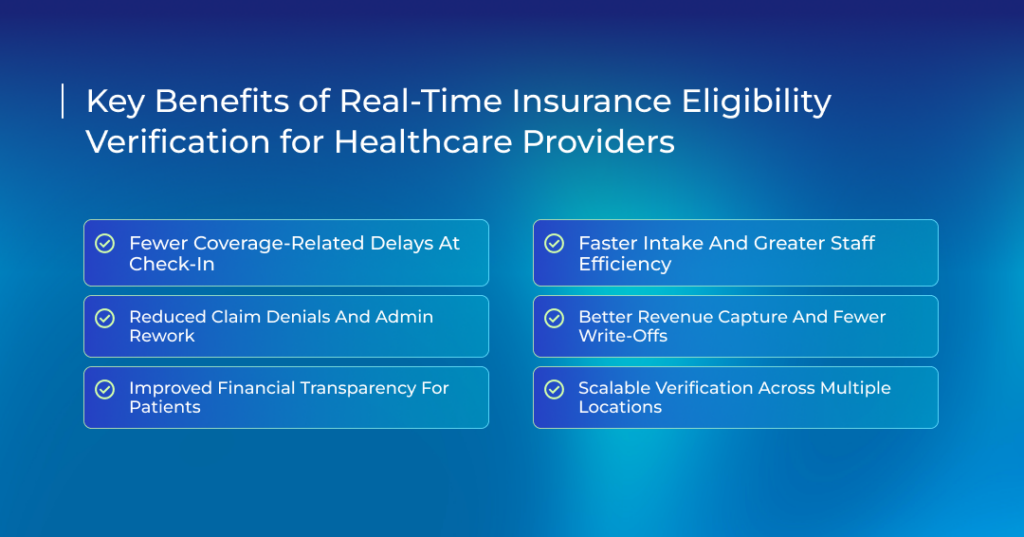
Fewer Coverage-Related Delays at Check-In
Automated eligibility checks ensure that a patient’s health insurance coverage is verified before the appointment. It doesn’t require any manual oversight. Your staff gets to know within seconds whether a patient’s insurance is valid, what services it covers, and whether there’s a need for authorization. This eliminates the wait time that patients usually experience during check-ins.
The system also catches issues early. You learn about a patient’s lapsed or changed coverage before the visit, not after services are rendered. This gives your team time to work with the patient on payment arrangements or reschedule if needed.
Reduced Claim Denials and Admin Rework
Automated verification ensures that every claim goes out with accurate information the first time. Since your staff isn’t stuck manually cross-referencing and typing information, the chances of entering the incorrect payer ID or policy number are pretty low.
If there are any issues, they are caught before claims go out. This not only lowers the rejection rate but also reduces the administrative burden on your team that has to investigate the reason for rejection, correct the error, and resubmit.
Improved Financial Transparency for Patients
The majority of patients expect your front desk to quote accurate pricing upfront to help them prepare. This makes real-time insurance eligibility checks all the more important. It allows your staff to clearly explain the patient’s deductible, copay, and coverage limits in advance.
This transparency makes it more likely that patients pay on time. It also reduces the chance of disputes while improving trust in your healthcare brand.
Faster Intake and Greater Staff Efficiency
Your staff stops burning themselves out with automated insurance verification and eligibility tools. They click a button and get instant results.
What does your team do with that recovered time? They greet patients. They handle scheduling. They take care of tasks that actually need a human touch. Hence, patients move through registration faster, wait times drop, and staff go home less exhausted.
When the system connects to your electronic health records, it gets even simpler. Coverage details appear right in the patient’s chart. Staff see everything they need in one view without jumping between programs or typing the same information twice.
Better Revenue Capture and Fewer Write-Offs
Running an insurance eligibility check before the appointment tells you if you’re going to get paid. You’re not hoping the insurance comes through after you’ve already provided care.
Maybe their insurance lapsed, or their deductible is higher than they thought. Either way, you can work out a payment plan before they see the doctor, not weeks later when you’re trying to collect on an unpaid bill.
Automated systems also catch secondary insurance. If a patient has Medicare and a supplemental plan, the system flags both. You bill both payers and collect the full amount you’re owed. Without automation, that secondary coverage often goes unnoticed until it’s too late.
Scalable Verification Across Multiple Locations
If you run multiple clinics, you know the headache of inconsistent processes. One office does verification one way. Another location has a completely different system. Training new staff means teaching them a different process at each site.
Centralized, automated real-time insurance eligibility verification solves this. Every location uses the same platform, so patients get the same experience no matter which location they visit.
Training also becomes straightforward. New hires learn one system that works everywhere. When payer policies change or you update a workflow, the change goes live across all locations at once. Nobody gets left behind running an outdated process.
The fact is that manual verification can’t keep up when you’re seeing hundreds of patients across multiple sites each day. Automated tools handle thousands of checks daily without adding staff. Your practice can grow without drowning in administrative work.
What Real-Time Eligibility Verification Looks Like in Practice
We’re going to take a real-world scenario to show how automated systems streamline insurance verification for both patients and providers. Consider a patient named Rebecca who schedules an appointment with her cardiologist for next week.
The moment she books, the system runs an insurance eligibility check through its platform. Within seconds, staff confirm her coverage is active, identify her deductible status, and spot that her plan requires prior authorization for the planned procedure.
The front desk calls Rebecca that afternoon. They explain that her plan covers the visit, she’s met $800 of her $1,500 deductible, and she’ll need authorization before her procedure. Rebecca now knows exactly what to expect. She’ll not be surprised to see her bill weeks later.
On appointment day, Rebecca checks and the system runs another verification. This is because insurance details can change daily. Here, her coverage still checks out.
The front desk collects her copay. She sees the doctor, gets her procedure scheduled, and the authorization request goes out that same day.
This happens across dozens of patients every day. Your staff doesn’t need to waste time calling payers or logging into different portals. The system connects with hundreds of insurance providers through one interface to automatically confirm health insurance at scheduling, pre-registration, check-in, and before billing.
Streamlining Insurance Eligibility Checks Through AI & Automation
Smart automation reduces insurance checking processes to seconds. The system connects directly with payer databases through secure APIs. It queries hundreds of payers simultaneously to pull coverage details, benefit limits, copay amounts, and authorization requirements. Your staff has to enter the patient’s information only once to get all the data.
Eligibility and benefits verification now happens at multiple touchpoints. When patients book appointments online, systems verify coverage instantly. Pre-registration platforms check eligibility days before visits and send patients their estimated costs. At check-in, tablets run final verifications to catch any last-minute changes. Before billing, systems verify one more time. This constant verification catches problems early.
AI adds another layer. Machine learning identifies patterns in coverage changes and flags potential issues before they become denials. So, when a patient’s employer switches insurance providers mid-year, the system catches the discrepancy between old and new coverage information.
AI also learns which payers update eligibility information frequently and adjusts verification timing accordingly. Some insurance plans update nightly. Others refresh weekly. Smart systems adapt their verification schedules to match payer patterns, ensuring information stays current without excessive queries.
When verification shows coverage gaps, team members can immediately discuss payment options with patients. When authorizations are needed, staff submit requests while patients are still in the office.
Best Practices for Insurance Eligibility Verification Processes
Most providers know they need to verify insurance, but when and how they do it makes all the difference. Here’s what works.
- Check coverage when patients schedule, not when they walk through the door. This gives you days to fix problems instead of minutes.
- Run another check 24 hours before the appointment because insurance status changes constantly.
- Connect your verification software directly to your EHR and practice management system so information only gets entered once.
- Set up your system to automatically flag services that need prior authorization.
- Train your front desk to actually read the verification results. Knowing a patient has a $3,000 deductible matters when collecting payment.
- Keep notes on every verification in the patient chart with timestamps and staff initials. This helps during disputes.
- Watch which insurance companies take forever to respond and plan around their delays.
- Review your denial reports monthly to spot patterns. If one payer keeps denying a specific code, your verification process needs adjustment.
- Make sure your health insurance eligibility verification follows HIPAA rules with encrypted connections and limited staff access.
Ensuring Compliance for Insurance Eligibility Verification
Federal and state laws around patient billing have gotten stricter. Using automated systems helps providers stay compliant and avoid penalties from day one.
The No Surprises Act requires good-faith estimates for scheduled services. You can’t give patients accurate estimates without knowing what their insurance actually covers. When you run eligibility and benefits verification before creating those estimates, you’re using real data instead of guessing. If the verification shows a service isn’t covered, you document that conversation with the patient right away. The system timestamps everything automatically, which matters if a patient later disputes their bill.
HIPAA applies to every insurance eligibility check you run. Patient names, birth dates, insurance numbers, and procedure codes are all protected health information. Your verification system needs to encrypt data when talking to payers. Staff should only see verification results for patients they’re working with. The system should also log who checked what and when, which helps during audits.
State rules vary widely. California has rules that limit when providers can bill patients. Texas has specific balance billing restrictions after verification. Some states give you 30 days to bill after a denial, others give you 60. Insurance verification and eligibility software takes the guesswork out of these requirements. The system knows where your patient lives and which rules apply.
Real-time verification creates a paper trail showing you checked coverage, warned patients about costs, and followed the rules before treating anyone.
Televox’s Role in Improving Insurance Eligibility Verification for Healthcare Providers
Few things disrupt the patient experience faster than an insurance question that your front desk can’t answer on the spot. Every small delay quickly adds up to replace the patient’s confidence with confusion. That’s where Televox becomes part of the workflow, helping providers like you verify healthcare insurance in real time so every visit stays on track from the very first interaction.
Through digital intake tools like eCheck-in, we help you collect insurance details directly from patients, including photos of their insurance cards, as part of the intake process.
Eligibility checks are performed automatically, and verified information is synced back to your EHR, so your staff isn’t chasing missing details or re-entering data.
As patients complete forms, update demographics, pay copays, and verify insurance ahead of the visit, your office gains a clear view of who’s ready and who needs attention without juggling multiple systems.
We extend that experience with Televox Engage, our conversational AI agent that lets patients interact naturally while completing intake tasks and resolving basic questions tied to coverage or next steps. The result is fewer check-in delays, less manual work for your team, and more reliable insurance information before care is delivered.
Schedule a demo right now to see how Televox supports insurance eligibility verification within everyday patient workflows.
Related Posts