Dental patient communication has moved well beyond appointment reminders. Large practices and hospital-based dental teams…
How Digital Engagement Tools Improve Patient Experience for Healthcare Providers
Small communication gaps can have a sizable impact on how patients feel about their care. Healthcare providers are now judged more on how easy they are to communicate with from the very first interaction. Treatment quality will always matter but communication sets the tone for the entire patient journey. A missed message or unclear instruction early on often defines how the experience unfolds.
Digital engagement tools help providers meet those expectations. They improve how conversations are managed and delivered across channels. With AI integration, these same tools now help teams respond faster and guide patients more effectively without burning themselves out.
Let’s dive further into how modern engagement tools are improving patient experiences.
The Case for Digital Patient Engagement in Modern Healthcare
Healthcare patients today expect the same convenience they get from their banking apps and retail websites. They want to book appointments and pay bills from their phones. They want to text their doctor to confirm a potential symptom instead of waiting on hold.
The numbers back this up. 65% of patients were ready to switch providers in 2025 just for a better digital experience. This is because digital tools address every friction point patients face in traditional healthcare communication. They can reschedule the appointment at midnight if something comes up. Care continues from home as patients can text their doctors to confirm dosage routines. For providers, that means reduced administrative burden and missed appointments.
Better engagement means better outcomes. Patients who feel engaged in their care plan are more likely to follow it and return for future visits. That leads to fewer readmissions and stronger patient retention.
Healthcare providers who adopt patient engagement digital tools aren’t just meeting expectations. They’re solving operational problems that directly impact their bottom line.
Ways Digital Patient Engagement Tools Improve Patient Experience
Engagement tools cover more than easy scheduling. They give patients the confidence to follow through with their treatments. Technology is essentially a way for providers to give patients more control over their healthcare.
Providing Convenience With Ease of Access
Calling during office hours and resulting wait times often convince patients to skip scheduling appointments. Giving them a self-service tool means they can book visits on their own time. They can even check their test results and review their older records without any wait times. This removes barriers that lead to missed care or delayed decisions.
Providers who offer online scheduling see patients take action immediately rather than putting it off. It also builds trust and reduces the chance they’ll look elsewhere for care.
Reducing Pre-Visit Stress With Digital Intake and Clear Instructions
Patients are often stressed and anxious about their visit. Forcing them to waste time by filling out paperwork in the waiting room only adds to the problem.
Digital patient engagement starts before the actual visit. Patients can use intake tools to complete forms at home. They can review consent forms and receive preparation instructions.
This process reduces surprises. Patients arrive fully prepared. Your staff also spends less time checking them in. The visit itself focuses on care instead of admin tasks.
Keeping Patients on Track With Timely Reminders and Proactive Updates
Your patient engagement efforts don’t end after someone books an appointment. You still have to keep them updated about their upcoming visit. Text messages are excellent channels here to send timely reminders because patients already check their phones. They don’t have to download or log into an app.
However, appointment reminders do more than reduce no-shows. They’re also used to let patients confirm or reschedule without having to call the office. This reduces your admin burden while keeping your schedules full. Those last-minute cancellations hurt your healthcare revenue. Digital reminders make sure that doesn’t happen.
Addressing Patient Queries Faster With Two-Way Messaging
Patients always have questions between visits but that doesn’t have to result in another appointment. Two-way messaging tools let patients contact their provider without calling the office. They can post a question about a potential symptom or something in the test results.
Their providers can respond on their own schedule and even pose their own questions for further details. This ensures that a lack of communication doesn’t stop ongoing care plans.
Providing More Inclusive Care With Language and Accessibility Support
Modern providers rely on translation tools to give non-English speakers the same level of care. Patients can access online schedulers and receive reminders just like others but in their own language. It also enables your current staff to communicate with patients without having to hire local speakers.
Digital tools address accessibility challenges as well within the same context. Features like screen readers and simplified interfaces make care easier to navigate for patients with visual, hearing, or cognitive challenges.
One important shift in digital accessibility is letting patients set their own preferences. Patients shouldn’t have to hope or request that their provider communicate in Spanish or French. The healthcare app should have an option to set the right language or larger text or enable the option to automatically read messages.
Removing these accessibility barriers boosts engagement rates for healthcare organizations.
Delivering a Connected Experience Across the Full Care Journey
Digital engagement tools help you create a closed-loop experience where patients always know what’s next. They stay connected with their providers throughout the journey. This is important because care doesn’t end with the visit.
AI-powered patient engagement tools help track progress from pre-visit preparation all the way to follow-ups. Automated reminders go out for both appointments and medication. This continuity helps reduce gaps that lead to delayed treatments or missed follow-ups.
Digital Patient Engagement Tool Stack Healthcare Providers Need
Modern healthcare organizations need a complete set of digital tools for patient engagement to run efficiently. Here’s what belongs in your stack:
- Online Appointment Scheduling – easy appointment management from your phone. It frees your staff from endless phone calls and fills your calendar around the clock.
- Digital Check-In and Intake Forms – reduces wait times and feeds accurate data straight to your EHR. Patients arrive fully prepared so your staff sees reduced processing times.
- Two-Way Secure Messaging – patients can ask questions and get updates without calling the office. Your staff doesn’t have to field the same questions on calls all day long.
- Automated Appointment and Payment Reminders – helps improve cash flow by reminding patients about their next visit and what they owe.
- Online Payment Processing – patients pay their bills through a portal or mobile app with credit cards or payment plans.
- Patient Portal Access – a secure portal that gives patients 24/7 access to medical records and educational content.
- Analytics and Reporting – a single dashboard uses your incoming data to show what’s working and what’s not.
- Patient Survey Tools – automated feedback collection ensures you can spot service gaps without dedicating manual resources.
- Virtual Care – ideal for patients who can’t easily travel to your clinic. They’re particularly valuable for follow-ups and chronic disease management.
What Are the Benefits of Using the Right Patient Engagement Solutions?
Reducing your administrative burden is only the start. Digital engagement tools also drive measurable improvements in outcomes as well as your operational efficiency. They help providers keep their patients informed and involved throughout their care journey.
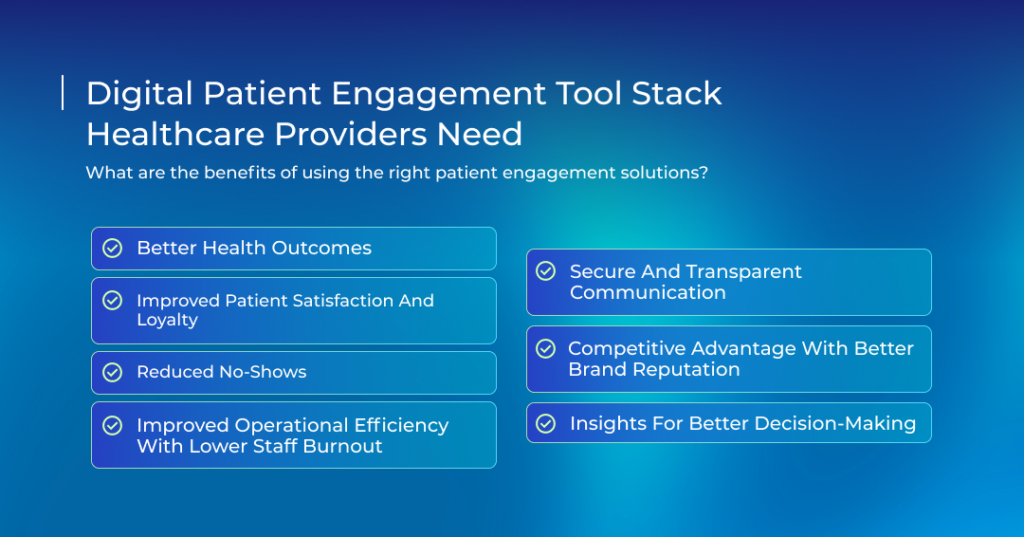
Better Health Outcomes
Timely communication plays a big role in helping patients stick to their care plans. Automated engagement tools make this possible without adding pressure on your staff. The system automatically sends hundreds of reminders and updates every single day.
You don’t need a manual team to flag overdue screenings and upcoming appointments. You only need the right tool to integrate with your patient records and communication systems.
Consistent engagement means no patient is left behind. They all receive timely care to ensure high adherence rates.
Improved Patient Satisfaction and Loyalty
Friction drives patients away. Someone reaching out under stress will not appreciate long wait times or confusing processes. Digital tools remove that frustration by giving patients control over their care. They deliver fast answers and consistent communication, which makes patients feel valued. They don’t feel like another number in the system.
Satisfied patients always return for future care and recommend their provider to others. You earn their loyalty by simply relying on technology to respect patients’ time and preferences.
Reduced No-Shows
It’s common for patients to forget their appointments. Their empty slots cost you both time and money. It also means someone else has to wait another week for their care. This cycle repeats across thousands of appointments every month.
Automated reminders put a stop to that disruptive pattern. The system sends multiple texts at different intervals before the visit. The patient also has the option to confirm or reschedule by simply replying.
Providers using these digital engagement tools see fewer missed appointments. This is because patients are more prone to rescheduling when they don’t have to call the office.
Improved Operational Efficiency With Lower Staff Burnout
Your front desk spends a large part of its day handling routine calls. Answering the same scheduling or insurance questions all day long burns them out. Modern healthcare organizations let digital tools handle such common tasks. This reduces call volume and frees your staff to focus on complex cases.
Just like patients, happier staff members become loyal and stay longer. You escape the perpetual cycle of hiring and training. Happier employees also become more productive. They have the energy and time to personalize their interactions, which feeds your customer satisfaction rates.
Secure and Transparent Communication
The right engagement solution meets HIPAA requirements. Every communication is encrypted to ensure sensitive patient information does not reach unauthorized eyes.
Engagement platforms also allow patients to choose their consent and messaging preferences. They know what data is being collected and how their provider is using it. The clarity here matters. A provider using complex legal terms or purposely hidden consent settings risks confusing patients and losing trust.
Competitive Advantage With Better Brand Reputation
Patients compare providers based on their experience. Someone who can easily schedule their appointments online or have their questions answered from home will always recommend your services to their friends and family.
Hence, convenient digital tools help providers stand out. A strong reputation attracts new patients and keeps current ones engaged. This is important because trust is vital in healthcare. Providers have an easier time engaging with existing patients than trying to prove their trust to regain those who have left.
Insights for Better Decision-Making
Digital analytics tools show you where your patients are dropping off or which workflows are creating the most friction. These patterns are difficult to spot manually but they are there in your daily operations.
What messages keep getting ignored? What’s causing the most delays? Patterns like these are highlighted by engagement platforms. Your teams review these patterns to adjust their workflows based on actual patient behavior.
Where AI Adds Value In Patient Engagement Workflows
AI isn’t a buzzword in digital patient engagement and health. It’s becoming a practical tool that solves specific workflow problems.
Smarter Message Routing
AI systems read patient messages and route them to the right department automatically. A billing question goes to billing while a clinical concern goes to nursing. This reduces delays from unnecessary handoffs. Importantly, your team handles fewer mundane tasks and focuses on complex patient needs.
Automated Waitlist Management
When someone cancels, AI automatically messages patients on a waitlist to offer cancelled appointment slots. Hence, schedules stay full without any manual effort. This also means that patients are always on a waitlist for their earliest possible appointment.
Predictive No-Show Prevention
AI analyzes patterns in your appointment data to predict which patients are likely to miss appointments. It triggers additional reminders or outreach to at-risk patients before they no-show. This targeted approach works better than blanket reminders sent to everyone.
Personalized Patient Communication
AI tailors all communication based on each patient’s preferences and past behavior. Someone who always opens texts in the morning gets reminded then instead of at night. A patient who ignores texts but clicks emails gets email reminders instead. This personalization improves response rates without creating manual work.
Real-Time Language Translation
AI translation tools break down language barriers in patient portals and messaging. Patients read instructions, view results, and communicate with your practice in their preferred language. This expands access without requiring multilingual staff.
Prescription Management
AI flags potential drug interactions and suggests formulary alternatives. It also automates routine refill requests that don’t require clinical review. This way, providers catch safety issues faster and handle prescriptions more efficiently.
How Televox Supports Better Patient Experience Across The Care Journey
Patients don’t just want care. They want clarity, easy access, and timely responses at every step of their journey. Televox helps providers like you meet those rising expectations by delivering a patient experience that feels connected from the very first touchpoint.
Engage puts patient communication on autopilot. Our conversational AI platform uses intelligent virtual agents (IVAs) to manage both inbound and outbound conversations across voice, SMS, RCS, and digital workflows. Patients can get answers, confirm appointments, or reschedule on their own time without navigating phone trees.
Our IVAs go further by supporting intake forms, insurance verification, and co-pay interactions. With 24/7 availability, patients experience less friction while your teams gain time to focus on care that truly requires a human touch.
Televox also offers Insights360, our analytics solution that turns every patient interaction into visibility you can act on. You actually see where engagement breaks down instead of guessing.
Missed opportunities? Recurring questions? Workflow bottlenecks that affect revenue? Insights360 gives you a complete picture to improve communication and adherence with confidence.
Schedule a demo if you’re ready to turn everyday patient conversations into better experiences.
Related Posts