Patient messaging plays a growing role in how pharmaceutical companies support patients after a prescription…
SMS Marketing in Healthcare: Use Cases & Benefits for Providers, Pharma, and Payers
SMS marketing in healthcare uses text messages to communicate with patients in a timely fashion. It spans two distinct use cases. You have transactional messages like appointment reminders and refill alerts. Then there are promotional messages like wellness campaigns and service awareness. Each case is governed by different rules and expectations.
With the right SMS solution, providers, pharmacies, and payers can stay compliant by default while turning text messaging into a reliable channel for engagement, efficiency, and measurable impact.
SMS as a Channel for Outreach and Communication With Patients
SMS marketing works best for providers because it doesn’t require apps, logins, or a strong internet connection. All it needs is a phone, which every patient already has. This is why text messages have the highest open and read rates among all channels.
SMS is also one of the few communication methods that works across all age groups. Most patients actually prefer a text for quick updates. They can send a simple “Yes” or “No” to confirm an appointment without disrupting their day.
The direct nature of SMS marketing benefits pharma and insurance payers as well. They can reach patients directly to send medication reminders, explain benefits, or help with program enrollment. A drug manufacturer can target specific populations with new treatments. An insurer can text members about preventive care covered in their plan.
This immediate outreach significantly helps in reducing no-shows and improving adherence rates, especially when using automation to send thousands of text messages in bulk. That’s automated SMS marketing that manual calling can’t match. Your system sends medication prompts at the exact time patients need to take their pills, appointment reminders at different intervals, and seasonal vaccination benefits at a massive scale.
Top Use Cases of SMS Marketing in Healthcare
Providers, pharmaceutical companies, and payers can use texts for more than appointment reminders. The channel supports patient acquisition, patient engagement, and long-term care relationships when applied to specific scenarios.
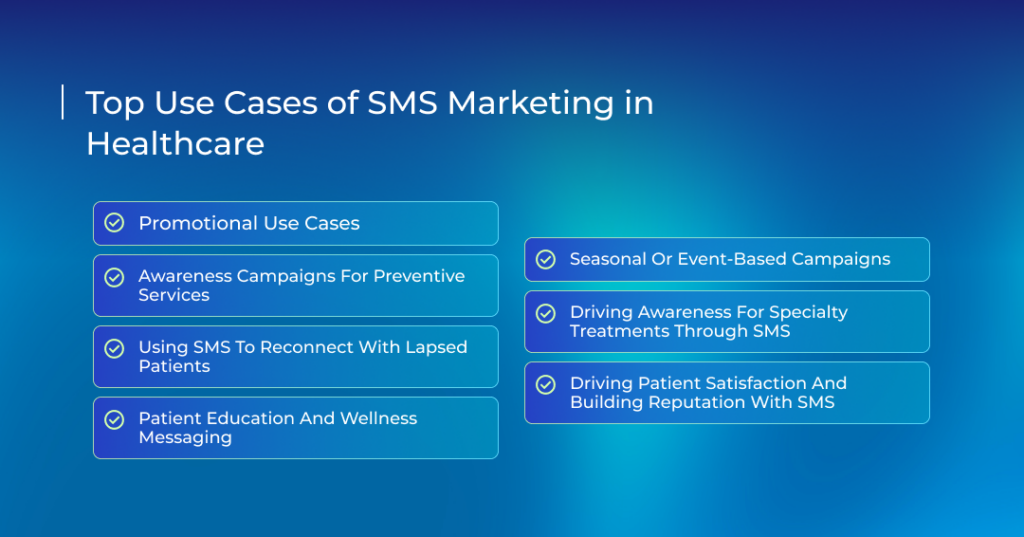
Promotional Use Cases
Healthcare providers acquire new patients through targeted SMS campaigns. You can text your existing database about new services, available appointment slots, or provider additions.
A family practice expanding to include a nutritionist can notify patients who previously expressed interest in weight management. A dental office might message patients due for their six-month cleaning. A dermatology practice can remind patients about annual skin cancer screenings.
Similarly, insurance companies can text members about preventive care that’s already covered. These prompts arrive at the right moment when patients need the service. It significantly helps improve patient acquisition as well as retention.
Awareness Campaigns for Preventive Services
People skip preventive care. They forget about screenings, put off immunizations, or delay check-ups until their health takes a turn.
Automated SMS marketing fixes this. Providers can text women over 40 about mammogram screenings when they’re due or primary care offices can prompt patients over 50 to schedule colonoscopy appointments.
Payers benefit from these campaigns by reducing future costs. A text campaign promoting flu shots prevents expensive emergency room visits for influenza complications. Messages about diabetes screenings catch conditions early when they’re cheaper to manage.
Using SMS to Reconnect with Lapsed Patients
Patients disappear for all kinds of reasons. They move, change jobs, forget to rebook, or don’t feel a visit is necessary because they’re feeling fine.
A simple text brings them back. “We haven’t seen you in 18 months. Want to schedule?” works better than voicemails nobody checks. Patients respond right away or click a booking link without explaining their absence to someone on the phone.
Some practices offer incentives in reactivation texts, such as a complimentary teeth whitening offer before the quarter ends or a free follow-up if patients return within two weeks.
Payers use similar strategies to reconnect members with in-network providers. A text campaign might list nearby doctors accepting new patients, making it easy for members to establish primary care relationships.
Patient Education and Wellness Messaging
Short, well-timed texts help give clarity and remind patients what was discussed during a visit. The trick is relevance. Your campaigns must be relevant to the person’s condition or treatment.
Someone starting cancer treatment can receive a series of texts covering what to expect during each phase. This steady stream of information reduces anxiety and improves outcomes.
The same approach is used by pharma manufacturers to support patients on specialty medications. They send texts about drug interactions, storage requirements, or assistance programs.
Seasonal or Event-Based Campaigns
Modern healthcare follows a proactive approach. They plan SMS campaigns around seasonal events. Your office can start texting patients in September about the availability of flu shots. An allergy specialist clinic can send a message to its patients in March about early treatment to prevent severe symptoms.
Payers benefit from the same approach, using seasonal campaigns to drive preventive care. Before flu season, they text members about free vaccine locations. In December, they send reminders about unused benefits before they expire.
SMS campaigns are especially effective in emergencies, as seen during the COVID-19 pandemic when public health agencies used texts to deliver urgent updates at scale.
Driving Awareness for Specialty Treatments Through SMS
Many practices offer elective services that patients don’t know exist. Physical therapy, weight loss programs, sports medicine, and specialty clinics operate below patient awareness until someone asks or searches.
SMS marketing in healthcare introduces these services to the right audience. The targeting makes the difference. Broadcasting specialty services to everyone wastes money and annoys recipients. But texting patients whose health records suggest they’d benefit from specific treatments generates interest.
Driving Patient Satisfaction and Building Reputation With SMS
Online reviews determine where new patients go. Most people check ratings before booking appointments. Yet most satisfied patients never leave reviews unless asked.
SMS makes requesting reviews simple. After appointments, providers text patients with a link to share their feedback. Happy patients click the link and post five-star reviews. Negative experiences get addressed privately.
Modern healthcare organizations use smart systems to detect dissatisfied patients through sentiment analysis and route them to staff for resolution rather than public review sites.
This feedback loop improves service quality. The system highlights patterns in text responses to reveal problems like long wait times, confusing billing, etc. Your team immediately knows what issues to fix before they become reputation problems.
The same goes for payers who can text members after claims processing or customer service interactions, collecting feedback on their experience and identifying improvement opportunities.
Benefits of SMS Marketing in Healthcare
Texts cut through the noise of crowded inboxes, patient portals, and unanswered calls. For providers, pharma, and payers, SMS makes it easier to get timely responses and coordinate care.
Lower Cost per Outreach Compared to Traditional Marketing
There are several expenses attached to phone calls, which make them a lot more expensive than text messages. You need to pay your staff for making the calls. They also spend several minutes per patient on dialing, waiting, leaving voicemails, and updating logs. Mail campaigns add more to your expenses in terms of printing, postage, and design costs.
Text messages eliminate these expenses. Your team can send an appointment reminder to 500 patients at roughly the same cost as sending one through a phone call.
The per-message cost typically runs between $0.01 and $0.05, compared to $0.50 or more for postage or $15-20 per outbound call when factoring in labor. The costs become even lower with automated systems, which remove manual oversights across your workflows.
SMS marketing reduces costs for pharmaceutical companies as well, with targeted messaging that works better than paying large sums for billboard rentals or printed ads.
Quick Communication for Faster Patient Action and Response
Speed matters a lot when considering that time drives outcomes. A single text arrives in seconds and is read within a couple of minutes. This makes appointment scheduling far more effective. You can have patients respond on the same day without your staff spending hours on phone calls. Lab results arrive as secure text links as soon as they are ready so patients can follow up immediately.
Pharmacies use automated SMS marketing to alert patients when their refills are due or available for pickup. Payers reduce their call volumes by simply texting members about claims processing or authorization approvals.
This quick communication keeps patients engaged and reduces confusion.
Improved Visibility With Mobile-First Audiences
Text messages have a near-instant open rate of over 90%. That’s way higher than other channels. Emails and voicemails can often go unseen in cluttered inboxes. Yes, phone calls are effective but factoring in their higher cost, they are best kept for interactions that involve complex information.
SMS marketing also works across all age groups. Everyone checks their phone throughout the day and responds to messages at their own time without having to download or log into different apps. There are no technical barriers to SMS outreach.
Compliance-Friendly Messaging at Scale
Healthcare communication faces strict regulations. HIPAA decrees that you must protect your patient information. TCPA requires consent before sending any promotional messages. SMS marketing for healthcare meets all these requirements.
Secure messaging platforms encrypt texts and restrict who can access patient data. Consent forms collected during intake or through digital forms establish permission. Opt-out options in every message keep practices compliant with TCPA.
Modern healthcare organizations rely on automation to scale their outreach. You can message large volumes of patients while staying compliant. The system automatically collects confirmations and logs all interactions for audit trails. Your staff is free to focus on matters that need their human judgment instead of being stuck with paperwork.
For pharmaceutical companies, compliant SMS platforms include risk information or links to correct dosages with every medication promotion. For payers, CMS regulations govern how they communicate with Medicare and Medicaid members. Compliant text platforms handle these requirements automatically.
Automating SMS Campaigns for Scalable Patient Engagement
It’s difficult and costly to scale manual messaging. You need to hire additional staff to send individual reminders, updates, and confirmations. This might sound doable in theory but not when you’re looking to send hundreds of texts every single day. Automation solves all these problems.
Automated systems send messages based on triggers. They’ll instantly send out a confirmation when they spot a confirmed appointment in the calendar. They’ll also keep track of the appointment and send additional reminders before the visit day. You can also adjust the messaging to include parking details or form links automatically. This creates personalization at scale that’s not possible with a manual approach.
Pharma teams use the same automation to support medication adherence. Someone starting a new prescription might get weekly messages asking how they’re feeling. If they report side effects, the system immediately loops in a pharmacist instead of letting the issue go unnoticed.
Pairing SMS With Other Communication Channels
Text messages are not meant to replace your entire communication ecosystem. They work best alongside other channels. This is because some patients prefer emails for detailed information. Others want phone calls for complex discussions. Most rely on patient portals to access their medical records. SMS marketing fills the gaps left behind by these channels.
Email handles lengthy content like educational materials, insurance forms and detailed treatment plans, but often sit unread in inboxes for days. Texts prompt patients to check their email for important documents.
Phone calls work for discussing test results, explaining treatment options, and addressing patient concerns. Texts can’t replace this human connection but they can schedule it by asking when patients are available for a callback. This removes the need to send voicemails.
Live chat serves patients who want immediate answers during business hours. Texts cover patients outside those hours.
Pharmacies combine texts with direct mail for patient assistance programs. The mailer explains program details and eligibility, and texts remind patients to complete enrollment before deadlines.
Payers can send benefit summaries via mail but text members about urgent coverage changes or approaching deductibles.
SMS and Beyond: Building a Connected Healthcare Experience With Televox
Patients expect actual conversations instead of more notifications. They want to reschedule appointments without calling, ask billing questions without waiting on hold, and get answers outside business hours.
Televox’s patient relationship management platform treats SMS as one piece of a connected communication system, combining conversational AI, live chat, voice calls, email, RCS, and text messaging into automated workflows that respond to patient needs around the clock.
Engage’s AI-driven virtual agents turn texts into real conversations, missed calls into automated follow-ups, and routine questions into instant answers.
Your staff sees the full conversation history, so they never ask patients to repeat themselves. This pairs with our Insights360 analytics to show you which channels get the best response rates, where patients drop off, and what questions come up most often. You get clarity that disconnected tools can’t provide.
Our platform scales from small clinics deploying basic reminders to large health systems running complex care coordination programs. Pharmaceutical companies rely on us for patient support programs and medication adherence. Payers deploy our tech for member support and claims questions.
We help you turn SMS into a seamless entry point for patient engagement. Schedule a demo and we’ll show you how to reduce no-shows and staff workload at the same time.
Related Posts