Average Handle Time (AHT) tracks how long a support interaction takes from start to finish…

Patient Engagement Strategies for Better Healthcare Outcomes
Patients who are strongly involved in their own care closely follow their treatment plans. Their meds and physical therapy don’t stop after leaving their doctor’s office. The plan continues because they see the difference it makes in their recovery.
Modern healthcare organizations give patients a voice in their journey for this very reason. They understand how patients have genuine concerns they want addressed during appointments.
Patients simply want to be heard and to trust their providers. All that trust depends on patient engagement strategies and how providers can avoid common pitfalls to improve outcomes.
Why Is Digital Patient Engagement Important?
Quality healthcare is when providers convince patients to actively take part in their care. That leads to better outcomes and is a far better alternative to simply waiting for someone to call them when their health starts deteriorating.
Digital tools help here in keeping patients informed and involved every step of their journey. They make patients feel supported and understood. Such satisfied patients are far more likely to follow through on medical advice.
But if past experiences left them frustrated or confused, they often skip treatments or ignore recommendations. Active engagement changes that. It helps people manage chronic conditions, weigh their options carefully, and make smarter health decisions over time.
12 Evidence-Based Strategies to Improve Patient Engagement in Healthcare
Trends and assumptions are rarely reliable when you’re looking for practical ways to improve patient engagement. You want an approach that’s backed by actual data and produces measurable outcomes across organizations.
The strategies mentioned below are proven to serve as a foundation for improving patient engagement. They are linked directly to patient satisfaction as well as overall health outcomes.
1. Use Technology to Improve Patient Engagement
Digital solutions like patient portals are highly useful but they alone aren’t enough to keep patients truly engaged. Consider that only about 65% of people access their patient portals. This is mostly because patient engagement requires more than just access to medical records. It requires conversations and support to make patients feel confident in their care.
AI-driven virtual agents help fill that gap. They answer common questions, help schedule appointments, and perform several other tasks without adding work for staff. There are then telehealth tools that make care more accessible for people in remote areas.
The trick is to combine technology with human interactions. Only then can providers meet the 84% of healthcare consumers who want to participate in their health decisions but often remain disengaged.
2. The Power of Personalized Patient Communication
Never underestimate the impact of personalized messages. Leverage the patient’s history and health conditions to tailor your communications. This helps build trust and makes the patient feel understood.
Reach out using their preferred channels. Patients who have a history of only taking clinical calls on a specific day or time will appreciate you following suit.
Also, care does not end after the patient leaves. Send follow-up information related to their conditions, health tips, reminders, etc, to further improve patient engagement.
3. Self-Service Scheduling & Health Monitoring
While already covered in the use of technology, online scheduling tools play a major role in improving patient satisfaction. Someone who is stressed or in pain cannot be expected to be rational about long call-waiting times or repeated calls to get an appointment.
Hence, give them the tools to set appointments on their own terms. This also means reduced phone calls for care providers, allowing them to focus their energy and time on something else.
Additionally, remote monitoring is an excellent complement to self-service healthcare options. There are several devices that track vital signs at home, highlighting possible symptoms that enable patients to take active roles in their own care.
4. Deliver Seamless Omnichannel Patient Support
Cover all possible communication channels and ensure you are delivering consistent messaging across all of them. Patients should be free to reach out through their preferred channels (calls, SMS/RCS, email, postcards, etc.).
They should also receive the same experience and information, ensuring they do not have to repeat themselves after switching channels.
5. Drive Patient Participation With Rewards & Loyalty Programs
Something else that improves patient engagement in healthcare is rewards programs. These encourage patients to be more active in self-care. You can motivate them by simply keeping a points system for keeping appointments. You can also throw down wellness challenges with small prizes to promote healthy habits.
When patients are acknowledged for their efforts such as by reaching certain health milestones, they readily engage with their care providers in the future.
6. Engage Patients Through Educational Content & Health Insights
Healthcare shouldn’t stop when patients leave the doctor’s office. One of the easiest ways to keep them involved is by sharing useful information regularly. For example, newsletters that explain simple ways to deal with the upcoming pollen season.
Touch complex health conditions with videos and webinars to enable patients to catch early signs. You can also turn health data into infographics. These give patients insight without overwhelming them with medical jargon.
7. Provide 24/7 Support With AI-Driven Virtual Assistants
Patients can’t always wait for the next appointment. Their health concerns are also not bound to your office hours. You can either keep spending on expanding your support staff or invest one time in AI-driven virtual assistants.
These intelligent chatbots can answer your patients’ most common questions and help them navigate your services. They’re available 24/7 and a single VA can handle dozens of inquiries simultaneously.
AI virtual assistants also take care of repetitive tasks like appointment scheduling or collecting verification information. So they provide a smooth and efficient experience for both patients and staff.
8. The Role of Mobile Health Apps in Patient Engagement
There’s a reason why major healthcare organizations are always improving their mobile health apps. It extends important features to improve patient engagement.
Patients can receive reminders and track their symptoms through apps. They can just log into their profiles to go through their recent clinical visits’ summaries—no need to call the office or set another appointment.
Most modern mobile apps even let patients message or chat with their providers.
9. Stay Connected Across the Entire Patient Journey
You don’t stop engaging with patients after a single appointment. You continue guiding them throughout the entire patient journey. That starts the moment someone discovers your clinic and continues through reminders to follow-ups—every touchpoint matters.
Following up on patients is actually a strong patient engagement strategy. It shows that you actually care about their well-being. Even small actions can create personal connections. A simple birthday greeting can do a lot to make the patient feel valued.
10. Gather Actionable Insights Through Patient Surveys
Ask patients for their feedback at every stage. Add comment cards in the waiting room or send questionnaires after visits. Display a sign at the front desk that mentions an online feedback link. Patients notice when their providers are genuinely trying to get their opinions. This builds trust and also helps you improve your approach to meet their needs.
Keep the questions short and clear to get an insight into how well patients are satisfied with your current operations. Remember that actionable improvements rely on data, which you get from your own patients.
11. Reduce Missed Appointments With Automated Follow-Ups & Reminders
Reducing no-shows also affects your patient engagement levels. Push constant reminders to give patients plenty of time to reschedule. Keep your communication channels open and clear to keep patients updated with accurate information. Multiple reminder methods catch patients across preferred channels.
You can even consider partnering with local ride-hailing services to help patients in far-flung areas with transportation issues.
12. Use Health News & Trends to Drive Patient Engagement
Seasonal health updates prepare patients for common conditions. Local health event announcements connect patients to community resources. New research summaries related to common conditions keep information current.
What Are the Benefits of Improving Patient Engagement?
Patient engagement is a lot more than just making people happy. You’re changing how your entire organization performs at critical touchpoints. Engagement influences whether patients return for starters. Then there’s adherence and even how much care ultimately costs you.
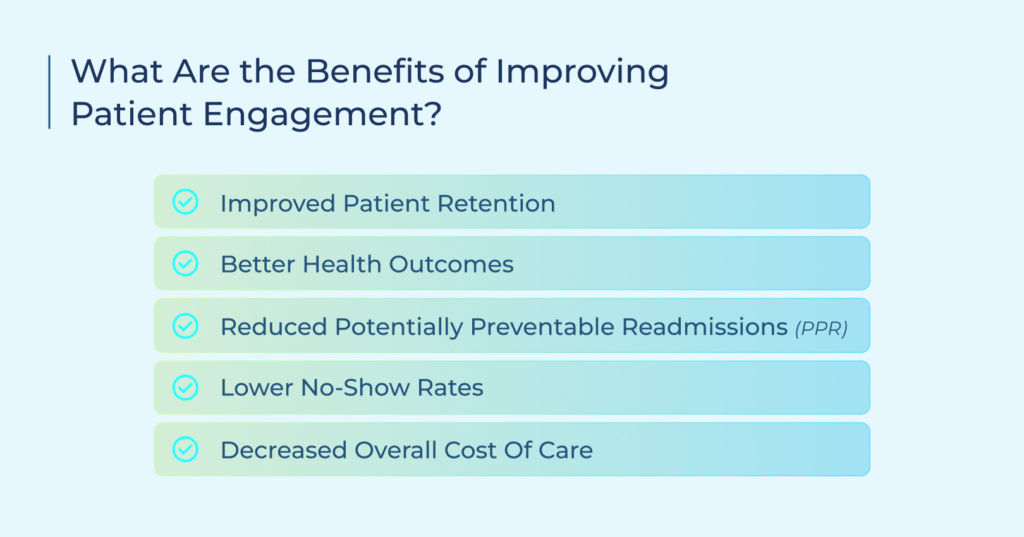
- Improved Patient Retention: Patients are far less likely to switch providers when they feel heard and supported. Think of it this way that you will never consider changing doctors unless there’s a bad experience or negative referral. Consistent engagement makes that possible and that leads to reduced patient churn.
- Better Health Outcomes: Patients who understand their care plans are more likely to follow them. They take their meds on time because they know it makes a difference. Such informed patients are also likely to ask more questions during appointments. That level of involvement leads to better recoveries and fewer complications.
- Reduced Potentially Preventable Readmissions (PPR): Educating patients about their health conditions makes it less likely that they will be readmitted. This is because they understand their medical instructions. Hence, at the earliest warning signs, they tend to contact care providers. This ensures that small issues do not become medical emergencies.
- Lower No-Show Rates: Missed appointments are a massive strain on the national healthcare industry. They often happen because patients simply forget or don’t see the urgency. You address that through engagement. Staying connected with patients makes each appointment important and personal instead of something optional.
- Decreased Overall Cost of Care: Engaged patients seek preventive care and address issues earlier. This costs patients (and care providers) less than a serious health emergency.
Putting Together a Patient Engagement Strategy That Works
You don’t have to worry about overhauling your entire practice. An excellent strategy for improving engagement only involves making key choices at the right moments.
Here’s what that looks like:
Start before the appointment – Ensure that patients arrive fully prepared by sending them intake forms and clear instructions ahead of time. They’ll arrive more relax and you’ll also come in prepared rather than spending the first 10 minutes catching up.
Segment your patients and then personalize – Not every patient responds to the same message or channel. You have to tailor your engagement to serve different patient groups. So segment them by demographics or symptoms. Your outreach starts landing as soon as you know exactly who you’re talking to.
Practice shared decision-making during visits – Invite patients into the conversation. Walk them through treatment options and ask them what they’re thinking. An excellent trick is to always ask patients to repeat what was just said in their own words. Letting them weigh in improves the chance of them staying on track because they agreed to their care plan instead of just being told to.
Use the channels patients actually prefer – Ask patients during onboarding which channels they prefer and then stick to them. Someone who only responds to texts won’t feel happy if you start calling them for reminders.
Stay connected after discharge – Aftercare is usually where engagement breaks down. This is actually where you can earn most of their trust. Checking in to ask about how they’re recovering shows that you care.
Track what actually matters – Patient satisfaction scores are useful but they don’t always reflect whether your patient engagement strategy is working. The better way is to track several metrics that tie directly to engagement. For instance: patient response rates, readmission rates, and appointment adherence. Compare before and after implementing your approach.
Automate where it makes sense – Several engagement tasks don’t need to be handled manually. You can automate appointment scheduling and follow-up sequences. The same system can also help gather feedback through preferred channels. Automation helps you handle large volumes of patients while keeping your staff focused on tasks that require a human touch.
Patient Engagement Challenges and How to Address Them
Patients can often face challenges in obtaining and understanding even basic health information. Here are some of the most common pitfalls to patient engagement strategies and how to address them:
1. Communication and Language Barriers
Patients cannot be expected to understand medical terminology. Their poor health literacy makes it difficult for them to follow treatment plans and understand diagnoses and prognoses. This also includes language barriers and not just education levels. If a patient is fluent in another language and the provider in another, important information will only get lost during communications.
How to Address the Challenge:
Train your staff on clear communication methods. Avoid using medical jargon and use plain language for the patient’s understanding.
Reports should also be appropriate for all reading levels. Use numbers and visual aids to represent important information instead of paragraphs of complex terms.
2. Obtaining Patient Trust
How many times have you heard a horror medical story from a friend? These secondhand experiences can make patients hesitant to reach out for care. Even if they do, they will often find it hard to trust their provider’s medical advice.
How to Address the Challenge:
Active listening functions as an extraordinary weapon. Patients experience a sense of value and understanding when doctors address their concerns with genuine care and empathy. This also gives them a voice in their treatment plans. These patients are most likely to prioritize their care without waiting for someone else to call.
Another way to establish trust between patients and providers is through clear billing practices. Patients often enjoy satisfactory visits but face frustration upon receiving bills filled with unexpected charges. They may feel misled. So make sure payment plans, insurance coverages, and breakdowns are conveyed with clarity.
3. Technology Adoption Barriers
Self-service digital portals and tools are important for streamlining care, but not at the expense of isolating patients who are not comfortable with technology. A blanket tech approach in healthcare can mean missed appointments, confusion about treatment plans, and just make it harder to engage patients.
How to Address the Challenge:
Give patients who are uncomfortable with technology an alternative way to communicate. Have friendly support agents standing by to answer patient questions and offer guidance.
Improve your online portals with user-friendly interfaces, step-by-step guides, and images to make navigation easier. Reach out to educate patients on how your digital systems work and the benefits they offer. For instance, patients may consider using an online scheduler if they are explained how it’s more convenient.
How to Measure the Impact of Patient Engagement Strategies
Now that you have a clear understanding of how to improve patient engagement, here are some common ways (and metrics) to check whether your healthcare strategies are working:
1. Patient Activation Measure (PAM)
PAM measures how well patients manage their own health and healthcare. These “activated patients” are more proactive in their health management, helping providers identify and focus their messaging on patients who need additional support.
PAM is calculated through questionnaires. Patients are categorized into different activation levels based on their responses.
2. Appointment Booking Rate
It is always helpful to check how many patients successfully booked appointments compared to patients who tried but couldn’t. High booking rates mean an easy and efficient booking system, leading to increased healthcare reach.
Metric Formula: (Total Book Appointments / Total Booking Attempts) x 100
3. Readmission Rate
It measures the percentage of patients who return for care within a specific period after discharge. This is normally set at 30 days. The readmission rate reflects care quality and how effective your communication was in educating the patient about their treatment plans.
Metric Formula: (Total Readmissions / Total Discharges) x 100
4. Patient Retention Rate
Probably the most important patient engagement metric of them all, it refers to the percentage of patients who continue to use healthcare services over a specific period. High retention rates indicate high patient satisfaction levels. It enables providers to understand patient loyalty.
Metric Formula: [(Total New Patients – Total Patients) / Total Patients in the Beginning of the Period)] x 100
5. Patient Satisfaction Scores
As evident, this metric relays how satisfied patients are with their healthcare experiences. This includes everything from staff interaction and cleanliness to care quality and comfort. Your patient satisfaction surveys are an excellent way to get direct feedback for actionable improvements.
Metric Formula: (Total Satisfied Patients / Total Survey Respondents) x 100
Use Televox to Improve Patient Engagement in Healthcare
You can’t expect to improve patient engagement if your patients can’t easily reach you or don’t hear from you when they need to. Televox helps you close that gap with AI virtual agents that manage both inbound and outbound conversations across calls, texts, and chat.
Our IVAs are powered by conversational AI to handle your routine tasks automatically without adding extra work for your staff. Patients can confirm appointments, receive timely reminders, complete intake steps, and get instant answers 24/7.
Communication also works better when it meets patients where they are. Televox supports multilingual and multichannel outreach. That means you connect in the language and format each patient prefers.
We understand that engagement also requires listening. Built-in survey capabilities help you gather feedback after visits, measure satisfaction, and identify service gaps before they turn into larger issues. You respond to real data instead of guessing what patients want.
Schedule a demo right now to discover how Televox’s solutions can help improve your patient engagement across the entire journey.
Related Posts