Dental patient communication has moved well beyond appointment reminders. Large practices and hospital-based dental teams…
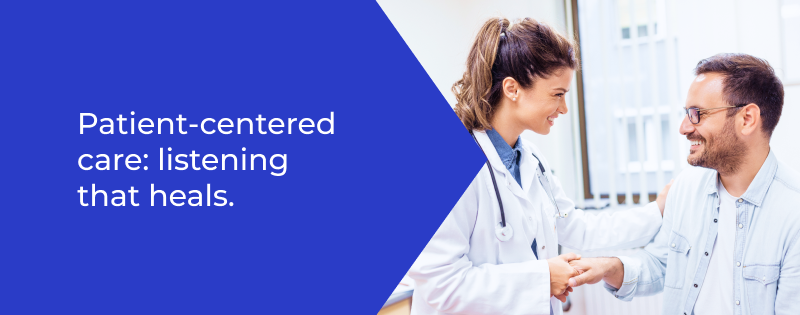
Patient-Centered Care: Importance and How to Make It Work
Healthcare works best when patients feel heard, understood, and genuinely involved in their care. That’s the idea behind patient-centered care, an approach that shifts focus from treating conditions to supporting the person behind them.
What Is Patient-Centered Care?
Patient-centered care, basically, means putting patients in charge of their own healthcare decisions. They make the final call on their treatment, while their doctors act as advisors.
You’re no longer looking at patients based on their symptoms. You start looking at them as a whole person who needs support. This differs from older healthcare models where doctors decided everything and patients simply followed orders.
Why Patient-Centered Care Is Important in Modern Healthcare
Unlike traditional provider-led models that focus more on managing patients, patient-centered care takes a few extra steps to make them feel genuinely cared for. It makes sure that they’re heard and involved at each step, leading to several gains for both patient and provider.
Improves Health Outcomes Through Engagement and Adherence
Patients become more invested in their care when they understand their conditions. They ask more questions, listen intently, and follow their treatment.
On that note, patients also take ownership of care plans designed around their specific needs. For instance, a diabetic patient is far more likely to stick with a plan with achievable blood sugar goals rather than one with a standardized list of rules.
Personalized communication plays a massive role here. The provider asks patients to explain the treatment in their own words or repeat what they’ve understood. If something’s unclear, the provider knows immediately and can explain it differently. This easy step avoids misunderstandings that derail treatment afterwards.
Builds Trust and Develops Patient-Provider Relationships
Conversations now flow both ways. Patients are encouraged to ask questions and share their most pressing concerns or what matters to them the most. They no longer visit just to hear their doctors speak the entire time.
This shared decision-making builds trust. Patients feel respected rather than processed. They are also more likely to call when problems arise instead of waiting until their situation gets serious.
Reduces Readmissions and Avoidable Complications
Your patients can’t afford to leave feeling confused about their next steps, and that’s how they find themselves back within the month. Patient-centered care bridges those gaps by focusing on tailored discharge information that’s easy to read and understand. That and a support system that stays valid even after the patient goes home.
Improved communication during hospitalization also matters. Nurses should take the time to explain medications and procedures. This allows patients to process all that information and leave prepared instead of feeling overwhelmed.
Empowers Patients With Greater Health Literacy and Confidence
Patients want to understand their health, but that’s hard to do when doctors speak in complex medical lingo. Clear communication that break down complex terms into simpler sentences that patients can understand makes all the difference.
Models like EDUCATE help providers do this better. When patients leave informed instead of confused, they feel more confident managing their health and knowing when something needs attention.
Improves Operational Efficiency for Care Teams
Better coordination reduces waste. Instead of ordering duplicate tests because records didn’t transfer, systems share information seamlessly. Instead of patients bouncing between specialists without anyone coordinating, care teams communicate about each patient’s overall picture.
Digital tools support this efficiency. Patients may view their records online rather than requesting test results by phone. Telehealth visits can manage follow-ups that do not involve physical exams.
Therefore, your clinical staff can devote more hours to involved cases requiring their skills and fewer hours to admin tasks or avoidable readmissions.
Competitive Edge for Healthcare Providers
Patients always research before deciding where to go. They will check out reviews, compare quality ratings, and ask around on forums about their experience. Needless to say, hospitals with low satisfaction scores cannot help but suffer.
Patient-centric facilities tend to deliver on every end, especially in terms of communication. That means keeping families informed, making appointments easy, ensuring specialists stay on the same page, and checking in once patients are home.
Core Elements of a Patient-Centered Care Framework
A patient-centered model is built on certain elements that collaborate to put patients first. These components lead the manner in which providers engage with patients, organize their services, and track success.
- Care coordination brings together everyone who is a part of a patient’s journey. This includes the main physicians, specialists, and even pharmacists exchanging daily updates so there is no broken communication.
- Clear access implies patients have access to their doctors at any time they feel like, without having to wait long or undergo complex steps. This includes same-day visits and virtual visits that eliminate referral procedures to ensure faster care for patients.
- Patient education is also a central feature in patient-centered models. They become more comfortable in deciding their next steps after understanding their health conditions.
- Every patient requires emotional support to combat their growing stress and anxiety. It falls on providers to remember to comfort their patients at every stage.
- The fundamental principle of effective care communication is active listening. Have patients repeat back what they heard to ensure they understood everything. This approach makes it more likely for patients to stay on their meds or proposed care plans.
Barriers to Patient-Centered Care and How to Overcome Them
Delivering patient-centered care isn’t always straightforward. Healthcare providers often face certain barriers that limit their ability to connect with patients. Hence, understanding these challenges is the first step towards overcoming them.
Staff shortages lead to time constraints. When there aren’t enough people working, doctors and nurses can’t have the conversations patients need. Hence, your staff starts rushing through appointments.
AI-driven scheduling software helps reduce this chaos. These tools send automated reminders to patients to reduce no-shows, and assign fair shifts so your staff have more energy for actual patient care.
Clinical burnout is another branching concern. Exhausted doctors are prone to mistakes and will never connect with patients as they should.
You can conduct team meetings to find out why they are overworked. It can be more than just staff shortages. Maybe other administrative concerns are making it difficult to provide care.
Technological gaps create friction. Data privacy laws, while important, can make it difficult for teams to coordinate. This can be solved by integrating HIPAA-compliant systems and portals that keep the communication streams open and secure.
Inconsistent communication can happen for several reasons. Many clinics don’t train staff on asking about patient goals or preferences.
The teach-back method fixes this by having patients repeat information back, which shows whether they actually understood. Digital tools like educational videos let patients learn about their conditions when it works for their schedule.
How to Make Patient-Centered Care Work in Practice
Putting patients at the center of care takes more than good intentions. It requires specific changes to how clinics operate day-to-day.
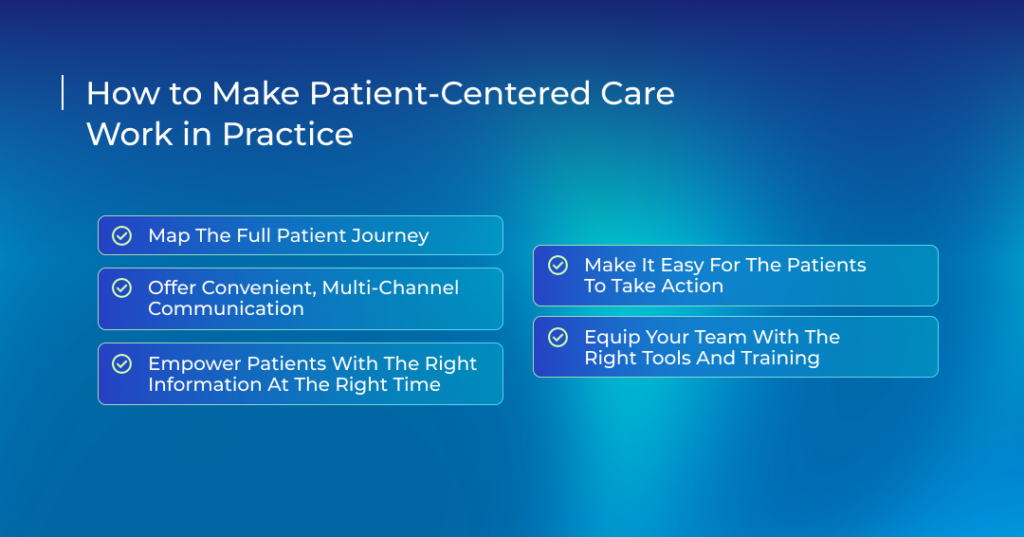
Map the Full Patient Journey
Look at every point where patients interact with your organization. Where do patients wait too long? When do they get confused about what comes next? Where does communication drop off?
Most problems hide in these gaps. Check your website, phone system, waiting room, exam rooms, and billing process. You should also talk to patients about what frustrates them. These surveys show you exactly where to improve.
Automate With Empathy
Personalization shouldn’t stop with automated messaging. Your text reminders can still feel personal with the right format. Mention the patient’s name and reference their appointments. Also, make sure to time these messages right. Send appointment reminders a day before, not a week early, when people will forget.
Offer Convenient, Multi-Channel Communication
Some patients prefer texts, while others want phone calls or emails. Let them choose instead of forcing everyone through one channel. Younger patients often pick SMS while older ones might want a phone conversation. Both groups should get what works for them.
With the right tools, like Televox, your team can manage every channel smoothly and meet patients where they already are. This flexibility makes communication faster and easier for everyone.
Empower Patients With the Right Information at the Right Time
There’s a difference between sending messages with purpose and sending them merely for the sake of communication. Note that an ill-timed message holds little value. Someone up for a blood test should automatically receive fasting instructions a few days in advance, not after they’ve arrived at the clinic. AI-driven chatbots are also quite helpful in automating responses to common questions. They make information accessible anytime.
Make It Easy for the Patients to Take Action
Remove steps where possible. For example, let patients schedule their appointments online instead of forcing them to make calls during business hours. That convenience extends to digital intake forms that they can complete at home rather than a congested waiting room.
You can also make payment plans available online so patients can pay their bills through their phones. Every eliminated barrier makes people more likely to follow through.
Equip Your Team With the Right Tools and Training
The right tools simplify work for your staff. Give them templates for common messages so that they don’t have to write the same explanations over and over again. Your tools should connect to all existing systems. Having to log into different systems just adds more unnecessary steps.
Training, on the other hand, strengthens communication and problem-solving skills. Teach staff to listen without interrupting, explain medical terms in plain language, and confirm that patients understand before they leave.
Automation can help with both goals, but it should only be used to support your staff, not replace them. With the right setup, your team can deliver better care while staying efficient and avoiding burnout.
Enabling Patient-Centered Care at Scale With Televox
Every healthcare organization wants to connect patients with the right message, at the right moment, without placing additional work on their staff. Televox allows you to do that. We integrate conversational AI, omnichannel communication, and seamless EHR integration to support providers such as yourself to engage patients more naturally.
Meet SMART Agent, our AI virtual assistant that’s not your average chatbot. It provides patients with answers to everyday questions and drives self-service, allowing patients to have immediate access to the info they require around the clock, via web chat, text, or voice.
And it all happens from a single platform, maintaining workflows and streamlining patient experiences. Want to see it in action? Schedule a demo and discover how TeleVox brings patient-centered care to life at scale.
Related Posts