
By: Amber Hull, Marketing Manager In today's healthcare ecosystem, patients face a growing number of…

Digital Transformation in Pharma: How Innovation Is Changing Everything
Uncovering a new drug in mere months, catching a production problem before it ruins an entire batch-that’s what digital transformation is making possible for the pharmaceutical industry.
From development to manufacturing, every single step is getting quicker, more intelligent, and more connected; thus, it enables giant leaps forward not only for the progress of the pharma sector itself but also for the benefit of patients.
What Digital Transformation Means for the Pharmaceutical Industry
Digital transformation refers to replacing the paperwork and legacy systems that pharmaceutical companies have been using for decades with AI, cloud platforms, and automation tools.
That being said, digital innovation in pharma goes beyond simple automated workflows. Research teams are using machine learning models to find drug candidates faster. These AI models also predict trial outcomes with greater accuracy, before enrolling participants.
Manufacturing facilities are building their quality and compliance checks on advanced monitoring tools, which catch issues early before they grow into bigger problems.
Data silos are also no longer a problem. Information flows from one department to the next to give leadership complete visibility across operations. Among various benefits, this seamless communication has changed patient care as well. Pharma companies are seeing improved medication adherence rates than ever before.
What’s Holding Back Digital Innovation in Pharma?
Moving away from traditional pharma workflows isn’t as easy as deploying a new AI system. Companies have to face several obstacles that range from technical and regulatory to even cultural.
- Legacy infrastructure: Old systems aren’t compatible with modern platforms. Companies have to replace everything or force incompatible tools that create new problems.
- Data security risks: Pharma handles extremely sensitive information, and regulations like GDPR and HIPAA set strict rules for how that data must be protected. This makes the move to the cloud complicated.
- Regulatory complexity: The FDA requirements keep evolving, so new tools might end up creating compliance gaps that regulators catch later on. This is a problem because validation alone can take several months.
- Cultural resistance: Employees who’ve used paper systems for decades resist unfamiliar software. They might even see it as a threat to their roles.
- Fragmented approach: Companies treat digital initiatives as side projects. So, one department might implement new platforms while another sticks to spreadsheets.
Top Technologies Driving Pharma’s Digital Transformation
The process of digitizing a pharma company relies on three technologies, as mentioned below, changing how you discover, test, and manufacture.
Artificial Intelligence and Machine Learning
AI and ML processes data faster than any human team. They also catch patterns that researchers might otherwise miss. This combination has completely transformed how pharma companies discover and test new drugs.
Thousands of compounds get screened within hours instead of months. Molecular behaviors and toxicity risks are flagged early, and the system even manages to predict the best candidates to move forward with—all this leads to smarter decisions and improved clinical outcomes.
Cloud Computing
Cloud platforms give pharmaceutical teams the computing power and storage they need without investing in massive data centers. Researchers across different locations can work on the same datasets in real time, running heavy AI/ML models, and share insights on the backs of lowered IT costs.
The cloud also makes it easy to scale up computing power to handle large data streams or scale down as needed without being forced to maintain expensive hardware.
Furthermore, security and compliance checks are handled by the cloud vendor. Regional data storage handling, encryption, access controls, etc, are all baked in, so pharma companies don’t have to manually go out of their way to manage compliance.
Internet of Things and Digital Twins
IoT sensors in manufacturing plants constantly track temperature, humidity, pressure, and equipment status. This real-time data feeds digital replicas of your operational pipelines.
So, if a sensor detects unusual temperature changes, the digital twin sends out an alert. Maintenance can then be scheduled instead of reacting to emergency breakdowns.
Importantly, quality control gets a massive boost. Parts are replaced on time, critical deviations are automatically documented for regulators, and process improvements can be tested virtually before any physical changes are made.
How the Pharma Industry Is Being Transformed Through Digitalization
Digital transformation is reshaping the pharmaceutical industry, impacting discovery, clinical trials, supply chains, facilities, and patient support.
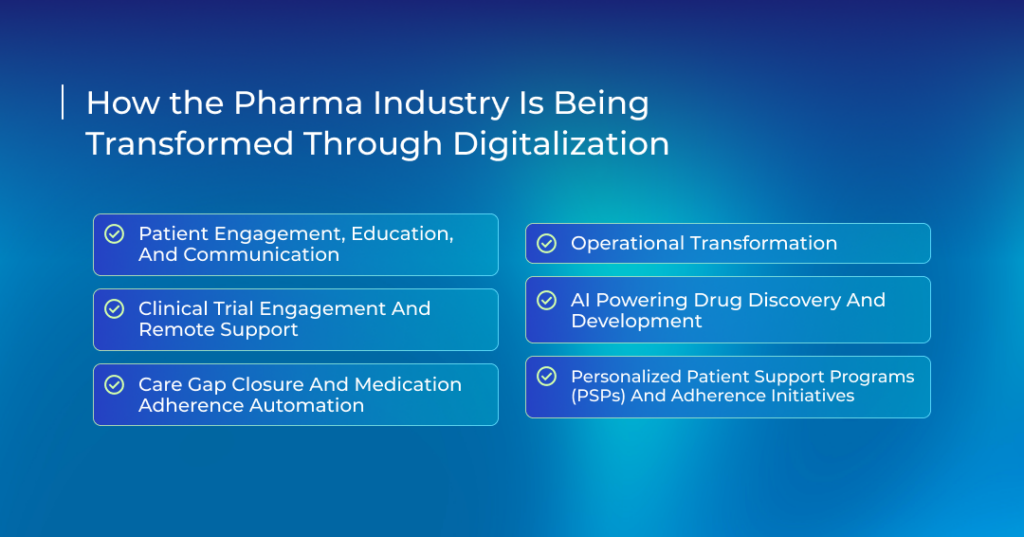
Patient Engagement, Education, and Communication
Pharma companies now communicate with patients through SMS/RCS, emails, apps, and online portals. These platforms send medication reminders, share health information, and alert patients about upcoming appointments.
Many systems support two-way communication. So, patients can ask questions, report problems, or request prescription refills through apps rather than call the office.
Automated systems also monitor which messages patients read and respond to. If one group of patients watches videos but ignores long emails, the system makes adjustments. Hence, the communication becomes more targeted over time for improved results.
Clinical Trial Engagement and Remote Support
Decentralized trials are making it easier for people to take part in studies without constantly traveling to research centers. Participants can join from home using remote tools that handle everything. They can log symptoms and measurements directly in the app, while wearable devices automatically capture other health data.
Video consultations, further, mean fewer trips. Pharma staff and facility coordinators can communicate without the need for in-person visits.
Care Gap Closure and Medication Adherence Automation
Digital systems now play a major role in helping patients stay on their meds. They keep track of which patients are approaching their refill dates and send them automated reminders via their preferred channels. This makes it likely that they remember to renew (and pick up) their prescriptions on time.
Pharma companies also track what happens after sending reminders. They see who comes back for care and tweak their approach for those who don’t. Timing is key here. Sending the right message at the right moment makes all the difference.
Operational Transformation
Digital transformation in pharma operations swaps paper manufacturing records for digital systems. Production teams view instructions, complete quality checks, and access compliance documents on tablets right on the factory floor.
AI handles repetitive work—examining quality samples, scheduling maintenance, and catching procedure deviations. Systems create audit trails automatically without anyone writing down each step manually.
Errors drop because systems prevent missed steps and wrong entries. Changes that needed weeks of paperwork now happen in days.
AI Powering Drug Discovery and Development
As already mentioned before in this blog, AI is able to screen thousands, if not millions, of compounds digitally, predict molecular behavior, flag safety risks early, and identify patterns across genetics and patient data that humans might miss.
In clinical trials, AI helps design studies and pinpoint patients likely to benefit, with several AI-assisted drugs already showing promising early results.
Personalized Patient Support Programs (PSPs) and Adherence Initiatives
Pharmaceutical companies run automated programs that walk patients through their treatment. For instance, starting a new medication will trigger educational messages about proper use, expected effects, and when to call a doctor.
Additionally, pharma apps remind patients when to take doses based on their specific schedule. They track adherence and send positive feedback for staying on track. Multiple missed doses trigger alerts offering help.
PSPs also watch for typical side effects and suggest ways to manage them. Patients can report symptoms through the app, and serious issues get escalated for immediate medical review.
How Digital Transformation Drives Value Across the Pharma Industry
Digital transformation delivers measurable improvements to pharma companies in the form of speed, cost, patient care, and compliance. Some of the key value drivers are as follows:
Lower costs: Automation handles manufacturing tasks and quality checks without human input. Your equipment gets serviced when needed, preventing breakdowns and emergency fixes. Cloud systems eliminate expensive data centers, and digital workflows finally replace piles of paper.
Faster time-to-market: AI screens drug candidates in hours, replacing months of physical testing. Research teams in different countries collaborate with no delay. Trials collect information remotely through apps and wearables. In all, the development cycles that took years now move in months.
Stronger compliance: Systems create automatic audit trails, and cloud platforms track every document change and user access for regulators.
Smarter decisions: AI removes the guesswork from your operational decisions. It spots patterns and predicts outcomes that help you make informed decisions.
Higher productivity: Automation handles repetitive tasks like data entry, sample analysis, and routine reporting. This means research teams spend more time on doing actual research than managing paperwork.
Additionally, manufacturing teams access instructions and quality checks on tablets instead of searching through binders. These might seem basic features, but collectively enable staff to be more productive.
Competitive edge: Companies that adopt digital systems move faster when bringing treatments to market and stay more in tune with changing conditions. Their up-to-date data and workflows make them attractive partners for tech providers and research organizations looking for digitally capable collaborators.
The Shift From Pharma 4.0 to 5.0: Evolving Beyond Automation
Pharma 4.0 was all about automation, but the industry is now stepping into a more human-centric framework with Pharma 5.0. The 4.0 robotics and data analytics are still central to how pharma companies operate. The difference is that they’re being used to now support personalization, ethical decision-making, and sustainability across the entire pharmaceutical lifecycle.
- Pharma companies must explain how algorithms make decisions. AI models need transparency so patients and doctors understand why the system suggests certain treatments.
Hence, human oversight remains mandatory. AI may analyze tons of data, but human specialists still make the final decision.
- Patients join clinical trials as advisors, not subjects. Their participation is now easier than ever through digital tools.
Someone living far away or with mobility issues can still collaborate with research teams via remote tools. The resulting treatments work better and for a broader population because they’re built around real patient needs instead of assumptions.
- Pharmaceutical manufacturing uses a lot of energy and water and generates chemical waste. AI can reduce the consumption of energy without slowing down production.
The system also tracks and recycles water whenever possible. Manufacturing lines can even predict exactly how much material they need, which cuts down on waste.
- Patients are being put at the center. AI looks at each person’s genetics, lifestyle, and health history to personalize treatments.
Manufacturing can create custom formulations and dosing schedules, while clinical trials focus on identifying which therapies work best for individual patients instead of using a one-size-fits-all approach.

Role of Televox in the Digital Transformation of the Pharmaceutical Industry
Pharmaceutical companies looking to improve patient engagement can rely on Televox to keep patients connected and informed.
Our enhanced patient engagement platform handles multichannel, bidirectional communication, helping you reach patients through the channels they prefer, 24/7.
We make it easy for you to run automated outreach and messaging campaigns, including reminders, follow-ups, surveys, referrals, and billing notifications—helping your patients stay informed while reducing manual work for your staff.
With Televox Engage, our Speech-to-Speech AI-powered virtual agent, your patients can engage in common tasks such as requesting prescription refills, managing billing, or accessing forms, making communication more accessible and self-service friendly.
If you want to see how Televox can support your pharma’s digital transformation, check out our patient engagement solutions, or reach out to our team to learn more.
Related Posts