Patient engagement used to end with a simple reminder text. Now, it's about keeping them…
Multichannel Engagement in Pharma: What It Means and How It Drives Results
Pharmacies followed a pretty straightforward communication strategy a few years back. Their sales rep would pay a visit here, send a brochure there, or maybe set up a booth at a medical conference.
Today, all of those touchpoints have multiplied into emails, texts, webinars, and even postcards with QR codes. The message hasn’t changed, but how it reaches healthcare professionals has.
That’s what multichannel engagement really means. It’s about connecting with HCPs through the channels they prefer, not forcing everyone into the same mold.
For pharma companies, this shift has transformed more than just marketing. It’s changing how relationships are built, how decisions are made, and how both patient outcomes and business performance keep improving side by side.
What Does Multichannel Engagement Mean in Pharma?
Multichannel engagement means using multiple communication channels to reach doctors or patients. These can be in the form of emails, phone calls, text messages, live chats, etc.
Each channel, however, works in isolation. For example, a doctor might get an email about a new treatment, click through to a website with nearly identical content, and then attend a webinar that covers the same content again.
Why Multichannel Communication and Engagement Are Important for the Pharma Industry
The way healthcare professionals consume information has changed. Just like patients, they have their own preferences for how they receive information.
If you want your message to land, you have to meet them where they are. This varies from doctor to doctor because their preferred channels are largely influenced by their specialty, schedules, where they practice, etc.
When you reach out through the channels they want, HCPs get timely, relevant updates that help them make better decisions for their patients.
There’s the trust factor as well. Consistent communication improves engagement, and that starts building relationships. Doctors begin to recognize your brand, trust your expertise, and engage more often.
It also makes sense from a business perspective. Multichannel engagement gives pharma companies the data to see which messages get attention or which channels drive responses, and then use that insight to personalize future outreach for stronger ROI.
Key Trends Shaping Multichannel Engagement in Pharma
Digital technology has completely changed the health sector. Pharma companies now have more data than ever before, and they don’t know what to do with it. The disconnection between different systems also means most HCPs still get generic messages that feel impersonal. Multichannel engagement now has every company’s attention in fixing that gap.
Shift Toward Patient-Centric Engagement Models
More pharma companies have started to prioritize patients, not just doctors. This is because drug regulations now require patient input in clinical trials and safety monitoring.
Patients also have more tools to manage their own health, which means companies have to build direct communication channels to meet patients’ needs. This helps everyone.
We all know that adherence improves when patients understand their treatment options. That matters for outcomes and for business.
Integration of Digital, Rep, and Remote Engagement Channels
HCPs still prefer face-to-face interactions, but also value remote options for saving time and staying flexible. The choice isn’t one or the other anymore.
Pharma companies are pushing to mix in-person visits with virtual calls and self-service portals. Remote tools let HCPs and sales reps communicate without worrying about location or schedule conflicts.
A rep might detail a product in person, follow up via email, then invite the doctor to a webinar with clinical data.
Use of Data and AI for Real-Time Orchestration
AI has made it incredibly easy to pull data from multiple sources and show you what’s happening in real time. Pharma companies no longer have to wait for a report after ending their campaigns. They can now see what’s working while campaigns are still running, allowing them to change messaging halfway if needed.
AI also suggests what the next steps sales reps should take to make their call planning more effective. Consider a case where the system notices a cardiologist attending a webinar about heart failure treatments, then tells the rep to follow up with a specific patient outcome study. It saves your reps’ time while improving engagement with HCPs.
Modular Content for Faster, Compliant Delivery
Modular content means assembling modules into different types of content for different purposes. So, instead of writing a new email and getting it approved for the regulatory board, marketers grab approved text, images, and charts from a library.
This matters for multichannel engagement in pharma because you need different content for different channels. Modular content is channel-agnostic, meaning the same approved content blocks can be used across multiple channels.
Growing Focus on Measuring Impact and ROI
The fact is that companies want proof that their marketing is working. It’s why pharma marketers now use attribution modeling to figure out which touchpoints actually lead to prescriptions, and multi-touch attribution to track how multiple channels work together to influence a single decision.
Did the webinar drive that prescription, the follow-up email, the rep visit, or all three? Being able to answer such questions is pushing the pharma sector away from surface metrics like impressions and clicks to actual outcomes. This way, they can show their campaigns help with diagnosis, treatment, and adherence.
Creating an Effective Multichannel Strategy in Pharma
Pharmacies need to carefully plan and execute an effective multichannel engagement platform. Here’s how to create one that delivers results.
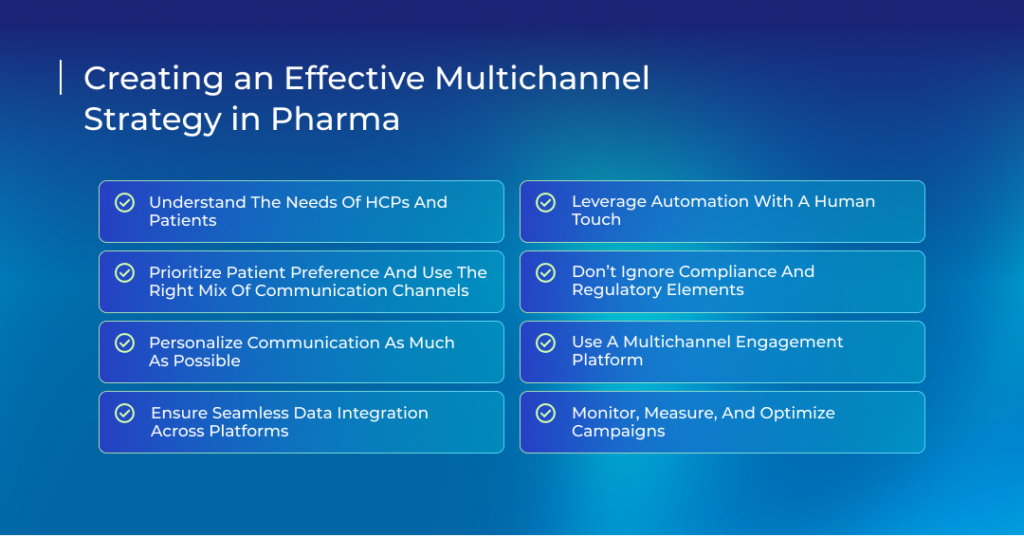
Understand the Needs of HCPs and Patients
Start by mapping who you’re reaching out to. Not every HCP is the same. Even those with the same specialties might have different habits and preferred communication channels.
Most pharma companies make the mistake of relying too much on basic demographics. Those don’t work here. You have to figure out your targeted HCPs’ pain points.
What information gaps can you fill in their practice? Which part of the care journey are they helping with? The more you understand these distinctions, the more your messages matter.
Prioritize Patient Preference and Use the Right Mix of Communication Channels
Stop assuming that all channels work the same for everyone. Some HCPs might want a mix of in-person and digital channels. Others might only lean towards remote options. It’s your job to find the best way to combine their needs.
Do surveys and respect their choices. Run surveys and respect their choices. Remember that the essence of effective pharma communication is to provide the right content, format, and timing.
Personalize Communication as Much as Possible
The people you’re reaching out to are being swamped with generic outreach from a dozen other companies, so what makes yours any different? The difference here lies in personalization. Make them feel the content was created just for them.
Tailor content based on specific factors: disease area interest, prescribing behavior, knowledge level, or channel preference. Even the smallest adjustment in personalization can immediately click and drive major improvements in engagement.
Ensure Seamless Data Integration Across Platforms
Pharma companies use various teams for different types of data. There’s marketing to track non-personal promotions, sales reps to manage CRMs, medical affairs to log conference interactions, etc. These teams might be doing fine on their own, but if their systems don’t talk to each other, you lose the complete picture of your HCPs.
You need platforms that pull all these different data streams into one place. With a single, connected dashboard, you can easily segment HCPs, personalize content, and refine your channel strategies.
Leverage Automation With a Human Touch
Automation is excellent at handling scale, but that doesn’t mean you can start replacing your teams. The tech’s all about freeing them for what actually matters.
Set up your systems to handle the routine tasks like triggering follow-up emails, tracking engagement patterns, or scheduling webinar invitations. This keeps things moving without manual work.
However, always give HCPs a way to talk to an actual person. Some questions need human judgment. There are situations that call for empathy that no automated message can provide. Build in clear paths to reps, medical liaisons, or support staff when someone needs more than what automation offers.
Don’t Ignore Compliance and Regulatory Elements
Regulatory compliance isn’t something you can just slip in later during data collection, hoping it’ll save time. Pharma companies should have baked-in HIPAA and FDA compliance as part of their communication strategy from day one. Otherwise, you’ll lose more than just money in fines; you’ll also lose HCP trust.
Use a Multichannel Engagement Platform
A good platform pulls everything together in one place. You want something that connects with your existing systems, lets you automate routine tasks, and makes personalization actually manageable instead of theoretical.
For example, Televox’s platform supports innovative channels like postcards with scannable QR codes and RCS messaging to help pharma brands bridge traditional and digital outreach in one workflow. There’s also a dashboard that gives you a complete view of each HCP or patient across channels.
Monitor, Measure, and Optimize Campaigns
Make sure to have clear KPIs before any launch. You should be focusing on metrics that reflect outcomes, not numbers that impress the internal staff. Track engagement rates, conversion by channel, HCP satisfaction scores, and business outcomes like prescription lifts.
Use integrated tracking tools to view performance by channel. Review key data such as response rates, satisfaction, and business outcomes in intuitive dashboards highlighting what matters most.
Importantly, act on what the data is telling you. If a channel isn’t delivering, change your strategy. If there are certain messages that see better responses, use them as a template.
How Multichannel Engagement Drives Positive Results in Pharma
Using multiple ways to reach your prospects has several benefits, ranging from improving your operations and relationships to business performance.
- You increase your reach: Multiple channels make it more likely that you reach different HCPs on their preferred platforms. This means connecting with more potential customers than you would through a single channel.
- You improve your brand recognition: Consistent messaging leads to higher engagement rates. HCPs start to recognize and trust your brand, which also leads to better retention. The repeated exposure helps convert new customers as well.
- You see higher ROI with better resource allocations: Pharma companies start dedicating resources more efficiently since they have the data to know which channel strategy is working best. The improved performance impacts your sales as well as your team’s productivity.
- You have the room to test new strats: Multichannel engagement allows companies to test which advertising mediums work best for their brand and result in the most engagements and customer conversions.
- You start making informed decisions: Multichannel communication gives pharma companies more clarity. This means you see exactly where your efforts pay off and where to adjust, making each next campaign smarter than the last.
Smarter Patient Engagement Starts With TeleVox
Every interaction with an HCP, but keeping all those conversations going across calls, emails, text, and even mail, can feel like a juggling act. Televox brings all your outreach together under one roof; not just for convenience, but to make every touchpoint more meaningful and measurable.
Meet Engage, our AI-powered concierge that gives HCPs and patients an instant way to get answers, complete forms, or access information on demand. These virtual agents are available 24/7, handling your team’s daily tasks so they can instead focus on higher-value conversations.
Add in postcards with scannable QR codes that lead straight to product info or event sign-ups, plus RCS messaging that transforms plain texts into rich, visual experiences, and suddenly your outreach feels less like marketing and more like a collaboration.
Our platform also integrates seamlessly with your existing systems, pulling the right data into one place so you can see what’s working and refine your outreach strategy with confidence.
Your multichannel engagement strategy doesn’t have to be complicated. Schedule a demo today and see how Televox helps you reach the right HCPs, at the right time, with the right message.
Related Posts