
Patient engagement used to end with a simple reminder text. Now, it's about keeping them…

Patient Engagement Challenges: How to Overcome Them for Better Care
Patient engagement is more than just reminders or messages. It’s how effectively patients connect with their provider and take responsibility for their own health. The resulting improved outcomes make healthcare revenue more predictable.
Yet many providers struggle to keep patients involved at every stage of care. Gaps appear at every point in a patient’s journey, often quietly undermining both satisfaction and adherence.
Let’s explore the root causes of these challenges and share practical strategies to address them. We’ll also go over how Televox makes engagement more coordinated and effective.
Top Patient Engagement Challenges Providers Face and How to Overcome Them
Every part of healthcare delivery has its fair share of challenges. Some stem from how we communicate. Others come from broken workflows or access barriers. Here’s what most providers often face and how to fix it.
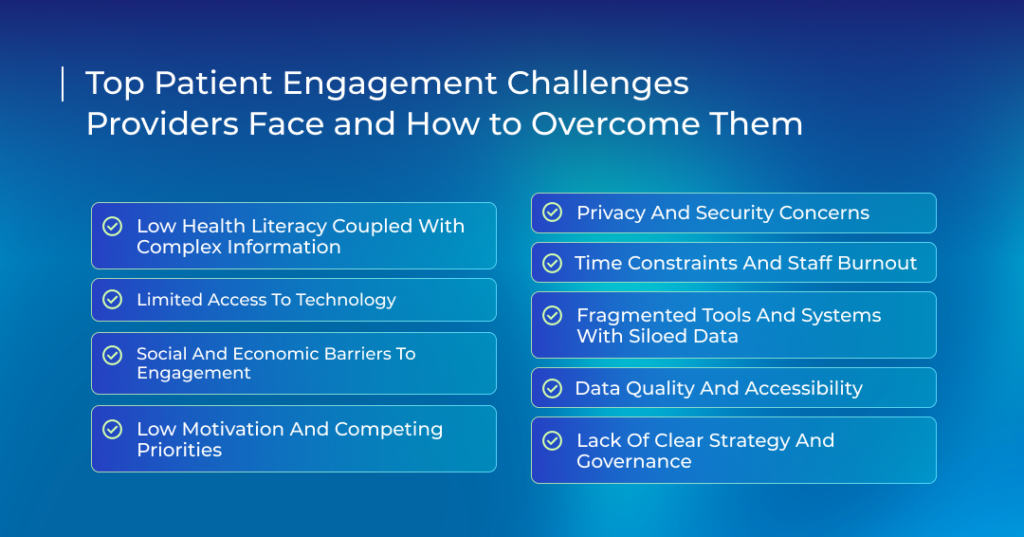
Low Health Literacy Coupled With Complex Information
Most patients struggle to understand basic health information. They nod along during visits and leave confused about what to do next. This gets worse with chronic conditions, which often involve multiple layers of treatment. However, medical jargon makes those care plans read like textbooks. Without clear direction, they start making guesses or do nothing.
Addressing Low Health Literacy and Education
Plain language works wonders for every patient. Your discharge papers should read like they were written for a fifth grader. Every medical term should be replaced with a clear explanation. So “high blood pressure” won’t confuse as “hypertension” would.
Visuals help greatly here. Have diagrams to show proper inhaler techniques or videos for physical therapies. They beat unnecessary paragraphs of text.
Televox supports this through templated messages written in plain language. Your team sends pre-written messages instead of building every communication from scratch. Automation makes you add clarity by pulling the right information from your systems for each patient. This includes showing which messages or actions had the highest response rates.
Limited Access to Technology
Not everyone has a smartphone or reliable internet. Even patients with devices often feel uncomfortable using them for healthcare. These patients often get left behind when your engagement depends on an app or online portal.
Addressing Access Barriers to Technology
Offer multiple ways to reach patients. You start with preferred channels but fall back to other channels if there’s no response. This ensures that your message always gets through.
Another way to increase adoption rates is to demonstrate your tech in person. Someone who isn’t comfortable with using a portal might feel otherwise after seeing it in action. Have your staff ready to guide such patients through your app during their visits. Show them in person how they can save time by downloading their new test results from the app instead of calling the office.
Televox enables this flexible outreach through a multichannel approach. A single platform manages communication across voice, text, email, portal, and even postcards. You’re not locked into one channel.
Social and Economic Barriers to Engagement
Care is hard to access without basic logistics. A patient without reliable transportation is bound to miss appointments. Someone juggling multiple jobs can’t take time off for a weekday visit. A mother without childcare can’t sit in waiting rooms for hours.
Financial pressure makes things worse. Patients ration meds to make them last longer. They skip visits because the copay feels out of reach. Symptoms are ignored until there’s no choice but to seek emergency care.
Language adds another layer. Those who don’t speak English struggle with forms, instructions, and automated phone menus.
How to Overcome Social and Economic Barriers
Effective outreach starts with meeting patients where they are. A message in Spanish reaches Spanish-speaking patients more clearly. Evening calls land better when patients are off work. Flexible appointment times make it easier to say yes to care.
Also, support shouldn’t stop at reminders. Practical details matter just as much. Sharing ride options helps patients plan their visit. Including payment plan information reduces stress around bills. Proactively highlighting flexible scheduling removes barriers before they turn into missed appointments.
Televox automatically organizes patients based on factors like language preference, risk level, and social needs. That information then shapes how and when outreach happens.
Low Motivation and Competing Priorities
Work and family obligations often come first for most people. This pushes appointments down the priority list. They intend to refill prescriptions but forget. They plan workouts but run out of time.
Managing a chronic condition makes this even harder. It demands consistency over months or years, and that level of effort wears people down. Many pull back from their providers out of guilt after they fall off track.
How to Overcome This Challenge
Small but regular nudges help keep care from slipping out of focus. A simple message asking whether medication was taken today is often more effective and keeps patients engaged.
Tone plays a critical role. Supportive language invites patients back into care, while blame pushes them away. Asking if a different appointment time would help opens a conversation.
Progress also deserves recognition. Acknowledging even small wins can boost confidence and keep people motivated.
Televox helps providers maintain this steady rhythm without adding strain to staff. Automated sequences deliver daily medication reminders, timely education, and guidance based on patient needs. The system checks in at intervals that you define to keep patients engaged between visits.
Privacy and Security Concerns
Privacy fears are real. Patients worry about who sees their information. They fear discrimination and don’t want family members to find out about certain conditions.
Building trust across the board
Be transparent about what data you collect and how it’s used and protected. Make consent processes clear and optional where possible.
Honor preferences. If patients opt out of certain communications, respect that immediately. If they request specific contact methods, accommodate them.
Televox supports secure, HIPAA-compliant communication across all channels. The platform tracks consent and preferences automatically, ensuring you only reach patients in approved ways.
Time Constraints and Staff Burnout
Providers see hundreds of patients every week and that number doubles or triples for contact centers that field endless calls. Everyone’s stretched thin. There’s no time for proactive outreach or manual reminders. Burnout makes this worse and exhausted staffers start cutting corners.
Reducing Time Pressures and Supporting Staff Well-Being
Automation handles all the routine and mundane tasks that your staff normally burn themselves out on. They become free to focus on higher-value work, improving productivity and retention rates.
Their human element is never intended to be replaced by AI or machines. Automation just empowers them to do their jobs more effectively. They have more time and energy to add value like counseling patients and answering detailed questions.
Televox lets you run campaigns and workflows from one central system to reduce staff burnout. You set up reminder sequences once and the system starts sending them in the background without constant oversight.
Educational messages go out automatically right when patients need them, not when staff have time. Incoming responses are routed to the right team on their own so nothing sits in limbo. Your team steps in only when something actually needs attention.
Fragmented Tools and Systems With Siloed Data
Having multiple tools for each task creates disconnected experiences. Using one system for calls and another for texts sounds manageable. But without integration, it just doubles the work for your staff.
They answer the same questions multiple times because information shared in one system doesn’t show up in another. The same data is entered manually in multiple places. Different systems are checked to see if patients responded.
Unifying Tools and Connecting Disparate Systems
Consolidate engagement tools where possible. Fewer systems mean less complexity and better data flow.
Also, integrate with core clinical systems. When your engagement platform connects to the EHR, it should pull accurate data and update the other connected systems. This closes the loop.
Televox acts as a central hub for multichannel outreach. It connects directly with leading EHR systems so messages are automatically personalized with real patient data. That means staff can work from a single, familiar interface instead of bouncing between tools all day.
Data Quality and Accessibility
Outreach suffers due to outdated patient data. Old phone numbers mean reminders never arrive. Missing email addresses cuts off an entire channel of communication. Inaccurate consent records make things worse because patients get messages they never agreed to.
Poor data quality also creates blind spots. Segmentation falls apart if you don’t know the patient’s preferred language. Personalization never takes off if risk or clinical indicators are missing.
Improving Data Quality and Access for Better Decisions
Make data hygiene a regular practice. Schedule regular reviews and assign clear ownership for accountability.
Integration plays a critical role here. A phone number changed in the patient portal should automatically reflect across outreach tools and the EHR.
Engagement data can also highlight where problems exist. If messages consistently fail for certain patient groups, that’s a signal worth investigating. Delivery failures and low response rates often point to gaps in the underlying data.
Televox helps maintain accurate patient contact data through its integrated approach. Changes made by patients are synced back to the EHR. Delivery reports show which contacts are valid and which need updating, while engagement metrics reveal where data quality issues exist.
Lack of Clear Strategy and Governance
Patient engagement challenges often persist because there’s no coordination. One team runs appointment reminders while another sends wellness tips. The contact center makes outreach calls without any feedback from the other teams.
Working in isolation makes it difficult to align everyone to the same goals. Teams track different metrics and unknowingly duplicate work. This also means that strong engagement in one area never lifts performance elsewhere.
Establishing a Clear Engagement Strategy and Governance Model
Define ownership. Appoint someone responsible for engagement strategy across the organization and give them authority to coordinate efforts and allocate resources.
Standardize KPIs like response rates and appointment attendance. Include patient satisfaction as a core measure. Track these metrics consistently and use the data to guide decisions.
Televox supports a unified strategy by providing infrastructure and visibility to manage programs centrally. Leaders see engagement metrics across departments in one dashboard. They standardize message templates while allowing customization for specific needs. Campaigns are coordinated to avoid overwhelming patients. The platform becomes the backbone of coordinated engagement.
How Patient Engagement Challenges Show Up Across the Care Journey
Engagement challenges show up at every stage of care. Patients may struggle to connect with your practice between visits. They might leave confused and fall off track after appointments. Ignoring even one touchpoint can undo the trust and momentum you worked hard to build.
Before Care – Booking Appointments and Getting Answers
Long hold times discourage patients from calling. Anyone would hang up after 10 minutes on hold. Limited office hours also mean that working patients can’t reach you. They call during lunch breaks and get voicemail.
Patients then turn to your website or online schedulers to get answers or book appointments. However, confusing interfaces and burying clear actions under layers of navigation force them to give up.
These friction points cost you patients, before care even starts.
During Care – Understanding the Visit and Next Steps
Rushed visits cram too much into too little time. Providers race through explanations to get through their day. Their unclear instructions leave patients confused and they leave without knowing what to do next. Did “take twice daily” mean morning and night or taking two pills at the same time? Hence, adherence fails immediately.
Between Visits – Staying on Track With the Plan
The gap between visits is where engagement breaks down. Missing reminders mean patients forget to take their meds. Symptoms go untracked without check-ins and without an easy way to ask questions; small issues snowball into bigger ones.
This gap is especially dangerous for chronic care. A heart failure patient may be told to weigh themselves daily and report changes. Without systematic support, they don’t and often return through readmission.
After Care – Billing, Financial Questions, and Follow-Up
Confusing bills or unclear financial communications can undo all the goodwill built during care. When patients don’t understand charges or can’t easily get answers, frustration takes over. They may avoid calling with questions or even skip future appointments. Letting a single point of confusion erode trust and engagement might convince them to go to another provider.
How to Build an Effective Patient Engagement Strategy
Most healthcare organizations know they need better patient engagement. However, getting there requires a structured approach that most providers struggle with.
Start by defining what success looks like. Pick specific metrics like readmission rates for heart failure patients and medication adherence for diabetics. Include response and completion rates to track no-shows. Vague goals only produce vague results.
Next, identify which patient groups need attention first. You don’t have to fix everything at once. Look at your data. Which populations have the worst outcomes? Which conditions drive the most readmissions? Start there.
Map the patient journey for your priority group. Walk through every touchpoint and note where patients drop off or when they stop taking their meds. These gaps show where patients are leaving confused.
Choose interventions that match the gaps. If patients miss appointments because they forget, automated reminders help address that. If they don’t understand their discharge instructions, simplified education materials work better than handing them a stack of papers.
Start small when deploying your new patient engagement strategy. Pick one condition or one clinic. Learn what works and fix what doesn’t before expanding.
Finally, review and adjust your engagement strategy every quarter. Patient needs change. There might be a new tech update that proves more valuable. You need to flex with these changes.
How Technology and Automation Support Patient Engagement and Communication
Technology helps providers manage patient engagement challenges without adding extra work. It extends what your staff can do without replacing their human connection.
Multichannel messaging enables providers to reach patients in ways that suit them. You send appointment reminders and medication alerts through whatever channel each patient prefers and when they most need them. This simple change helps reduce no-shows in most practices.
Automated workflows handle repetitive tasks that burn out staff. When a patient misses an appointment, the system automatically sends a rescheduling link. When lab results come back, patients get notified without a nurse spending time on the phone. The system handles all routine communications to keep patients connected without requiring constant manual effort.
Analytics track which messages reach patients and which ones get responses. You identify patterns to spot where engagement is lagging. Maybe Spanish-speaking patients need different messaging times. Maybe diabetes patients respond better to video education than PDFs.
Televox as a Solution to Patient Engagement Challenges
Keeping patients engaged doesn’t have to drain your team. Televox gives you one platform to handle outreach, follow-ups, and reminders without juggling multiple systems.
Engage, our conversational AI, helps patients get answers, manage billing, find a provider, request prescription refills, and access intake forms instantly through self-service chat.
We also support insurance collection as part of our broader platform. This helps providers reduce friction in coverage and payment processes while keeping patient communication consistent.
Insights360 is our analytics solution. It tracks every interaction, showing where patients respond and where engagement lags.
Televox’s Enterprise Edition brings it all together. You get to coordinate outreach, standardize messaging, and gain visibility across departments from a single dashboard.
See how it works for your organization. Schedule a demo today and experience patient engagement made simple and manageable.
Related Posts