Dental patient communication has moved well beyond appointment reminders. Large practices and hospital-based dental teams…

Best Patient Engagement Software for Healthcare Providers in 2026
Healthcare organizations are increasingly turning to digital solutions that improve their care capabilities beyond just managing appointments.
Patient engagement platforms are now fundamental on that end for any modern provider. The right fit can improve your communications and reduce administrative burden while improving the overall patient experience.
Choosing from the top patient engagement providers can significantly help you build stronger relationships with your patients while keeping operations efficient and future-ready. However, it’s not as simple as finding a random vendor. Take your pick from the best patient engagement software listed below.
1. Televox
Televox provides a comprehensive patient engagement platform for healthcare enterprises. Their AI-driven solutions are designed to drive meaningful patient relationships instead of sending generic messages in bulk—all through the magic of next-generation automation.
What makes Televox different from other AI-driven healthcare vendors is Engage, their advanced conversational AI platform. Engage deploys intelligent virtual assistants (IVAs) that manage all your inbound calls and messages in real time.
These IVAs are smart enough to understand context to handle human-like conversations. But they do a whole lot more than just answer FAQs with great accuracy. Patients can interact with Engage to manage their appointments, pay bills, and request prescription refills within the same conversation.
24/7 availability further means that Televox’s IVAs ensure that routine inquiries don’t stack up in your call queue. Your front desk spends less time on repetitive calls and more time helping patients who actually need human expertise.
The platform also includes built-in analytics with live response tracking. You can see what’s working and where patients drop off—then adjust quickly instead of guessing.
Pros:
- Multiple communication channels (SMS/RCS, voice, email, postcards).
- Two-way conversation capabilities.
- Live response tracking.
- Reduces no-show appointments.
- Offers self-service for appointment scheduling, bill payments, and prescription refills.
- Multi-language capabilities.
- On-demand broadcast messaging options.
- AI virtual assistants manage inbound inquiries 24/7.
- Strong customer support that’s backed by analytics to optimize performance.
Cons:
- Interface is powerful but may involve a short learning curve. Most teams adapt quickly with the help of Televox’s onboarding support and training tools.
- Customization is structured, not granular. Televox’s modular messaging ensures consistency and compliance, though it may offer less flexibility for highly individualized templates. That said, its formats are optimized for strong patient engagement.
- Heavily centered on SMS and voice engagement.
- Integration into existing EHR systems or workflows might take collaboration, especially in large organizations. However, Televox provides dedicated support throughout the implementation process to minimize friction.
Best For
Healthcare systems and larger practices that need robust, two‑way patient engagement across appointments, billing, and care programs. The platform’s AI‑assisted inbound communication makes it especially useful when managing large patient populations.
Pricing
Pricing isn’t published publicly; Televox provides custom quotes based on your organization’s size and workflow needs.
2. NexHealth
NexHealth is widely used by medical practices, especially dental, that want a text-based digital patient experience. It offers five different solutions that automate and streamline your communication and payment processes.
NexHealth particularly stands out as an excellent patient engagement software because of its robust integration. The platform easily links with your existing MS and automatically syncs all historical (and new) data in real time without requiring any manual data entry.
Your healthcare organization can also use its outreach tools for targeted campaigns to get more appointments.
Pros:
- Two-way HIPAA-compliant texting.
- Online scheduling that syncs with practice calendars.
- Automated appointment reminders and recall messages.
- Automated feedback requests right after visits.
- Automated insurance eligibility verification.
- Self-serving patient portal with payment processing capabilities.
Cons:
- Appointment reminders sometimes display incorrect times to patients.
- Syncing can take up to 45 minutes to update changes.
- Limited ability to send or receive images in texts.
- Patients who cancel appointments may still receive reminders.
- Integration with certain practice management systems (like Curve) needs improvement.
Best For
Clinics and practices that want real‑time scheduling, messaging, digital forms, and payments all tied directly into their existing system. It’s ideal when you want data flowing both ways between your practice management system and patient engagement tools.
Pricing
You need to contact the vendor to get a quote based on your practice’s size and selected features.
3. Klara
Klara aims to reduce phone call volumes in favor of a unified platform that supports text messaging, web chat, call-to-text, and voicemail transcription. It is specifically designed for medical practices that use various EHR systems like AdvancedMD and Veradigm.
Considering its stacked features, Klara still manages to offer one of the best user-friendly interfaces among all patient engagement software. Your patients are not required to download any apps, create accounts, or remember passwords. However, the faster communications are still secure and HIPAA-compliant.
Pros:
- Converts phone calls to text messages, reducing staff phone time.
- Works without requiring patients to download apps or create accounts.
- Integrates voicemail transcription to process messages quickly.
- Connects directly with pharmacies and labs to reduce hold times.
Cons:
- Users can’t see the history of mentions if accidentally dismissed.
- Certain patient replies may send them unnecessary notifications.
- Some users report difficulty distinguishing between legitimate messages and spam.
- Text transcription of voicemails isn’t always accurate.
Best For
Providers that want to centralize communication without forcing patients into apps or extra logins. It’s a strong fit when you want all patient conversations in one place.
Pricing
Klara operates on a quote‑based model. Pricing depends on the features and number of users you choose, so you’ll need to reach out for a custom plan.
4. Phreesia
Phreesia uses automation to reduce your medical administrative workload, but not at the expense of losing the human touch. This single platform combines several healthcare features such as online scheduling, appointment reminders, payments, and even patient outreach to improve your appointment numbers.
Phreesia is specifically built for providers with high patient volumes but fewer staff members. It easily integrates with existing systems to bridge service gaps and help patients manage their appointments and payments.
Pros:
- Supports the complete patient journey.
- Automates benefits checks and payment collection to improve billing accuracy.
- Closes staffing gaps by reducing hiring and training costs.
- Offers tailored workflows by specialty.
Cons:
- Smaller clinics may need help adjusting to the onboarding process.
- The interface can feel cluttered when used without proper training.
- Not every insurance or form field pulls data automatically.
- Some manual steps may remain despite automation features.
Best For
Ideal for organizations looking to simplify patient intake and self-service check-ins. It also makes patient engagement easy while connecting seamlessly to payments, eligibility checks, and reminders. Phreesia really stands out when improving intake efficiency is the main goal.
Pricing
Expect customized pricing that reflects your practice size and selected modules. The number of features and scale of deployment often influences this.
5. Solutionreach
Healthcare providers interested in reducing their no-show rates find exceptional results with Solutionreach. This platform features everything you need to drive patient engagement, including automated appointment reminders, patient messaging, online scheduling, and payment processing. Solutionreach is designed with the sole goal of saving your staff from mundane tasks so that they can focus their efforts on patient satisfaction.
Pros:
- Reduces no-shows through automated appointment reminders.
- Offers real-time texting capabilities to gather insurance information and schedule appointments.
- Works for various practice types, including dental, vision, and medical offices.
- Includes batch messaging for efficient mass communications.
- Implementation typically takes less than one week.
Cons:
- Users report inconsistent customer support and response times.
- Some mention reliability issues that impact practice operations.
- Multiple reminders can sometimes annoy patients.
- Location confusion in reminders creates problems for multi-location practices.
- Limited space for detailed support requests.
- Technical issues may take time to resolve.
Best For
Providers that want a broad set of patient engagement tools with flexibility in how features are bundled and scaled. It works across specialties and practice sizes.
Pricing
Solutionreach offers multiple packages tailored to practice needs. Official lists don’t show all tiers publicly, but review sites mention a starting rate around $329 per month, with costs increasing for larger practices and additional modules.
6. Tebra
Tebra is a powerful engagement software for healthcare providers, especially independent practices and billing companies. It is an all-in-one EHR platform that unifies your operations.
While you can find several other platforms that promise the same, what makes Tebra different is that it connects you with over 130 healthcare systems. That includes your electronic health records, revenue cycle management, patient scheduling, prescriptions, billings, and insurance- all accessible from a single interface.
Pros:
- Integrates EHR, billing, and patient management in one platform.
- Connects with over 130 healthcare systems.
- User-friendly interface.
- Helps practices convert physical files to digital records.
- Enables patient self-scheduling and digital intake forms.
- Provides full security and HIPAA compliance.
- Works without contracts or large upfront costs.
Cons:
- System outages can force practices to close temporarily.
- Some billing professionals report problems that affect revenue cycles.
- Medication management features have limitations, especially for controlled substances.
- Patients may find billing statements confusing.
- Customer service quality appears inconsistent.
Best For
Independent practices and small groups that want to combine practice management, EHR, patient engagement, scheduling, and billing in one system. This ensures they don’t have to patch together multiple tools later on.
Pricing
You’ll need to contact sales to get a quote tailored to your practice’s size and selected feature set.
7. ModMed
ModMed believes a responsible AI makes your healthcare better, and their results prove just that. The platform is specifically designed for healthcare providers and organizations that want more (and better) control over how they interact with their patients. This includes the usual appointment reminders, online forms, billing, etc.
Beyond that, however, are AI-driven solutions to drive patient experience on whole new levels. With automated clinical workflows, documentation, messaging, and even analytics and reporting to monitor your operations, ModMed offers all the tools you need to spend more time on your patients instead of chasing paperwork.
Pros:
- Uses AI to reduce time spent on notes and follow-ups.
- Built for specialty practices with specific workflows.
- Clean interface that makes navigation easy for staff and patients.
- Integration with ModMed’s EHR keeps everything in one system.
Cons:
- Limited use for general practices or large hospitals.
- AI suggestions may need frequent review depending on the specialty.
- Pricing can be high for smaller clinics.
- Technical support can sometimes be slow.
Best For
Specialty practices that want patient engagement built right into their clinical workflows and EHR. It’s especially useful for teams that rely on automated messaging and documentation support.
Pricing
Costs vary based on specialty, modules, and EHR integration, so you need a custom quote.
8. Artera
Artera uses a smarter approach to healthcare. Its patient engagement platform integrates AI-driven virtual agents to handle all patient communications through voice and text.
You empower your staff to respond faster and more accurately, gain access to automatic translation, make use of conversation summaries, enhance efficiency with automated workflows, and a whole lot more, thanks to natural language processing.
Artera’s staff-supporting tools and fully autonomous options set itself apart from several other AI solutions in the healthcare market.
Pros:
- Works with all major EHR systems.
- Supports 109 languages.
- Flexible implementation options based on AI readiness.
- Handles both voice and text communications.
- Pre-validated healthcare workflows.
- High customer retention.
Cons:
- Requires investment in digital transformation.
- May need staff training for implementation.
- Multiple solution options might create complexity.
- Healthcare-specific focus limits use in other industries.
- Multilingual capabilities may be prone to errors.
Best For
Healthcare providers that want AI-driven voice and text outreach. That as well as multilingual support.
Pricing
Artera typically requires a custom quote tailored to your practice’s needs and chosen solutions.
9. DoctorConnect
DoctorConnect offers a comprehensive patient engagement platform that’s designed to be compatible with your existing systems. It’s built to help you keep schedules on track and gather patient information easily through digital forms.
DoctorConnect also automates communications, so every patient interaction is consistent and meaningful across the care journey.
Pros:
- Integrates easily with existing EMR systems.
- Includes telehealth appointment functionality.
- Offers automated no-show management.
- Provides secure messaging options.
- Includes patient satisfaction surveys.
- Built-in patient recall system.
Cons:
- May require staff training for implementation.
- Limited customization options in some features.
- Unclear pricing structure based on available information.
- Return calls display unfamiliar numbers to patients.
Best For
Providers that want comprehensive patient engagement tools aligned with their existing systems.
Pricing
You’ll need to contact the vendor for a quote.
10. CipherHealth
CipherHealth aims to help healthcare providers deliver personalized support throughout the patient journey. The platform unifies patient and staff communication to coordinate care across the board, including at-home patients.
Several solutions, such as digital rounding tools and patient outreach capabilities, work to give patients a voice, improving satisfaction scores and reducing readmissions.
Additionally, workflows can be customized with proven scripts for tailored care and just exceptional patient experiences all around.
Pros:
- Reliable system performance.
- Helps prevent hospital readmissions.
- Provides trend analysis and progress tracking.
- Strong technical support and implementation team.
- Allows personalized patient interactions.
- Comprehensive care journey coverage.
Cons:
- Some functions are difficult to find or confusing to navigate.
- Issues with discharged patients remaining on active rosters.
- Occasional routing of calls to inappropriate departments.
- Multiple patients are sometimes assigned to the same room in system.
- Learning curve for certain features
- Interface could be more intuitive.
Best For
Hospitals and health systems looking for personalized patient outreach. It covers digital rounding and coordinated care communication to help improve satisfaction and outcomes.
Pricing
CipherHealth’s plans are custom quoted based on use cases and the modules you select.
11. Relatient
Relatient is another patient engagement software that deserves to be on this list. It is one of the best patient outreach solutions for healthcare organizations to improve their appointment numbers and credibility.
Relatient combines self-service portals for self-scheduling, appointment reminders, no-show engagement, feedback loops, and digital check-ins for time saving. Its solutions are also scalable, something enterprises love.
Pros:
- Personalized communication improves patient retention.
- Easy online scheduling tools.
- Automated scheduling and intakes reduce administrative burden.
- Improved communication and better convenience mean high patient satisfaction.
- Built-in secure messaging and communication tools.
Cons:
- Getting help from the technical support team can sometimes be delayed or difficult.
- The campaign functionality seems underwhelming or poorly supported.
- Patients can be spammed with too many reminders.
Best For
Mid‑sized to large practices that want to unify self‑scheduling, reminders, digital check‑ins, and secure messaging into a scalable engagement suite.
Pricing
It’s typically provided via custom quote depending on practice size and the features you need.
Differentiating Between a Patient Engagement Software and a Platform
Both patient engagement software and platforms are cut from the same cloth. They use technology to help healthcare providers improve their communications with patients. They also serve a similar purpose of empowering patients to conveniently access healthcare services and manage their needs whenever needed.
The differences lie in their offerings. Patient Engagement Software is a one-size-fits-all solution with a set of fixed features that may work well for smaller medical practices. It’s also quick to deploy. However, limited customization and flexibility make it harder to scale or resolve specific issues through tailored features.
A Patient Engagement Platform, on the other hand, is all about growth and customization. You get a complete platform that can be customized based on what you need and prefer. It’s a modular approach that enables healthcare enterprises to build interconnected experiences across every patient touchpoint, which is not possible with a ready-made software package.
Patient engagement providers can help you navigate these differences and choose the right solution based on your needs.
Why Platforms Win Long-Term
Imagine a healthcare organization that wants to expand its services. It will need its systems to support new features and update existing ones. Having a robust patient platform gives you agility in such a scenario, allowing you to build up as needed without overly expensive solutions.
Software locks you in, and while some software vendors can provide custom solutions, customizing your existing software package can easily disrupt ongoing services.
How to Choose the Best Patient Engagement System
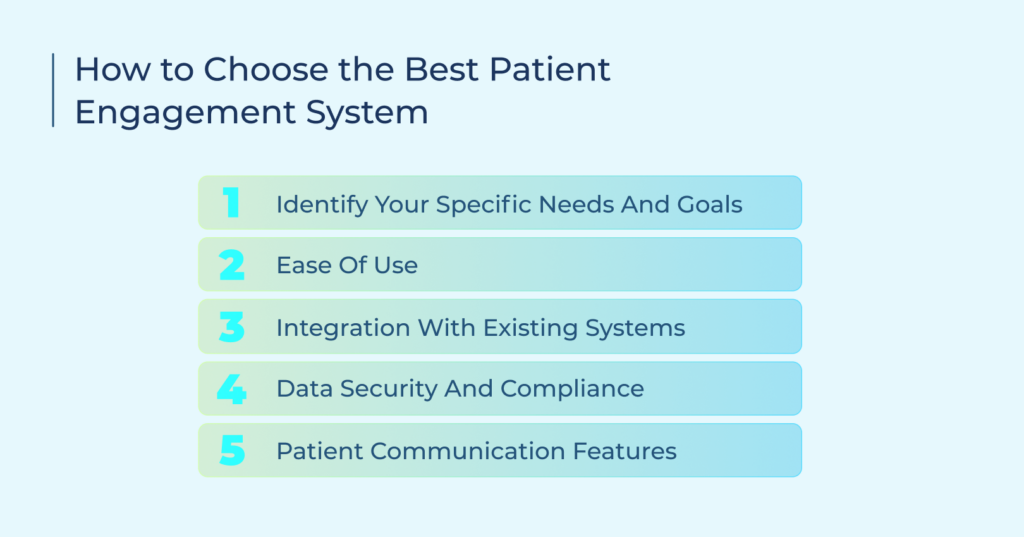
1. Identify Your Specific Needs and Goals
Just because a patient engagement software has dozens of good reviews doesn’t mean it’s the right fit for you. Make a list of what you want or need. Review your current patient experiences and systems or conduct patient surveys to find out what can and should be improved.
Once you have identified areas that are failing to engage patients, research the best patient engagement software that delivers on those fronts. Purchasing highly rated solutions without confirming your requirements is akin to wasting time and money.
2. Ease of Use
You can have all the features in the world, but they won’t matter much if your patient engagement platform is not user-friendly. Remember that the whole idea is to make patient interactions easier and convenient.
Hence, one of the first things to consider when choosing your patient engagement platform is to confirm that it is easy to navigate. The main features should be easy to find. There should be no clutter or confusion in the design.
3. Integration With Existing Systems
Your patient records are extremely important. Whichever patient engagement software or platform you choose, make sure it is perfectly compatible with the existing system. Since most healthcare organizations use EHR and EMR systems, automatically syncing your past digital data ensures no major disruption or loss of data.
4. Data Security and Compliance
HIPAA-compliant systems are absolutely necessary to avoid violations and sanctions. These systems also package security measures to protect your patient data. Healthcare organizations that suffer data breaches lose credibility and trust, making it challenging to engage patients as they should.
5. Patient Communication Features
While these do fall into your requirements and goals, as noted above, some communication features are critical for every healthcare provider. There’s no point in investing in a patient engagement software that does not come with built-in appointment scheduling features or two-way messaging capabilities.
Feedback collection and analytical tools are also equally important. Do not just confirm that a patient engagement platform has these features; evaluate if they actually improve your capabilities to deliver them efficiently.
How to Get Started With Televox
While many platforms offer a wide range of features to engage patients and improve workflows in healthcare, Televox stands out as a great alternative for long-term impact.
Getting started takes just a few minutes. Schedule a demo today to see how AI-driven virtual agents can deliver automated care. Our representatives will assess your current workflows to identify opportunities for improvement and develop an implementation plan specific to your organization.
Related Posts